Ch. 5 - Chromosome Mapping in Eukaryotes
Klug - Concepts of Genetics 12th Edition
Klug12th EditionConcepts of GeneticsISBN: 9780135564776당신이 사용하는 게 아니라요?교과서 변경
5장, 문제 27

Two plants in a cross were each heterozygous for two gene pairs (Ab/aB) whose loci are linked and 25 mu apart. Assuming that crossing over occurs during the formation of both male and female gametes and that the A and B alleles are dominant, determine the phenotypic ratio of their offspring.

검증된 단계별 안내
1
Understand the genetic setup: The two plants are heterozygous for two linked gene pairs (Ab/aB), and the loci are 25 map units (mu) apart. This means there is a 25% chance of recombination between these loci during gamete formation.
Determine the parental and recombinant gametes: The parental gametes are 'Ab' and 'aB', while the recombinant gametes are 'AB' and 'ab'. The recombination frequency of 25% means that 25% of the gametes will be recombinant (12.5% 'AB' and 12.5% 'ab'), and 75% will be parental (37.5% 'Ab' and 37.5% 'aB').
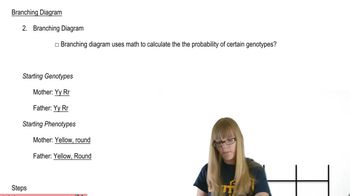
Set up the Punnett square: Create a 4x4 Punnett square to represent the cross between the gametes of the two heterozygous plants. The rows and columns will include the four types of gametes: 'Ab', 'aB', 'AB', and 'ab', with their respective probabilities.
Determine the genotypes of the offspring: Fill in the Punnett square by combining the gametes from each parent. For example, crossing 'Ab' with 'aB' will result in the genotype 'AaBb'. Repeat this for all combinations to determine the genotypes of all offspring.
Determine the phenotypic ratio: Since A and B are dominant alleles, any offspring with at least one 'A' and one 'B' allele will display the dominant phenotype. Count the number of offspring with each phenotype (dominant for both traits, dominant for one trait, or recessive for both traits) and calculate the phenotypic ratio based on the probabilities from the Punnett square.

비슷한 문제에 대한 검증된 영상 답변:

이 영상 해법은 위 문제에 도움이 된다고 튜터들이 추천한 것입니다.
영상 길이:
1m
도움이 되었나요?

주요 개념

질문에 올바르게 답하기 위해 반드시 이해해야 하는 핵심 개념들은 다음과 같습니다.

Linkage and Genetic Mapping

Linkage refers to the tendency of genes located close to each other on a chromosome to be inherited together. Genetic mapping uses the frequency of recombination between linked genes to estimate their distance apart, measured in map units (mu). In this case, the genes are 25 mu apart, indicating a 25% chance of recombination occurring between them.
추천 영상:
가이드 코스
07:33
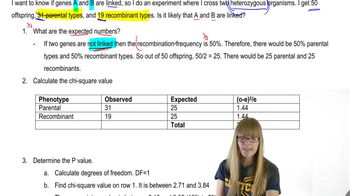
Chi Square and Linkage

Heterozygosity and Gamete Formation

Heterozygosity occurs when an organism has two different alleles for a particular gene. In this scenario, both parent plants are heterozygous for two gene pairs (Ab/aB), which means they can produce gametes with different combinations of these alleles. The formation of gametes involves the segregation of alleles and can result in parental types and recombinant types due to crossing over.
추천 영상:
가이드 코스
04:06
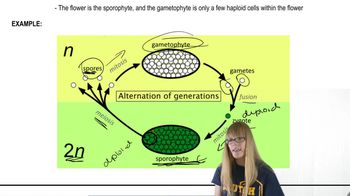
Formation of Plant Gametes

Phenotypic Ratios in Dihybrid Crosses

Phenotypic ratios describe the relative frequencies of different phenotypes in the offspring resulting from a genetic cross. In a dihybrid cross involving linked genes, the phenotypic ratio can be influenced by the degree of linkage and the occurrence of crossing over. The expected ratio can be calculated by considering both parental and recombinant gametes produced by the heterozygous parents.
추천 영상:
관련 실천
교과서 질문

Traditional gene mapping has been applied successfully to a variety of organisms including yeast, fungi, maize, and Drosophila. However, human gene mapping has only recently shared a similar spotlight. What factors have delayed the application of traditional gene-mapping techniques in humans?

542
views
교과서 질문

In laboratory class, a genetics student was assigned to study an unknown mutation in Drosophila that had a whitish eye. He crossed females from his true-breeding mutant stock to wild-type (brick-red-eyed) males, recovering all wild-type F1 flies. In the F2 generation, the following offspring were recovered in the following proportions:

wild type: 5/8

bright red: 1/8

brown eye: 1/8

white eye: 1/8

The student was stumped until the instructor suggested that perhaps the whitish eye in the original stock was the result of homozygosity for a mutation causing brown eyes and a mutation causing bright red eyes, illustrating gene interaction. After much thought, the student was able to analyze the data, explain the results, and learn several things about the location of the two genes relative to one another. One key to his understanding was that crossing over occurs in Drosophila females but not in males. Based on his analysis, what did the student learn about the two genes?

554
views
교과서 질문

In a certain plant, fruit is either red or yellow, and fruit shape is either oval or long. Red and oval are the dominant traits. Two plants, both heterozygous for these traits, were testcrossed, with the following results.

Determine the location of the genes relative to one another and the genotypes of the two parental plants.

712
views
교과서 질문

A female of genotype

produces 100 meiotic tetrads. Of these, 68 show no crossover events. Of the remaining 32, 20 show a crossover between a and b, 10 show a crossover between b and c, and 2 show a double crossover between a and b and between b and c. Of the 400 gametes produced, how many of each of the 8 different genotypes will be produced? Assuming the order a–b–c and the allele arrangement previously shown, what is the map distance between these loci?

827
views
교과서 질문

DNA markers have greatly enhanced the mapping of genes in humans. What are DNA markers, and what advantage do they confer?

774
views
교과서 질문

A number of human–mouse somatic cell hybrid clones were examined for the expression of specific human genes and the presence of human chromosomes. The results are summarized in the following table. Assign each gene to the chromosome on which it is located.

988
views