In this chapter, we have focused on genetic systems present in bacteria and on the viruses that use bacteria as hosts (bacteriophages). In particular, we discussed mechanisms by which bacteria and their phages undergo genetic recombination, which allows geneticists to map bacterial and bacteriophage chromosomes. In the process, we found many opportunities to consider how this information was acquired. From the explanations given in the chapter, what answers would you propose to the following questions? How do we know that intergenic exchange occurs in bacteriophages?
Ch. 6 - Genetic Analysis and Mapping in Bacteria and Bacteriophages

6장, 문제 1f
In this chapter, we have focused on genetic systems present in bacteria and on the viruses that use bacteria as hosts (bacteriophages). In particular, we discussed mechanisms by which bacteria and their phages undergo genetic recombination, which allows geneticists to map bacterial and bacteriophage chromosomes. In the process, we found many opportunities to consider how this information was acquired. From the explanations given in the chapter, what answers would you propose to the following questions? How do we know that in bacteriophage T4 the rII locus is subdivided into two regions, or cistrons?
검증된 단계별 안내1
Understand the concept of a cistron: A cistron is a segment of DNA that codes for a single polypeptide chain or functional RNA. In the context of bacteriophage T4, the rII locus is a region of the genome that can be subdivided into two cistrons based on genetic and functional analysis.
Review the experimental approach used by Seymour Benzer: Benzer performed detailed genetic mapping experiments using bacteriophage T4. He infected E. coli with phages carrying mutations in the rII locus and analyzed the recombination events between these mutations.
Consider the complementation test: Benzer used a complementation test to determine whether two mutations in the rII locus affected the same functional unit (cistron). He co-infected E. coli with two phages, each carrying a different mutation in the rII locus. If the mutations were in different cistrons, the two phages could complement each other, allowing the infected bacteria to produce functional phage particles.
Analyze recombination frequency: Benzer also performed recombination experiments to map the relative positions of mutations within the rII locus. By analyzing the frequency of recombination between pairs of mutations, he was able to determine that the rII locus was subdivided into two distinct regions.
Conclude based on the data: The combination of complementation tests and recombination mapping provided strong evidence that the rII locus in bacteriophage T4 is subdivided into two cistrons. This conclusion was based on the observation that certain mutations could complement each other, while others could not, and the recombination data supported the physical separation of the two regions.

비슷한 문제에 대한 검증된 영상 답변:
이 영상 해법은 위 문제에 도움이 된다고 튜터들이 추천한 것입니다.
영상 길이:
1m도움이 되었나요?
주요 개념
질문에 올바르게 답하기 위해 반드시 이해해야 하는 핵심 개념들은 다음과 같습니다.
Cistrons
Cistrons are segments of DNA that correspond to a single gene or functional unit within a genetic sequence. In the context of bacteriophages like T4, cistrons can be identified through genetic mapping techniques, which reveal how specific mutations affect the function of the virus. Understanding cistrons is crucial for determining how genetic information is organized and expressed in phages.
Genetic Recombination
Genetic recombination is a process by which genetic material is exchanged between different organisms or within the same organism, leading to new genetic combinations. In bacteriophages, recombination can occur during co-infection of a bacterial cell, allowing for the mapping of genetic loci like the rII locus in T4. This process is essential for understanding genetic diversity and the evolution of phages.
추천 영상:
가이드 코스
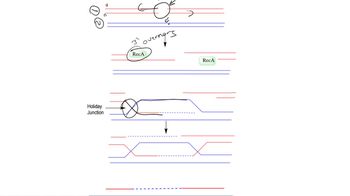
Recombination after Double Strand Breaks
Mapping Genetic Loci
Mapping genetic loci involves determining the positions of genes on a chromosome and understanding their relationships to one another. In bacteriophage T4, researchers use techniques such as complementation tests to ascertain the subdivision of the rII locus into two cistrons. This mapping is fundamental for genetic analysis and helps elucidate the functional roles of different genetic regions.
추천 영상:
가이드 코스
QTL Mapping
관련 실천
교과서 질문
474
views
교과서 질문
With respect to F⁺ and F⁻ bacterial matings, answer the following questions: How was it established that physical contact between cells was necessary?
419
views
교과서 질문
How do we know that bacteriophages recombine genetic material through transduction and that cell-to-cell contact is not essential for transduction to occur?
531
views
교과서 질문
Write a short summary that contrasts how recombination occurs in bacteria and bacteriophages.
695
views
교과서 질문
How do we know whether or not genetic recombination between bacteria involves cell-to-cell contact?
487
views
교과서 질문
With respect to F⁺ and F⁻ bacterial matings, answer the following questions: How was it established that chromosome transfer was unidirectional?
507
views
