Ch. 6 - Genetic Analysis and Mapping in Bacteria and Bacteriophages
Klug - Concepts of Genetics 12th Edition
Klug12th EditionConcepts of GeneticsISBN: 9780135564776당신이 사용하는 게 아니라요?교과서 변경
6장, 문제 3a

With respect to F⁺ and F⁻ bacterial matings, answer the following questions: How was it established that physical contact between cells was necessary?

검증된 단계별 안내
1
Understand the biological context: F⁺ bacteria contain the F plasmid and can donate genetic material to F⁻ bacteria, which lack the plasmid, through a process called conjugation.
Recognize that the question asks about the experimental evidence showing that physical contact between F⁺ and F⁻ cells is necessary for conjugation to occur.
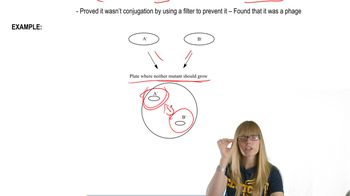
Recall the classic experiment where researchers used a U-tube apparatus with a filter that allowed the passage of liquid and small molecules but prevented direct cell-to-cell contact between F⁺ and F⁻ bacteria.
Note that when F⁺ and F⁻ cells were separated by this filter, no genetic transfer occurred, indicating that soluble factors alone were insufficient for conjugation.
Conclude that the necessity of physical contact was established because genetic transfer only happened when F⁺ and F⁻ cells were allowed to touch directly, demonstrating that conjugation requires cell-to-cell contact.

비슷한 문제에 대한 검증된 영상 답변:

이 영상 해법은 위 문제에 도움이 된다고 튜터들이 추천한 것입니다.
영상 길이:
1m

주요 개념

질문에 올바르게 답하기 위해 반드시 이해해야 하는 핵심 개념들은 다음과 같습니다.

F⁺ and F⁻ Bacterial Mating

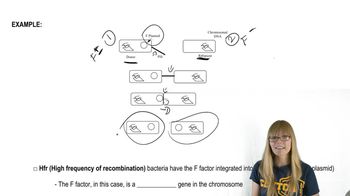
F⁺ bacteria contain the fertility (F) plasmid, enabling them to form a pilus and transfer genetic material to F⁻ bacteria, which lack the plasmid. This conjugation process results in the transfer of the F plasmid, converting F⁻ cells into F⁺ cells.
추천 영상:
가이드 코스
08:52
F Factor and Hfr

Role of Physical Contact in Conjugation

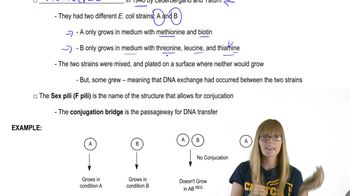
Physical contact between F⁺ and F⁻ cells is essential for conjugation because the F pilus connects the two cells, allowing DNA transfer. Experiments using filters that prevent cell contact but allow molecular diffusion showed no gene transfer, proving contact is necessary.
추천 영상:
가이드 코스
04:06
Conjugation Overview

Experimental Evidence Using Membrane Filters

Researchers used membrane filters with pores small enough to block bacteria but allow molecules to pass. When F⁺ and F⁻ cells were separated by such filters, no conjugation occurred, demonstrating that direct cell-to-cell contact, not just chemical signals, is required for DNA transfer.
추천 영상:
관련 실천
교과서 질문

In this chapter, we have focused on genetic systems present in bacteria and on the viruses that use bacteria as hosts (bacteriophages). In particular, we discussed mechanisms by which bacteria and their phages undergo genetic recombination, which allows geneticists to map bacterial and bacteriophage chromosomes. In the process, we found many opportunities to consider how this information was acquired. From the explanations given in the chapter, what answers would you propose to the following questions? How do we know that intergenic exchange occurs in bacteriophages?

474
views
교과서 질문

Write a short summary that contrasts how recombination occurs in bacteria and bacteriophages.

695
views
교과서 질문

In this chapter, we have focused on genetic systems present in bacteria and on the viruses that use bacteria as hosts (bacteriophages). In particular, we discussed mechanisms by which bacteria and their phages undergo genetic recombination, which allows geneticists to map bacterial and bacteriophage chromosomes. In the process, we found many opportunities to consider how this information was acquired. From the explanations given in the chapter, what answers would you propose to the following questions? How do we know that in bacteriophage T4 the rII locus is subdivided into two regions, or cistrons?

428
views
교과서 질문

List all major differences between:

(a) The F⁺ x F⁻ and the Hfr x F⁻ bacterial crosses

(b) The F⁺, F⁻, Hfr, and F' bacteria.

903
views
교과서 질문

With respect to F⁺ and F⁻ bacterial matings, answer the following questions: How was it established that chromosome transfer was unidirectional?

507
views
교과서 질문

With respect to F⁺ and F⁻ bacterial matings, answer the following questions: What is the genetic basis for a bacterium's being F⁺.

604
views