Ch. 6 - Genetic Analysis and Mapping in Bacteria and Bacteriophages
Klug - Concepts of Genetics 12th Edition
Klug12th EditionConcepts of GeneticsISBN: 9780135564776당신이 사용하는 게 아니라요?교과서 변경
6장, 문제 7

Why are the recombinants produced from an Hfr x F⁻ cross rarely, if ever, F⁺?

검증된 단계별 안내
1
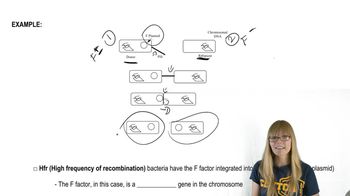
Understand the nature of Hfr and F⁻ strains: An Hfr (High frequency recombination) strain has the F factor integrated into its bacterial chromosome, while an F⁻ strain lacks the F factor entirely.
Recall the process of conjugation between Hfr and F⁻: During conjugation, the Hfr cell attempts to transfer part of its chromosome, starting from the integrated F factor origin, into the F⁻ recipient.
Recognize that the F factor is part of the bacterial chromosome in Hfr cells, so the transfer begins with the F factor sequence but usually does not complete the entire F factor transfer before the mating bridge breaks.
Since the F factor is transferred last in the sequence, the F⁻ recipient rarely receives the complete F factor, meaning it usually remains F⁻ even after recombination.
Therefore, recombinants produced from an Hfr x F⁻ cross are typically chromosomal recombinants (with new genetic traits) but remain F⁻ because the full F factor is not transferred and integrated.

비슷한 문제에 대한 검증된 영상 답변:

이 영상 해법은 위 문제에 도움이 된다고 튜터들이 추천한 것입니다.
영상 길이:
3m
도움이 되었나요?

주요 개념

질문에 올바르게 답하기 위해 반드시 이해해야 하는 핵심 개념들은 다음과 같습니다.

Hfr and F⁻ Bacterial Mating

Hfr (High frequency recombination) strains have the F factor integrated into their chromosome, allowing them to transfer chromosomal genes to F⁻ cells during conjugation. F⁻ cells lack the F factor and can receive genetic material but typically do not become F⁺ after mating with Hfr.
추천 영상:
가이드 코스
08:52
F Factor and Hfr

Mechanism of F Factor Transfer in Hfr x F⁻ Cross

During conjugation, the Hfr cell initiates transfer from the integrated F factor origin, transferring chromosomal genes first. The entire F factor is rarely transferred because it is located at the end of the transfer sequence, so the recipient usually remains F⁻.
추천 영상:
가이드 코스
08:52
F Factor and Hfr

Recombinant Formation and F Factor Status

Recombinants arise when chromosomal genes from the Hfr donor integrate into the F⁻ recipient's genome. Since the full F factor is seldom transferred, recombinants typically gain new chromosomal traits but do not acquire the F plasmid, thus remaining F⁻ rather than becoming F⁺.
추천 영상:
가이드 코스
08:52
F Factor and Hfr