Define the terms genotype and phenotype, and relate them to one another.
Ch. 1 - The Molecular Basis of Heredity, Variation, and Evolution

1장, 문제 7
Define natural selection, and describe how natural selection operates as a mechanism of evolutionary change.
검증된 단계별 안내1
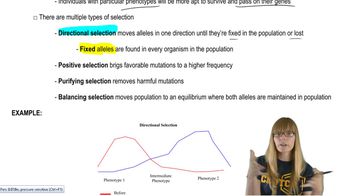
Define natural selection: Natural selection is the process by which individuals with traits that are better suited to their environment have a higher chance of surviving and reproducing. These advantageous traits are then passed on to the next generation, leading to changes in the population over time.
Explain the variation in traits: Natural selection requires genetic variation within a population. This variation arises from mutations, genetic recombination during meiosis, and other sources of genetic diversity.
Describe differential survival and reproduction: Individuals with traits that provide a survival or reproductive advantage are more likely to survive and reproduce. This is often referred to as 'survival of the fittest,' where 'fitness' refers to reproductive success.
Explain inheritance of traits: The advantageous traits that improve survival and reproduction are heritable, meaning they can be passed on to offspring. Over generations, these traits become more common in the population.
Discuss the cumulative effect: Over time, natural selection can lead to significant evolutionary changes, such as the adaptation of a species to its environment or the emergence of new species. This process is a key mechanism of evolution.

비슷한 문제에 대한 검증된 영상 답변:
이 영상 해법은 위 문제에 도움이 된다고 튜터들이 추천한 것입니다.
영상 길이:
1m도움이 되었나요?
주요 개념
질문에 올바르게 답하기 위해 반드시 이해해야 하는 핵심 개념들은 다음과 같습니다.
Natural Selection
Natural selection is a fundamental mechanism of evolution, proposed by Charles Darwin. It describes the process by which individuals with advantageous traits are more likely to survive and reproduce, passing those traits to the next generation. Over time, this leads to the adaptation of species to their environments.
추천 영상:
가이드 코스
Natural Selection
Variation and Heritability
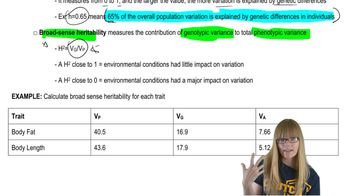
For natural selection to occur, there must be variation among individuals in a population, and these variations must be heritable. This means that traits can be passed from parents to offspring. Variations can arise from mutations, genetic recombination, and other processes, providing the raw material for natural selection to act upon.
추천 영상:
가이드 코스
Calculating Heritability
Survival of the Fittest
The phrase 'survival of the fittest' encapsulates the idea that individuals best suited to their environment are more likely to survive and reproduce. 'Fittest' refers not just to physical strength but to overall adaptability, including behaviors and reproductive success. This concept emphasizes the dynamic nature of populations as they respond to environmental pressures.
추천 영상:
가이드 코스
Natural Selection
관련 실천
교과서 질문
856
views
교과서 질문
All life shares DNA as the hereditary material. From an evolutionary perspective, why do you think this is the case?
882
views
교과서 질문
Describe the modern synthesis of evolution, and explain how it connects Darwinian evolution to molecular evolution.
955
views
교과서 질문
Define the terms allele, chromosome, and gene, and explain how they relate to one another. Develop an analogy between these terms and the process of using a street map to locate a new apartment to live in next year (i.e., consider which term is analogous to a street, which to a type of building, and which to an apartment floor plan).
1135
views
교과서 질문
What are the four processes of evolution? Briefly describe each process.
1165
views
교과서 질문
Define each of the following terms:
DNA replication
827
views