뒤로
뒤로
문제 1a
Which of the following traits would you expect to be inherited as quantitative traits?
Body weight in chickens
문제 1b
Which of the following traits would you expect to be inherited as quantitative traits?
Growth rate in sheep
문제 1c
Which of the following traits would you expect to be inherited as quantitative traits?
Milk production in cattle
문제 1d
Which of the following traits would you expect to be inherited as quantitative traits?
Fruit weight in tomatoes
문제 1e
Which of the following traits would you expect to be inherited as quantitative traits?
Coat color in dogs
문제 2
For the traits listed in the previous problem, which do you think are likely to be multifactorial traits, with phenotypes that are influenced by genes and environment? Identify two environmental factors that might play a role in phenotypic variation of the traits you identified.
문제 3
Compare and contrast broad sense heritability and narrow sense heritability, giving an example of each measurement and identifying how the measurement is used.
문제 4
In a cross of two pure-breeding lines of tomatoes producing different fruit sizes, the variance in grams (g) of fruit weight in the F₁ is 2.25 g and the variance among the F₂ is 5.40 g. Determine the genetic and environmental variance (VG and VE) for the trait and the broad sense heritability of the trait.
문제 5
Describe the difference between continuous phenotypic variation and discontinuous variation. Explain how polygenic inheritance could be the basis of a trait showing continuous phenotypic variation. Explain how polygenic inheritance can be the basis of a threshold trait.
문제 6
Calculate the mean, variance, and standard deviation for a sample of turkeys weighed at 8 weeks of age that have the following weights in ounces:
161, 172, 155, 173, 149, 177, 156, 174, 158, 162, 171, 181.
문제 7a
Provide a definition and an example for each of the following terms:
Additive genes
문제 7b
Provide a definition and an example for each of the following terms:
Concordance of twin pairs
문제 7c
Provide a definition and an example for each of the following terms:
Multifactorial inheritance
문제 7d
Provide a definition and an example for each of the following terms:
Polygenic inheritance
문제 7e
Provide a definition and an example for each of the following terms:
Quantitative trait locus
문제 7f
Provide a definition and an example for each of the following terms:
Threshold trait
문제 8
What is a random sample, and why can a random sample be used to represent a population?
문제 9
Why is heritability an important phenomenon in plant and animal agriculture?
문제 10a
Three pairs of genes with two alleles each (A₁ and A₂, B₁ and B₂, and C₁ and C₂) control the height of a plant. The alleles of these genes have an additive relationship: Each copy of alleles A₁, B₁, and C₁ contributes 6 cm to plant height, and each copy of alleles A₂, B₂, and C₂ contributes 3 cm.
What are the expected heights of plants with each of the homozygous genotypes A₁A₁B₁B₁C₁C₁ and A₂A₂B₂B₂C₂C₂?
문제 10b
Three pairs of genes with two alleles each (A₁ and A₂, B₁ and B₂, and C₁ and C₂) control the height of a plant. The alleles of these genes have an additive relationship: Each copy of alleles A₁, B₁, and C₁ contributes 6 cm to plant height, and each copy of alleles A₂, B₂, and C₂ contributes 3 cm. What height is expected in the F₁ progeny of a cross between A₁A₁B₁B₁C₁C₁ and A₂A₂B₂B₂C₂C₂?
문제 10c
Three pairs of genes with two alleles each (A₁ and A₂, B₁ and B₂, and C₁ and C₂) control the height of a plant. The alleles of these genes have an additive relationship: Each copy of alleles A₁, B₁, and C₁ contributes 6 cm to plant height, and each copy of alleles A₂, B₂, and C₂ contributes 3 cm. What is the expected height of a plant with the genotype A₁A₂B₂B₂C₁C₂?
문제 10d
Three pairs of genes with two alleles each (A₁ and A₂, B₁ and B₂, and C₁ and C₂) control the height of a plant. The alleles of these genes have an additive relationship: Each copy of alleles A₁, B₁, and C₁ contributes 6 cm to plant height, and each copy of alleles A₂, B₂, and C₂ contributes 3 cm. Identify all possible genotypes for plants with an expected height of 33 cm.
문제 10e
Three pairs of genes with two alleles each (A₁ and A₂, B₁ and B₂, and C₁ and C₂) control the height of a plant. The alleles of these genes have an additive relationship: Each copy of alleles A₁, B₁, and C₁ contributes 6 cm to plant height, and each copy of alleles A₂, B₂, and C₂ contributes 3 cm. Identify the number of different genotypes that are possible with these three genes.
문제 10f
Three pairs of genes with two alleles each (A₁ and A₂, B₁ and B₂, and C₁ and C₂) control the height of a plant. The alleles of these genes have an additive relationship: Each copy of alleles A₁, B₁, and C₁ contributes 6 cm to plant height, and each copy of alleles A₂, B₂, and C₂ contributes 3 cm. Identify the number of different phenotypes (expected plant heights) that are possible with these three genes.
문제 11a
In selective breeding experiments, it is frequently observed that the strains respond to artificial selection for many generations, with the selected phenotype changing in the desired direction. Often, however, the response to artificial selection reaches a plateau after many generations, and the phenotype no longer changes as it did in past generations. What is the genetic explanation for the plateau phenomenon?
문제 11b
In selective breeding experiments, it is frequently observed that the strains respond to artificial selection for many generations, with the selected phenotype changing in the desired direction. Often, however, the response to artificial selection reaches a plateau after many generations, and the phenotype no longer changes as it did in past generations. Once a plateau has been reached, is the heritability of the trait very high or is it very low? Explain.
문제 12a
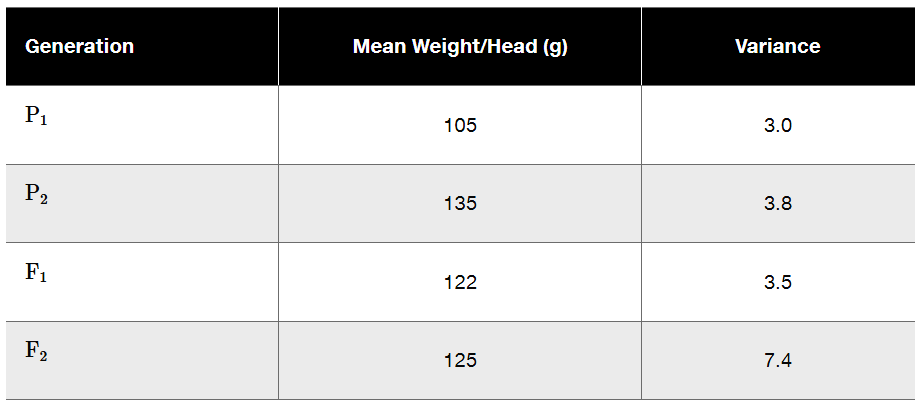
Two inbred lines of sunflowers (P₁ and P₂) produce different total weights of seeds per flower head. The mean weight of seeds (grams) and the variance of seed weights in different generations are as follows:
Use the information above to determine VG, VE, and VP for this trait.
문제 13
What is a quantitative trait locus (QTL)? Suppose you wanted to search for QTLs influencing fruit size in tomatoes. Describe the general structure of a QTL experiment, including the kind of tomato strains you would use, how molecular markers should be distributed in the genome, how the genetic marker alleles should differ between the two strains, and how you would use the F₁ progeny in a subsequent cross to obtain information about the possible location(s) of QTLs of interest.
문제 14
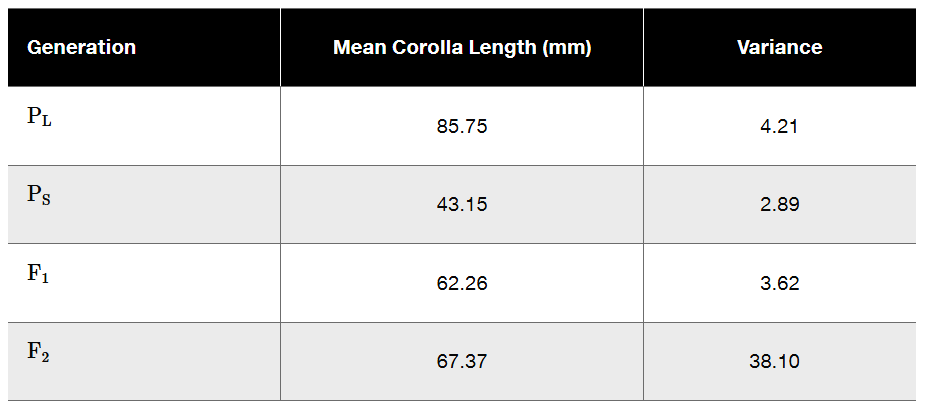
In Nicotiana, two inbred strains produce long (PL) and short (PS) corollas. These lines are crossed to produce F₁, and the F₁ are crossed to produce F₂ plants in which corolla length and variance are measured. The following table summarizes the mean and variance of corolla length in each generation. Calculate H² for corolla length in Nicotiana.
문제 15
Suppose the length of maize ears has narrow sense heritability (h²) of 0.70. A population produces ears that have an average length of 28 cm, and from this population a breeder selects a plant producing 34-cm ears to cross by self-fertilization. Predict the selection differential (S) and the response to selection (R) for this cross.