Ch. 1 - The Molecular Basis of Heredity, Variation, and Evolution
Sanders - Genetic Analysis: An Integrated Approach 3rd Edition
Sanders3rd EditionGenetic Analysis: An Integrated ApproachISBN: 9780135564172당신이 사용하는 게 아니라요?교과서 변경
1장, 문제 21

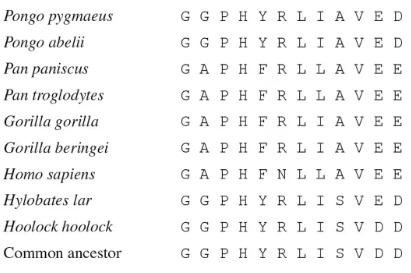
Using the following amino acid sequences obtained from different species of apes, construct a phylogenetic tree of the apes.
Amino acid sequences from various ape species arranged to aid in constructing a phylogenetic tree.

검증된 단계별 안내
1
Start by aligning the amino acid sequences from the different species of apes. Use a sequence alignment tool (e.g., ClustalW or MUSCLE) to identify conserved regions and differences among the sequences.
Calculate the pairwise sequence differences or similarities between each pair of species. This can be done by counting the number of mismatched amino acids in the aligned sequences.
Convert the pairwise differences into a distance matrix. The distance matrix will represent the evolutionary distances between the species based on their amino acid sequence differences.
Use the distance matrix to construct the phylogenetic tree. Apply a tree-building algorithm such as the Neighbor-Joining method or UPGMA (Unweighted Pair Group Method with Arithmetic Mean) to infer the relationships among the species.
Visualize the phylogenetic tree. Label the branches with the species names and ensure the branch lengths reflect the evolutionary distances calculated from the distance matrix.

비슷한 문제에 대한 검증된 영상 답변:

이 영상 해법은 위 문제에 도움이 된다고 튜터들이 추천한 것입니다.
영상 길이:
4m
도움이 되었나요?

주요 개념

질문에 올바르게 답하기 위해 반드시 이해해야 하는 핵심 개념들은 다음과 같습니다.

Amino Acid Sequences

Amino acid sequences are the linear arrangements of amino acids in a protein, determined by the genetic code. These sequences can vary between species, reflecting evolutionary relationships. By comparing these sequences, scientists can infer how closely related different species are, which is essential for constructing phylogenetic trees.
추천 영상:
가이드 코스
08:41
Sequencing Difficulties

Phylogenetic Tree

A phylogenetic tree is a diagram that represents the evolutionary relationships among various biological species based on their genetic characteristics. The branches of the tree illustrate how species diverged from common ancestors over time. Constructing a phylogenetic tree involves analyzing genetic data, such as amino acid sequences, to determine the order and timing of evolutionary events.
추천 영상:
가이드 코스
08:16
Phylogenetic Trees

Molecular Phylogenetics

Molecular phylogenetics is the study of evolutionary relationships using molecular data, primarily DNA, RNA, and protein sequences. This approach allows for more precise insights into the evolutionary history of organisms compared to morphological data alone. By applying statistical methods to molecular data, researchers can construct and validate phylogenetic trees that depict the genetic divergence among species.
추천 영상:
가이드 코스
08:16
Phylogenetic Trees