Ch. 10 - Eukaryotic Chromosome Abnormalities and Molecular Organization
Sanders - Genetic Analysis: An Integrated Approach 3rd Edition
Sanders3rd EditionGenetic Analysis: An Integrated ApproachISBN: 9780135564172당신이 사용하는 게 아니라요?교과서 변경
10장, 문제 28a

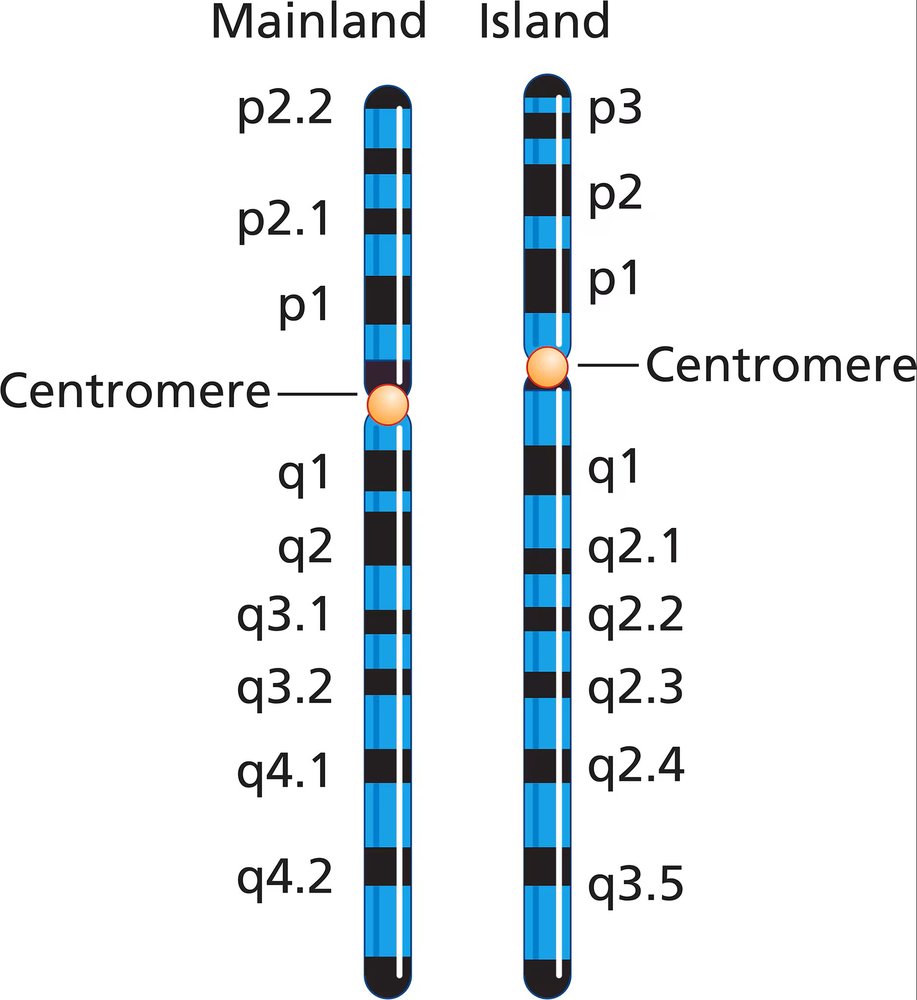
A small population of deer living on an isolated island is separated for many generations from a mainland deer population. The populations retain the same number of chromosomes but hybrids are infertile. One chromosome (shown here) has a different banding pattern in the island population than in the mainland population.
Comparison of mainland and island deer chromosomes showing different banding patterns and centromere positions.
Describe how the banding pattern of the island population chromosome most likely evolved from the mainland chromosome. What term or terms describe the difference between these chromosomes?

검증된 단계별 안내
1
The difference in banding patterns between the island and mainland chromosomes likely arose due to structural changes in the chromosome. These changes could include inversions, translocations, deletions, or duplications. Such mutations can alter the arrangement of genetic material without changing the total number of chromosomes.
The isolated island population experienced genetic drift and natural selection over many generations. These forces can fix structural mutations in the population, especially if they provide a selective advantage or are neutral in the isolated environment.
The infertility of hybrids suggests that the structural differences between the chromosomes have led to reproductive isolation. This is a key mechanism in speciation, where genetic incompatibilities prevent successful reproduction between populations.
The term that describes the structural differences between the chromosomes is 'chromosomal rearrangement.' Specifically, if the banding pattern difference is due to an inversion, it would be called an 'inversion polymorphism.' Other terms like 'structural mutation' or 'karyotypic variation' may also apply.
To confirm the evolutionary changes, scientists could use techniques like comparative genomic hybridization (CGH) or fluorescence in situ hybridization (FISH) to visualize and compare the chromosomal structures of the island and mainland populations.

비슷한 문제에 대한 검증된 영상 답변:

이 영상 해법은 위 문제에 도움이 된다고 튜터들이 추천한 것입니다.
영상 길이:
3m
도움이 되었나요?

주요 개념

질문에 올바르게 답하기 위해 반드시 이해해야 하는 핵심 개념들은 다음과 같습니다.

Chromosomal Variation

Chromosomal variation refers to differences in the structure or number of chromosomes between populations. This can include changes in banding patterns, which are indicative of alterations in the DNA sequence or chromatin structure. Such variations can arise due to mutations, genetic drift, or environmental pressures, leading to distinct chromosomal characteristics in isolated populations.
추천 영상:
가이드 코스
09:28
Genomic Variation

Speciation

Speciation is the evolutionary process by which populations evolve to become distinct species. In the case of the isolated deer population, prolonged separation from the mainland population can lead to genetic divergence due to lack of gene flow. This divergence can result in reproductive isolation, as seen with the infertile hybrids, and contribute to the development of unique traits, such as the altered banding pattern.
추천 영상:

Genetic Drift

Genetic drift is a mechanism of evolution that refers to random changes in allele frequencies within a population, particularly in small populations. In the isolated island deer population, genetic drift can lead to the fixation or loss of certain alleles over generations, contributing to the observed differences in chromosomal banding patterns. This process can significantly impact genetic diversity and the evolutionary trajectory of the population.
추천 영상:
관련 실천
교과서 질문

Genomic DNA from the nematode worm Caenorhabditis elegans is organized by nucleosomes in the manner typical of eukaryotic genomes, with 145 bp encircling each nucleosome and approximately 55 bp in linker DNA. When C. elegans chromatin is carefully isolated, stripped of nonhistone proteins, and placed in an appropriate buffer, the chromatin decondenses to the 10-nm fiber structure. Suppose researchers mix a sample of 10-nm–fiber chromatin with a large amount of the enzyme DNase I that randomly cleaves DNA in regions not protected by bound protein. Next, they remove the nucleosomes, separate the DNA fragments by gel electrophoresis, and stain all the DNA fragments in the gel.

Approximately what range of DNA fragment sizes do you expect to see in the stained electrophoresis gel? How many bands will be visible on the gel?

465
views
교과서 질문

A small population of deer living on an isolated island is separated for many generations from a mainland deer population. The populations retain the same number of chromosomes but hybrids are infertile. One chromosome (shown here) has a different banding pattern in the island population than in the mainland population.

In a mainland–island hybrid deer, recombination takes place in band q1 of the homologous chromosomes. Draw the gametes that result from this event.

506
views
교과서 질문

Genomic DNA from the nematode worm Caenorhabditis elegans is organized by nucleosomes in the manner typical of eukaryotic genomes, with 145 bp encircling each nucleosome and approximately 55 bp in linker DNA. When C. elegans chromatin is carefully isolated, stripped of nonhistone proteins, and placed in an appropriate buffer, the chromatin decondenses to the 10-nm fiber structure. Suppose researchers mix a sample of 10-nm–fiber chromatin with a large amount of the enzyme DNase I that randomly cleaves DNA in regions not protected by bound protein. Next, they remove the nucleosomes, separate the DNA fragments by gel electrophoresis, and stain all the DNA fragments in the gel.

How do the expected results support the 10-nm–fiber model of chromatin?

457
views
교과서 질문

Genomic DNA from the nematode worm Caenorhabditis elegans is organized by nucleosomes in the manner typical of eukaryotic genomes, with 145 bp encircling each nucleosome and approximately 55 bp in linker DNA. When C. elegans chromatin is carefully isolated, stripped of nonhistone proteins, and placed in an appropriate buffer, the chromatin decondenses to the 10-nm fiber structure. Suppose researchers mix a sample of 10-nm–fiber chromatin with a large amount of the enzyme DNase I that randomly cleaves DNA in regions not protected by bound protein. Next, they remove the nucleosomes, separate the DNA fragments by gel electrophoresis, and stain all the DNA fragments in the gel.

Explain the origin of DNA fragments seen in the gel.

596
views
교과서 질문

A small population of deer living on an isolated island is separated for many generations from a mainland deer population. The populations retain the same number of chromosomes but hybrids are infertile. One chromosome (shown here) has a different banding pattern in the island population than in the mainland population.

Suppose that 40% of all meioses in mainland–island hybrids involve recombination somewhere in the chromosome region between q2.1 and p2. What proportion of the gametes of hybrid deer are viable? What is the cause of the decreased proportion of viable gametes in hybrids relative to the parental populations?

554
views
교과서 질문

A small population of deer living on an isolated island is separated for many generations from a mainland deer population. The populations retain the same number of chromosomes but hybrids are infertile. One chromosome (shown here) has a different banding pattern in the island population than in the mainland population.

Draw the synapsis of these homologs during prophase I in hybrids produced from the cross of mainland with island deer.

519
views