Ch. 10 - Eukaryotic Chromosome Abnormalities and Molecular Organization
Sanders - Genetic Analysis: An Integrated Approach 3rd Edition
Sanders3rd EditionGenetic Analysis: An Integrated ApproachISBN: 9780135564172당신이 사용하는 게 아니라요?교과서 변경
10장, 문제 13b

An animal heterozygous for a reciprocal balanced translocation has the following chromosomes:
      MN • OPQRST
      MN • OPQRjkl
      cdef • ghijkl
      cdef • ghiST
Identify the gametes produced by alternate segregation. Which, if any, of these gametes are viable?

검증된 단계별 안내
1
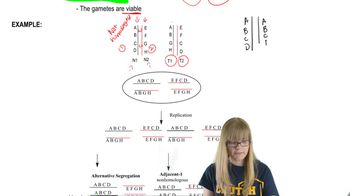
Step 1: Understand the concept of reciprocal balanced translocation. This occurs when two non-homologous chromosomes exchange segments without any genetic material being lost or gained. In a heterozygous individual, one set of chromosomes is normal, and the other set carries the translocation.
Step 2: Recognize alternate segregation. During meiosis, alternate segregation refers to the separation of chromosomes such that the translocated chromosomes move to one pole and the normal chromosomes move to the opposite pole. This results in gametes that either contain both translocated chromosomes or both normal chromosomes.
Step 3: Analyze the chromosome combinations resulting from alternate segregation. The gametes produced will be: (1) MN • OPQRST and cdef • ghiST (normal chromosomes), and (2) MN • OPQRjkl and cdef • ghijkl (translocated chromosomes).
Step 4: Determine viability of the gametes. Gametes are viable if they contain a balanced set of genetic material. Both combinations from alternate segregation are balanced because they either contain the normal chromosomes or the translocated chromosomes, ensuring no genetic material is missing or duplicated.
Step 5: Conclude that the gametes produced by alternate segregation are viable. This is because the genetic material is balanced in both cases, allowing for proper development if fertilization occurs.

비슷한 문제에 대한 검증된 영상 답변:

이 영상 해법은 위 문제에 도움이 된다고 튜터들이 추천한 것입니다.
영상 길이:
2m
도움이 되었나요?

주요 개념

질문에 올바르게 답하기 위해 반드시 이해해야 하는 핵심 개념들은 다음과 같습니다.

Reciprocal Balanced Translocation

A reciprocal balanced translocation occurs when two non-homologous chromosomes exchange segments without any loss of genetic material. This results in a rearrangement of genetic information but maintains the overall balance of genes. In heterozygous individuals, one chromosome carries the normal arrangement while the other has the translocated segments, which can affect gamete formation and viability.
추천 영상:
가이드 코스
12:42
Reciprocal Translocation

Segregation Patterns in Meiosis

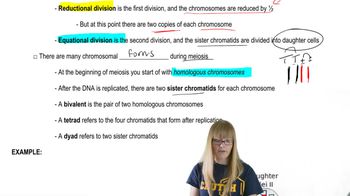
During meiosis, chromosomes segregate into gametes, and the pattern of segregation can influence genetic diversity. In the case of reciprocal translocations, alternate segregation leads to gametes that contain either all normal chromosomes or all translocated chromosomes. Understanding these patterns is crucial for predicting the viability of the resulting gametes.
추천 영상:
가이드 코스
05:30
Meiosis Overview

Viability of Gametes

The viability of gametes refers to their ability to develop into a viable organism upon fertilization. In the context of reciprocal balanced translocations, gametes produced by alternate segregation are typically viable because they maintain a complete set of genetic information. However, those produced by adjacent segregation may be unbalanced and often lead to non-viable offspring.
추천 영상:
가이드 코스
21:21
Gamete Development
관련 실천
교과서 질문

A pair of homologous chromosomes in Drosophila has the following content (single letters represent genes):

Chromosome 1RNMDHBGKWU

Chromosome 2RNMDHBDHBGKWU

What term best describes the unusual structure that forms during pairing of these chromosomes?

434
views
교과서 질문

An animal heterozygous for a reciprocal balanced translocation has the following chromosomes:

      MN • OPQRST

      MN • OPQRjkl

      cdef • ghijkl

      cdef • ghiST

Identify the gametes produced by adjacent-2 segregation. Which if any of these gametes are viable?

538
views
교과서 질문

An animal heterozygous for a reciprocal balanced translocation has the following chromosomes:

      MN • OPQRST

      MN • OPQRjkl

      cdef • ghijkl

      cdef • ghiST

Diagram the pairing of these chromosomes in prophase I.

450
views
교과서 질문

An animal heterozygous for a reciprocal balanced translocation has the following chromosomes:

MN • OPQRST           

MN • OPQRjkl           

cdef • ghijkl           

cdef • ghiST

Among the three segregation patterns, which is least likely to occur? Why?

416
views
교과서 질문

An animal heterozygous for a reciprocal balanced translocation has the following chromosomes:

      MN • OPQRST

      MN • OPQRjkl

      cdef • ghijkl

      cdef • ghiST

Identify the gametes produced by adjacent-1 segregation. Which, if any, of these gametes are viable?

497
views
교과서 질문

A pair of homologous chromosomes in Drosophila has the following content (single letters represent genes):

Chromosome 1RNMDHBGKWU

Chromosome 2RNMDHBDHBGKWU

How does the pairing diagrammed in part (b) differ from the pairing of chromosomes in an inversion heterozygote?

425
views