Ch. 10 - Eukaryotic Chromosome Abnormalities and Molecular Organization
Sanders - Genetic Analysis: An Integrated Approach 3rd Edition
Sanders3rd EditionGenetic Analysis: An Integrated ApproachISBN: 9780135564172당신이 사용하는 게 아니라요?교과서 변경
10장, 문제 6

Consider synapsis in prophase I of meiosis for two plant species that each carries 36 chromosomes. Species A is diploid and species B is triploid. What characteristics of homologous chromosome synapsis can be used to distinguish these two species?

검증된 단계별 안내
1
span>Understand the ploidy levels: Species A is diploid (2n), meaning it has two sets of chromosomes, while Species B is triploid (3n), meaning it has three sets of chromosomes.
span>Calculate the number of chromosome sets: For Species A, with 36 chromosomes, each set contains 18 chromosomes (36/2). For Species B, each set contains 12 chromosomes (36/3).
span>Consider synapsis in prophase I: In diploid Species A, homologous chromosomes pair up to form bivalents, resulting in 18 bivalents during synapsis.
span>Analyze synapsis in triploid Species B: Homologous chromosomes may form trivalents or univalents due to the extra set, leading to irregular pairing and potentially 12 trivalents or a mix of bivalents and univalents.
span>Distinguish characteristics: The presence of trivalents or unpaired chromosomes (univalents) during synapsis in Species B can be used to distinguish it from Species A, which will have regular bivalent formation.

비슷한 문제에 대한 검증된 영상 답변:

이 영상 해법은 위 문제에 도움이 된다고 튜터들이 추천한 것입니다.
영상 길이:
1m

주요 개념

질문에 올바르게 답하기 위해 반드시 이해해야 하는 핵심 개념들은 다음과 같습니다.

Meiosis and Chromosome Number

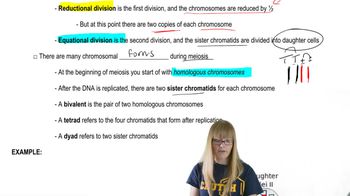
Meiosis is a specialized form of cell division that reduces the chromosome number by half, resulting in gametes. In diploid organisms like species A, there are two sets of chromosomes (36 total, or 18 pairs), while triploid organisms like species B have three sets (54 total, or 18 triplets). Understanding the difference in chromosome number is crucial for analyzing synapsis during prophase I.
추천 영상:
가이드 코스
05:30
Meiosis Overview

Synapsis and Homologous Chromosomes

Synapsis is the process during prophase I of meiosis where homologous chromosomes pair up closely along their lengths. This pairing is essential for genetic recombination and ensures proper segregation of chromosomes. In diploid species, homologous chromosomes form pairs, while in triploid species, there may be incomplete pairing due to the presence of an extra set of chromosomes, affecting the synapsis characteristics.
추천 영상:
가이드 코스
07:10
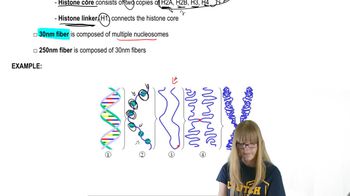
Chromosome Structure

Genetic Recombination

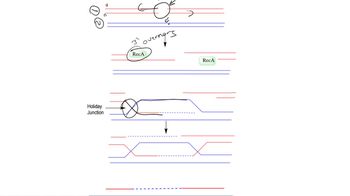
Genetic recombination occurs during synapsis when homologous chromosomes exchange genetic material, leading to genetic diversity in gametes. In diploid species, this process is straightforward as each chromosome has a homologous partner. In triploid species, the presence of an additional chromosome set complicates recombination, potentially leading to unequal exchanges and affecting the overall genetic variation produced.
추천 영상:
가이드 코스
03:37
Recombination after Double Strand Breaks