Give descriptions for the following terms: Nucleosome core particle
검증된 단계별 안내
1
The nucleosome core particle is the fundamental unit of chromatin structure in eukaryotic cells, responsible for compacting DNA into a more organized and condensed form.
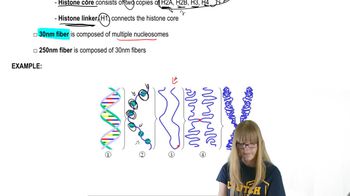
It consists of a segment of DNA wrapped around a core of histone proteins. Specifically, the core is made up of an octamer of histones, which includes two copies each of the histones H2A, H2B, H3, and H4.
Approximately 146 base pairs of DNA are wrapped around the histone octamer in 1.65 superhelical turns, forming the nucleosome core particle.
The nucleosome core particle is connected to adjacent nucleosomes by a stretch of linker DNA, which is typically bound by the histone H1 protein to further stabilize the chromatin structure.
This structure plays a critical role in regulating gene expression, as the degree of DNA compaction can influence the accessibility of transcription factors and other regulatory proteins to the DNA sequence.
비슷한 문제에 대한 검증된 영상 답변:
이 영상 해법은 위 문제에 도움이 된다고 튜터들이 추천한 것입니다.
영상 길이:
3m
영상 재생:
0 댓글
주요 개념
질문에 올바르게 답하기 위해 반드시 이해해야 하는 핵심 개념들은 다음과 같습니다.
Nucleosome Structure
A nucleosome is the fundamental unit of chromatin, consisting of a segment of DNA wrapped around a core of histone proteins. This structure helps package DNA into a compact form, allowing it to fit within the cell nucleus while also playing a crucial role in gene regulation.
Histones are a group of small, positively charged proteins that bind to negatively charged DNA, facilitating the formation of nucleosomes. There are five main types of histones (H1, H2A, H2B, H3, and H4), and they play a key role in the structural organization of chromatin and the regulation of gene expression.
Chromatin is the complex of DNA and proteins that forms chromosomes within the nucleus of eukaryotic cells. The organization of nucleosomes into higher-order structures allows for the regulation of DNA accessibility, impacting processes such as transcription, replication, and repair, which are essential for cellular function.

 Sanders 3rd Edition
 검증된 단계별 안내
 07:10
07:10