Ch. 10 - Eukaryotic Chromosome Abnormalities and Molecular Organization
Sanders - Genetic Analysis: An Integrated Approach 3rd Edition
Sanders3rd EditionGenetic Analysis: An Integrated ApproachISBN: 9780135564172당신이 사용하는 게 아니라요?교과서 변경
10장, 문제 8a

If the haploid number for a plant species is 4, how many chromosomes are found in a member of the species that has one of the following characteristics? Explain your reasoning in each case.
Diploidy

검증된 단계별 안내
1
Understand the concept of haploid number: The haploid number (n) represents the number of chromosomes in a single set of the organism's genome. For this plant species, the haploid number is given as 4 (n = 4).
Define diploidy: Diploidy refers to an organism having two complete sets of chromosomes, one set inherited from each parent. This means the total number of chromosomes in a diploid organism is 2n.
Apply the formula for diploidy: To calculate the total number of chromosomes in a diploid organism, use the formula: 2×n. Substitute the haploid number (n = 4) into the formula.
Perform the multiplication: Multiply 2 by the haploid number (4) to determine the total number of chromosomes in a diploid organism. This step provides the chromosome count for diploidy.
Explain the reasoning: Since diploidy involves two sets of chromosomes, the chromosome count is double the haploid number. This ensures the organism has a complete set of genetic material from both parents.

비슷한 문제에 대한 검증된 영상 답변:

이 영상 해법은 위 문제에 도움이 된다고 튜터들이 추천한 것입니다.
영상 길이:
2m
도움이 되었나요?

주요 개념

질문에 올바르게 답하기 위해 반드시 이해해야 하는 핵심 개념들은 다음과 같습니다.

Haploid and Diploid

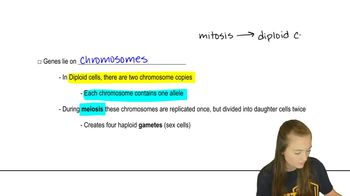
Haploid refers to a cell or organism that has a single set of chromosomes, denoted as 'n'. In contrast, diploid cells contain two sets of chromosomes, represented as '2n'. For the plant species in question, with a haploid number of 4, the diploid number would be 8, as diploidy means having two complete sets of chromosomes.
추천 영상:
가이드 코스
27:36
Diploid Genetics

Chromosome Number

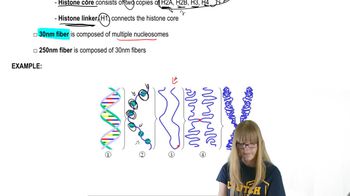
The chromosome number is the total count of chromosomes in a cell. In diploid organisms, this number is double that of haploid organisms. Understanding the relationship between haploid and diploid states is crucial for determining the chromosome count in various life stages of an organism, such as gametes and somatic cells.
추천 영상:
가이드 코스
07:10
Chromosome Structure

Plant Reproduction

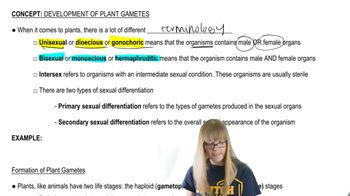
Plants typically reproduce through a life cycle that alternates between haploid (gametophyte) and diploid (sporophyte) stages. In this context, knowing that the diploid stage has twice the number of chromosomes as the haploid stage helps in understanding how genetic information is passed on and how traits are expressed in the plant species.
추천 영상:
가이드 코스
02:56
Plant Gamete Terminology