Ch. 11 - Gene Mutation, DNA Repair, and Homologous Recombination
Sanders - Genetic Analysis: An Integrated Approach 3rd Edition
Sanders3rd EditionGenetic Analysis: An Integrated ApproachISBN: 9780135564172당신이 사용하는 게 아니라요?교과서 변경
11장, 문제 28a

In an Ames test using hisSalmonella bacteria a researcher determines that adding a test compound plus the S9 extract produces a large number of his⁺ revertants but mixing the his⁻ strain plus the test compound without adding S9 does not produce an elevated number of his⁺ revertants.
What is the reason for the different experimental results described?

검증된 단계별 안내
1
Understand the Ames test: The Ames test is used to assess the mutagenic potential of a compound. It involves using a strain of bacteria (e.g., his⁻ Salmonella) that cannot synthesize histidine due to a mutation. If the compound causes mutations that revert the bacteria to his⁺, it indicates mutagenic activity.
Recognize the role of the S9 extract: The S9 extract is a mixture of enzymes derived from the liver of mammals (often rats). It mimics the metabolic processes that occur in the liver, which can activate or detoxify compounds. Some compounds are not directly mutagenic but become mutagenic after metabolic activation by the S9 extract.
Analyze the experimental results: In the experiment, the test compound plus the S9 extract produced a large number of his⁺ revertants, indicating that the compound becomes mutagenic after metabolic activation. Without the S9 extract, the compound did not produce an elevated number of his⁺ revertants, suggesting it is not directly mutagenic in its original form.
Conclude the reason for the difference: The test compound requires metabolic activation by the enzymes in the S9 extract to become mutagenic. Without the S9 extract, the compound remains inactive and does not induce mutations in the his⁻ Salmonella strain.
Summarize the importance of the S9 extract: The inclusion of the S9 extract in the Ames test is crucial for identifying compounds that are pro-mutagens (inactive until metabolized). This highlights the importance of simulating metabolic processes in mutagenicity testing.

비슷한 문제에 대한 검증된 영상 답변:

이 영상 해법은 위 문제에 도움이 된다고 튜터들이 추천한 것입니다.
영상 길이:
3m

주요 개념

질문에 올바르게 답하기 위해 반드시 이해해야 하는 핵심 개념들은 다음과 같습니다.

Ames Test

The Ames test is a widely used method for screening potential carcinogens by assessing their mutagenic effects on specific strains of bacteria, typically Salmonella. In this test, bacteria that require histidine (his⁻) for growth are exposed to a test compound, and the number of revertants (his⁺) that can grow without histidine is measured. A significant increase in revertants indicates that the compound may cause mutations that restore the bacteria's ability to synthesize histidine.
추천 영상:
가이드 코스
04:29
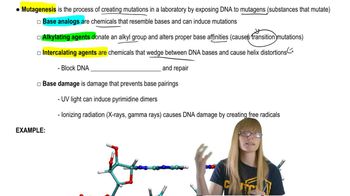
Induced Mutations

S9 Extract

S9 extract is a metabolic activation system derived from the liver of rodents, containing enzymes that can convert pro-mutagens into active mutagens. In the Ames test, the addition of S9 extract allows researchers to simulate the metabolic processes that occur in living organisms, which can enhance the mutagenic potential of certain compounds. This is crucial for identifying substances that may not be mutagenic in their original form but become so after metabolic activation.
추천 영상:
가이드 코스
04:17
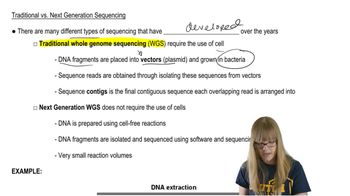
Traditional vs. Next-Gen

Mutagenesis and Reversion

Mutagenesis refers to the process by which genetic mutations are induced, leading to changes in the DNA sequence. In the context of the Ames test, reversion is the process where a his⁻ mutant bacterium undergoes a mutation that restores its ability to synthesize histidine, resulting in the his⁺ phenotype. The presence of S9 extract can facilitate this reversion by activating compounds that cause mutations, explaining the observed difference in revertant numbers when S9 is included versus when it is not.
추천 영상:
가이드 코스
04:29
Induced Mutations
관련 실천
교과서 질문
Briefly compare the production of DNA double-strand breaks in bacteria versus the double-strand breaks that precede homologous recombination.
705
views
교과서 질문

Following the spill of a mixture of chemicals into a small pond, bacteria from the pond are tested and show an unusually high rate of mutation. A number of mutant cultures are grown from mutant colonies and treated with known mutagens to study the rate of reversion. Most of the mutant cultures show a significantly higher reversion rate when exposed to base analogs such as proflavin and 2-aminopurine. What does this suggest about the nature of the chemicals in the spill?

437
views
교과서 질문
During mismatch repair, why is it necessary to distinguish between the template strand and the newly made daughter strand? Describe how this is accomplished.
699
views
교과서 질문

A wild-type culture of haploid yeast is exposed to ethyl methanesulfonate (EMS). Yeast cells are plated on a complete medium, and 6 colonies (colonies numbered 1 to 6) are transferred to a new complete medium plate for further study. Four replica plates are made from the complete medium plate to plates containing minimal medium or minimal medium plus one amino acid (replica plates numbered 1 to 4) with the following results:

Identify the colonies that are prototrophic (wild type). What growth information leads to your answer? 

441
views
교과서 질문

In an Ames test using hisSalmonella bacteria a researcher determines that adding a test compound plus the S9 extract produces a large number of his⁺ revertants but mixing the his⁻ strain plus the test compound without adding S9 does not produce an elevated number of his⁺ revertants.

Is the test compound still considered to be a potential mutagen? Explain why or why not.

473
views
교과서 질문

A wild-type culture of haploid yeast is exposed to ethyl methanesulfonate (EMS). Yeast cells are plated on a complete medium, and 6 colonies (colonies numbered 1 to 6) are transferred to a new complete medium plate for further study. Four replica plates are made from the complete medium plate to plates containing minimal medium or minimal medium plus one amino acid (replica plates numbered 1 to 4) with the following results:

Identify the colonies that are auxotrophic (mutant). What growth information leads to your answer? 

556
views