Ch. 12 - Regulation of Gene Expression in Bacteria and Bacteriophage
Sanders - Genetic Analysis: An Integrated Approach 3rd Edition
Sanders3rd EditionGenetic Analysis: An Integrated ApproachISBN: 9780135564172당신이 사용하는 게 아니라요?교과서 변경
12장, 문제 28c

How would mutations that inactivate each of the following genes affect the determination of the lytic or lysogenic life cycle in mutated λ phage strains? Explain your answers.
cro

검증된 단계별 안내
1
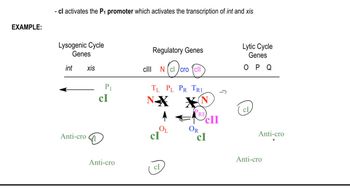
Understand the role of the cro gene: The cro gene in λ phage encodes the Cro protein, which is a key regulator in determining whether the phage enters the lytic or lysogenic cycle. Cro protein represses the expression of the cI gene, which encodes the λ repressor protein. The λ repressor promotes the lysogenic cycle by repressing lytic genes.
Analyze the effect of inactivating cro: If the cro gene is inactivated, the Cro protein will not be produced. Without Cro, the cI gene will not be repressed, leading to increased production of the λ repressor protein.
Predict the impact on the life cycle: With higher levels of the λ repressor protein, the phage is more likely to enter or remain in the lysogenic cycle, as the λ repressor actively suppresses the expression of genes required for the lytic cycle.
Consider the balance of regulatory proteins: Normally, the decision between the lytic and lysogenic cycles depends on the balance between Cro and the λ repressor. In the absence of Cro, this balance is disrupted, favoring the lysogenic cycle.
Summarize the outcome: Mutations that inactivate the cro gene would likely result in a bias toward the lysogenic life cycle, as the repression of the cI gene by Cro is a critical step in promoting the lytic cycle.

비슷한 문제에 대한 검증된 영상 답변:

이 영상 해법은 위 문제에 도움이 된다고 튜터들이 추천한 것입니다.
영상 길이:
3m
도움이 되었나요?

주요 개념

질문에 올바르게 답하기 위해 반드시 이해해야 하는 핵심 개념들은 다음과 같습니다.

Lytic and Lysogenic Cycles

The lytic and lysogenic cycles are two distinct pathways that bacteriophages, like λ phage, can follow after infecting a bacterial host. In the lytic cycle, the phage replicates rapidly, leading to the destruction of the host cell and the release of new phage particles. In contrast, the lysogenic cycle involves the integration of the phage DNA into the host genome, allowing it to replicate along with the host cell without causing immediate harm.
추천 영상:
가이드 코스
08:04
Decision Between Lytic and Lysogenic Cycles

Role of the cro Gene

The cro gene in λ phage is crucial for regulating the switch between the lytic and lysogenic cycles. It encodes a protein that promotes the lytic cycle by inhibiting the expression of genes necessary for lysogeny, such as cI, which encodes the repressor protein. When cro is active, it favors the production of new phage particles, while its inactivation can lead to a preference for the lysogenic pathway.
추천 영상:
가이드 코스
11:19
Segmentation Genes

Mutations and Gene Function

Mutations are changes in the DNA sequence that can affect gene function. In the context of the cro gene, mutations that inactivate it would prevent the production of the cro protein, disrupting the balance between the lytic and lysogenic cycles. This could lead to an increased likelihood of lysogeny, as the repression of lysogenic genes would be lifted, allowing the phage to integrate its DNA into the host genome instead of immediately replicating.
추천 영상:
가이드 코스
08:26
Functional Genomics