Ch. 12 - Regulation of Gene Expression in Bacteria and Bacteriophage
Sanders - Genetic Analysis: An Integrated Approach 3rd Edition
Sanders3rd EditionGenetic Analysis: An Integrated ApproachISBN: 9780135564172당신이 사용하는 게 아니라요?교과서 변경
12장, 문제 4b

Identify similarities and differences between an inducible operon and a repressible operon in terms of
The presence and action of allosteric regulatory molecules.

검증된 단계별 안내
1
Understand the basic structure of an operon: An operon is a cluster of genes under the control of a single promoter and regulatory elements. It includes structural genes, a promoter, an operator, and regulatory genes that produce proteins influencing gene expression.
Define an inducible operon: An inducible operon is typically 'off' and requires the presence of an inducer molecule to activate transcription. The inducer binds to a repressor protein, causing a conformational change that prevents the repressor from binding to the operator, allowing RNA polymerase to transcribe the genes.
Define a repressible operon: A repressible operon is typically 'on' and actively transcribed. It is turned 'off' when a corepressor molecule binds to a repressor protein, enabling the repressor to bind to the operator and block transcription.
Compare the role of allosteric regulatory molecules: In an inducible operon, the allosteric regulatory molecule (inducer) inactivates the repressor, allowing transcription. In a repressible operon, the allosteric regulatory molecule (corepressor) activates the repressor, inhibiting transcription.
Summarize the key difference: The main difference lies in the action of the allosteric regulatory molecules. Inducible operons rely on an inducer to initiate transcription, while repressible operons rely on a corepressor to halt transcription.

비슷한 문제에 대한 검증된 영상 답변:

이 영상 해법은 위 문제에 도움이 된다고 튜터들이 추천한 것입니다.
영상 길이:
4m
도움이 되었나요?

주요 개념

질문에 올바르게 답하기 위해 반드시 이해해야 하는 핵심 개념들은 다음과 같습니다.

Operons

Operons are clusters of genes under the control of a single promoter, allowing for coordinated regulation of gene expression in prokaryotes. They can be classified into two main types: inducible operons, which are activated in response to specific signals, and repressible operons, which are typically active but can be turned off when a specific molecule is present.
추천 영상:
가이드 코스
03:45
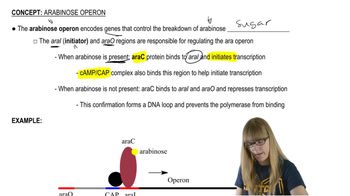
Arabinose Operon

Inducible Operons

Inducible operons, such as the lac operon, are usually off but can be turned on by the presence of an inducer molecule. This inducer often binds to a repressor protein, causing a conformational change that prevents the repressor from binding to the operator, thus allowing transcription of the downstream genes.
추천 영상:
가이드 코스
04:29
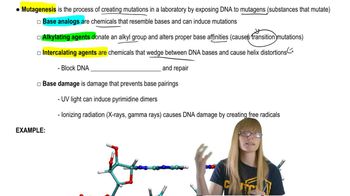
Induced Mutations

Repressible Operons

Repressible operons, like the trp operon, are typically active and can be turned off by a corepressor molecule. When the corepressor binds to the repressor protein, it activates the repressor, allowing it to bind to the operator and inhibit transcription, thus regulating gene expression based on the availability of specific metabolites.
추천 영상:
가이드 코스
03:45
Arabinose Operon