Ch. 13 - Regulation of Gene Expression in Eukaryotes
Sanders - Genetic Analysis: An Integrated Approach 3rd Edition
Sanders3rd EditionGenetic Analysis: An Integrated ApproachISBN: 9780135564172당신이 사용하는 게 아니라요?교과서 변경
13장, 문제 18a

The UG4 gene is expressed in stem tissue and leaf tissue of the plant Arabidopsis thaliana. To study mechanisms regulating UG4 expression, six small deletions of the DNA sequence upstream of the gene-coding sequence are made. The locations of deletions and their effect on UG4 expression are shown here. Explain the differential effects of deletions B and F on expression in the two tissues.

검증된 단계별 안내
1
Identify the role of the upstream DNA sequence in regulating gene expression. These sequences often contain regulatory elements such as promoters, enhancers, or silencers that control where and when a gene is expressed.
Examine the specific deletions (B and F) and their effects on UG4 expression in stem and leaf tissues. Deletion B may remove a regulatory element that is specific to one tissue, while deletion F may affect a different regulatory element.
Consider the possibility that deletion B removes an enhancer or promoter element required for UG4 expression in one tissue (e.g., stem tissue) but not the other (e.g., leaf tissue). This would explain why UG4 expression is reduced in one tissue but unaffected in the other.
Analyze deletion F and its potential to remove a regulatory element that is active in both tissues. If deletion F reduces UG4 expression in both stem and leaf tissues, it may have removed a shared enhancer or promoter element.
Conclude that the differential effects of deletions B and F on UG4 expression are likely due to the specific regulatory elements they disrupt. Deletion B may target a tissue-specific element, while deletion F may target a shared regulatory element.

비슷한 문제에 대한 검증된 영상 답변:

이 영상 해법은 위 문제에 도움이 된다고 튜터들이 추천한 것입니다.
영상 길이:
1m

주요 개념

질문에 올바르게 답하기 위해 반드시 이해해야 하는 핵심 개념들은 다음과 같습니다.

Gene Expression Regulation

Gene expression regulation refers to the mechanisms that control the timing and amount of gene expression. This can involve various elements such as promoters, enhancers, and silencers, which interact with transcription factors to either promote or inhibit the transcription of a gene. Understanding these regulatory elements is crucial for analyzing how specific deletions can affect gene expression in different tissues.
추천 영상:
가이드 코스
02:09
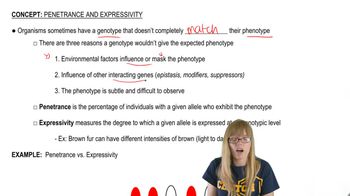
Penetrance and Expressivity

Tissue-Specific Expression

Tissue-specific expression is the phenomenon where certain genes are expressed in specific tissues or developmental stages. In the case of the UG4 gene in Arabidopsis thaliana, its expression in stem and leaf tissues may be influenced by unique regulatory sequences that respond differently to deletions. This concept is essential for understanding why deletions B and F might have varying effects on UG4 expression in these tissues.
추천 영상:
가이드 코스
02:09
Penetrance and Expressivity

Deletion Mutations

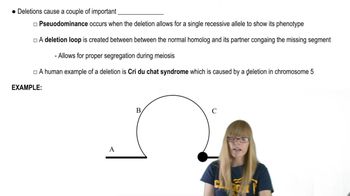
Deletion mutations involve the removal of a segment of DNA, which can disrupt the normal function of genes and their regulatory elements. The impact of such deletions can vary based on their location relative to critical regulatory sequences. Analyzing how deletions B and F affect UG4 expression requires an understanding of how these mutations alter the gene's regulatory landscape in the context of the specific tissues involved.
추천 영상:
관련 실천
교과서 질문

Diagram and explain how the inducibility of a gene—for instance in response to an environmental cue—could be mediated by an activator. Then show how it could be mediated by a repressor.

670
views
교과서 질문

The UG4 gene is expressed in stem tissue and leaf tissue of the plant Arabidopsis thaliana. To study mechanisms regulating UG4 expression, six small deletions of DNA sequence upstream of the gene-coding sequence are made. The locations of deletions and their effect on UG4 expression are shown here. Why does deletion D raise UG4 expression in leaf tissue but not in stem tissue?

529
views
교과서 질문

How does dsRNA lead to posttranscriptonal gene silencing?

814
views
교과서 질문

A hereditary disease is inherited as an autosomal recessive trait1. The wild-type allele of the disease gene produces a mature mRNA that is 1250 nucleotides (nt) long. Molecular analysis shows that the mature mRNA consists of four exons that measure 400 nt (exon 1), 320 nt (exon 2), 230 nt (exon 3), and 300 nt (exon 4). A mother and father with two healthy children and two children with the disease have northern blot analysis performed in a medical genetics laboratory. The results of the northern blot for each family member are shown here. Identify the genotype of each family member, using the sizes of mRNAs to indicate each allele. (For example, a person who is homozygous wild type is indicated as '1250/1250.')

440
views
교과서 질문

A hereditary disease is inherited as an autosomal recessive trait1. The wild-type allele of the disease gene produces a mature mRNA that is 1250 nucleotides (nt) long. Molecular analysis shows that the mature mRNA consists of four exons that measure 400 nt (exon 1), 320 nt (exon 2), 230 nt (exon 3), and 300 nt (exon 4). A mother and father with two healthy children and two children with the disease have northern blot analysis performed in a medical genetics laboratory. The results of the northern blot for each family member are shown here. Based on your analysis, what is the most likely molecular abnormality causing the disease allele?

456
views
교과서 질문

The UG4 gene is expressed in stem tissue and leaf tissue of the plant Arabidopsis thaliana. To study mechanisms regulating UG4 expression, six small deletions of DNA sequence upstream of the gene-coding sequence are made. The locations of deletions and their effect on UG4 expression are shown here. Why does deletion E lower expression of UG4 in leaf tissue but not in stem tissue?

462
views