Ch. 14 - Analysis of Gene Function via Forward Genetics and Reverse Genetics
Sanders - Genetic Analysis: An Integrated Approach 3rd Edition
Sanders3rd EditionGenetic Analysis: An Integrated ApproachISBN: 9780135564172당신이 사용하는 게 아니라요?교과서 변경
14장, 문제 2

You conduct a study in which the transcriptional fusion of regulatory sequences of a particular gene with a reporter gene results in relatively uniform expression of the reporter gene in all cells of an organism. A translational fusion with the same gene shows reporter gene expression only in the nucleus of a specific cell type. Discuss some biological causes for the difference in expression patterns of the two transgenes.

검증된 단계별 안내
1
Understand the difference between transcriptional and translational fusions: A transcriptional fusion involves linking the regulatory sequences of a gene (e.g., promoter and enhancer regions) to a reporter gene, which reflects where the gene is transcribed. A translational fusion, on the other hand, links the coding sequence of the gene to the reporter gene, allowing the reporter to mimic the protein's localization and expression pattern.
Analyze the uniform expression in the transcriptional fusion: The uniform expression of the reporter gene in all cells suggests that the regulatory sequences of the gene are active in all cells, driving transcription of the reporter gene. This indicates that the gene's transcriptional control elements are not restricted to specific cell types.
Consider the restricted expression in the translational fusion: The translational fusion shows reporter gene expression only in the nucleus of a specific cell type. This suggests that the protein encoded by the gene is localized to the nucleus and is expressed only in certain cell types, likely due to post-transcriptional regulation or cell-specific translation.
Discuss potential biological causes for the difference: The difference in expression patterns could be due to post-transcriptional regulatory mechanisms, such as mRNA stability, translation efficiency, or protein localization signals. For example, the gene may have a nuclear localization signal (NLS) that directs the protein to the nucleus, and this signal is only functional in specific cell types.
Conclude with the importance of regulatory levels: This difference highlights the complexity of gene regulation, where transcriptional control determines where a gene is transcribed, while post-transcriptional and translational mechanisms, including protein localization, determine where and how the protein functions within the organism.

비슷한 문제에 대한 검증된 영상 답변:

이 영상 해법은 위 문제에 도움이 된다고 튜터들이 추천한 것입니다.
영상 길이:
1m
도움이 되었나요?

주요 개념

질문에 올바르게 답하기 위해 반드시 이해해야 하는 핵심 개념들은 다음과 같습니다.

Transcriptional Fusion

Transcriptional fusion involves linking the regulatory sequences of a gene to a reporter gene, allowing researchers to study the gene's expression patterns. This method reveals how the gene is activated and regulated across different cell types, as the reporter gene's expression reflects the activity of the promoter and enhancer elements controlling it.
추천 영상:
가이드 코스
09:16
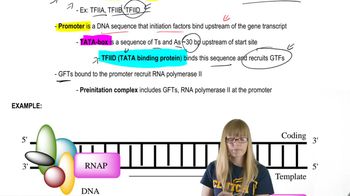
Eukaryotic Transcription

Translational Fusion

Translational fusion combines the coding sequence of a gene with a reporter gene, which can affect the localization and stability of the resulting protein. This approach provides insights into the protein's expression and function within specific cellular compartments, such as the nucleus, highlighting how post-transcriptional modifications and localization signals influence protein behavior.
추천 영상:
가이드 코스
07:58
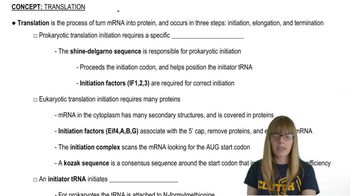
Translation initiation

Cell Type-Specific Regulation

Cell type-specific regulation refers to the mechanisms that control gene expression differently in various cell types. Factors such as transcription factors, chromatin structure, and signaling pathways can lead to distinct expression patterns, explaining why a reporter gene may be uniformly expressed in all cells when linked transcriptionally, but only in specific cells when linked translationally.
추천 영상: