Ch. 14 - Analysis of Gene Function via Forward Genetics and Reverse Genetics
Sanders - Genetic Analysis: An Integrated Approach 3rd Edition
Sanders3rd EditionGenetic Analysis: An Integrated ApproachISBN: 9780135564172당신이 사용하는 게 아니라요?교과서 변경
14장, 문제 12

You have identified a recessive mutation that alters bristle patterning in Drosophila and have used recombinant DNA technology to identify a genomic clone that you believe harbors the gene. How would you demonstrate that your gene is on the genomic clone?

검증된 단계별 안내
1
Step 1: Perform a rescue experiment. Introduce the genomic clone containing the suspected gene into mutant Drosophila using a transgenic approach. Observe whether the bristle patterning phenotype is restored to wild-type, which would indicate that the gene on the clone is responsible for the phenotype.
Step 2: Conduct a loss-of-function experiment. Use RNA interference (RNAi) or CRISPR-Cas9 to specifically knock down or delete the gene on the genomic clone in wild-type Drosophila. Observe whether the bristle patterning phenotype mimics the mutant phenotype, confirming the gene's involvement.
Step 3: Analyze gene expression. Use techniques such as RT-PCR or in situ hybridization to determine whether the gene on the genomic clone is expressed in tissues or developmental stages relevant to bristle patterning. Correlation of expression with the phenotype supports the gene's role.
Step 4: Sequence the gene. Compare the sequence of the gene on the genomic clone from wild-type and mutant Drosophila. Look for mutations in the gene that are consistent with the recessive bristle patterning phenotype.
Step 5: Perform functional assays. Introduce the wild-type version of the gene from the genomic clone into mutant Drosophila and observe whether it rescues the phenotype. Additionally, introduce the mutant version of the gene into wild-type Drosophila to see if it recapitulates the mutant phenotype.

비슷한 문제에 대한 검증된 영상 답변:

이 영상 해법은 위 문제에 도움이 된다고 튜터들이 추천한 것입니다.
영상 길이:
3m
도움이 되었나요?

주요 개념

질문에 올바르게 답하기 위해 반드시 이해해야 하는 핵심 개념들은 다음과 같습니다.

Recessive Mutation

A recessive mutation is a genetic alteration that only manifests phenotypically when an individual has two copies of the mutated allele. In the context of Drosophila, this means that the altered bristle patterning will only be observed in flies that inherit the recessive allele from both parents. Understanding this concept is crucial for determining how the mutation affects the phenotype and for designing experiments to identify the responsible gene.
추천 영상:
가이드 코스
04:46
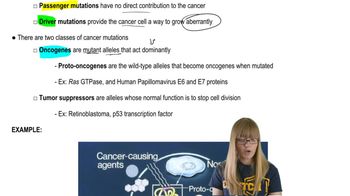
Cancer Mutations

Recombinant DNA Technology

Recombinant DNA technology involves combining DNA from different sources to create new genetic combinations. This technique is essential for isolating and characterizing genes, as it allows researchers to clone specific DNA fragments, such as the genomic clone suspected to contain the gene of interest. Mastery of this technology is vital for demonstrating the presence of the gene on the genomic clone through methods like gene mapping or functional assays.
추천 영상:
가이드 코스
03:51
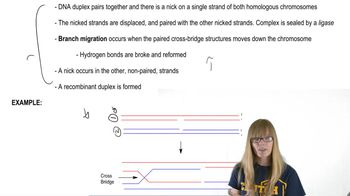
Recombination after Single Strand Breaks

Genomic Cloning

Genomic cloning is the process of isolating and amplifying a specific segment of DNA from an organism's genome. This technique is used to create a genomic library, which can be screened to find clones that contain genes of interest. To demonstrate that the gene responsible for the bristle patterning mutation is on the genomic clone, one could use techniques such as PCR amplification, sequencing, or complementation tests to confirm the presence and functionality of the gene within the clone.
추천 영상:
가이드 코스
07:
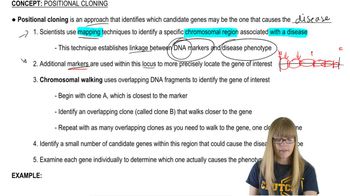
Positional Cloning
관련 실천
교과서 질문

Go to the website http://www.ncbi.nlm.nih.gov/omim and enter 'Lynch syndrome' in the Search box at the top of the page. From the list of options given, select '#120435—Lynch Syndrome.' Use the information you retrieve to answer the following questions. What are the approximate rates of cancer that develop in people carrying a mutation of one of these genes?

546
views
교과서 질문

The CBF genes of Arabidopsis are induced by exposure of the plants to low temperature. How would you examine the temporal and spatial patterns of expression after induction by low temperature?

676
views
교과서 질문

Go to the website http://www.ncbi.nlm.nih.gov/omim and enter 'Lynch syndrome' in the Search box at the top of the page. From the list of options given, select '#120435—Lynch Syndrome.' Use the information you retrieve to answer the following questions. Provide a brief summary of the normal functions of the protein products of these genes.

387
views
교과서 질문

Go to the website http://www.ncbi.nlm.nih.gov/omim and enter 'Lynch syndrome' in the Search box at the top of the page. From the list of options given, select '#120435—Lynch Syndrome.' Use the information you retrieve to answer the following questions. There are two types of Lynch syndrome. What are they?

456
views
교과서 질문

Genetic counseling has not been discussed in this chapter, but it is a service provided by trained professional counselors who also have detailed knowledge of medical genetics, as described in Application Chapter A. Genetic counselors provide details about gene mutations and have knowledge of most of the details of diseases associated with genetic abnormalities. With regard to genetic testing to identify one's personal risk of cancer, what are the three or four topics you think are most important to be able to discuss with a genetic counselor?

620
views
교과서 질문

The CBF genes of Arabidopsis are induced by exposure of the plants to low temperature. Can you design a method that would reveal these changes in gene expression in a way that a farmer could recognize them by observing plants growing in the field?

705
views