Ch. 15 - Recombinant DNA Technology and Its Applications
Sanders - Genetic Analysis: An Integrated Approach 3rd Edition
Sanders3rd EditionGenetic Analysis: An Integrated ApproachISBN: 9780135564172당신이 사용하는 게 아니라요?교과서 변경
15장, 문제 15b

The bacteriophage lambda genome can exist in either a linear form or a circular form.
Diagram the resulting fragments as they would appear on an agarose gel after electrophoresis.

검증된 단계별 안내
1
Understand the context: The bacteriophage lambda genome can exist in two forms—linear and circular. Linear DNA will produce distinct fragments when digested with restriction enzymes, while circular DNA may produce different patterns due to the absence of free ends.
Identify the restriction enzyme used: Determine which restriction enzyme is applied to the DNA. Each enzyme cuts at specific recognition sites, producing fragments of predictable sizes. For example, EcoRI recognizes the sequence GAATTC and cuts between G and A.
Predict the fragment sizes: For the linear form, calculate the sizes of fragments based on the known positions of restriction sites along the genome. Use the genome map to determine the distances between consecutive restriction sites.
Consider the circular form: In circular DNA, the restriction enzyme cuts at the same recognition sites, but the absence of free ends means the fragments may differ. For example, one fragment may represent the remainder of the circular genome after the first cut.
Diagram the gel: Represent the fragments as bands on an agarose gel. Larger fragments will migrate slower and appear closer to the top, while smaller fragments will migrate faster and appear closer to the bottom. Label the bands with their corresponding fragment sizes for both linear and circular forms.

비슷한 문제에 대한 검증된 영상 답변:

이 영상 해법은 위 문제에 도움이 된다고 튜터들이 추천한 것입니다.
영상 길이:
3m
도움이 되었나요?

주요 개념

질문에 올바르게 답하기 위해 반드시 이해해야 하는 핵심 개념들은 다음과 같습니다.

Bacteriophage Lambda Genome Structure

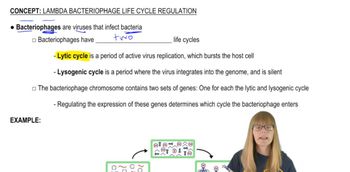
The bacteriophage lambda genome can exist in two forms: linear and circular. The linear form is typically found during the lytic cycle, where the virus injects its DNA into a host cell, while the circular form is associated with the lysogenic cycle, where the viral DNA integrates into the host genome. Understanding these forms is crucial for predicting how the DNA will behave during gel electrophoresis.
추천 영상:
가이드 코스
04:29
Bacteriophage Life Cycle

Gel Electrophoresis

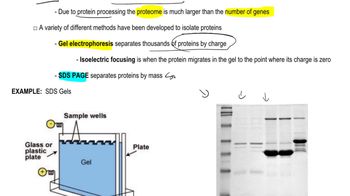
Gel electrophoresis is a technique used to separate DNA fragments based on their size. When an electric current is applied, negatively charged DNA moves towards the positive electrode, with smaller fragments migrating faster than larger ones. This method allows visualization of the DNA fragments, which is essential for analyzing the results of the bacteriophage lambda genome's different forms.
추천 영상:

Fragmentation Patterns

The fragmentation patterns of DNA during gel electrophoresis depend on the form of the genome and the restriction enzymes used. Linear DNA typically produces distinct bands corresponding to the sizes of the fragments generated, while circular DNA may appear as a single band or multiple bands depending on its conformation and any cuts made. Recognizing these patterns is key to accurately diagramming the results on an agarose gel.
추천 영상:
가이드 코스
11:19
Segmentation Genes
관련 실천
교과서 질문

To further analyze the CRABS CLAW gene, you create a map of the genomic clone. The 11-kb EcoRI fragment is ligated into the EcoRI site of the MCS of the vector shown in Problem 18. You digest the double-stranded form of the genome with several restriction enzymes and obtain the following results. Draw, as far as possible, a map of the genomic clone of CRABS CLAW.

What restriction digest would help resolve any ambiguity in the map?

438
views
교과서 질문

The bacteriophage ϕX174 has a single-stranded DNA genome of 5386 bases. During DNA replication, double-stranded forms of the genome are generated. In an effort to create a restriction map of ϕX174, you digest the z-stranded form of the genome with several restriction enzymes and obtain the following results. Draw a map of the ϕX174 genome.

645
views
교과서 질문
It is often desirable to insert cDNAs into a cloning vector in such a way that all the cDNA clones will have the same orientation with respect to the sequences of the plasmid. This is referred to as directional cloning. Outline how you would directionally clone a cDNA library in the plasmid vector pUC18.
724
views
교과서 질문

The bacteriophage lambda genome can exist in either a linear form or a circular form.

How many fragments will be formed by restriction enzyme digestion with XhoI alone, with XbaI alone, and with both XhoI and XbaI in the linear and circular forms of the lambda genome?

675
views
교과서 질문
A major advance in the 1980s was the development of technology to synthesize short oligonucleotides. This work both facilitated DNA sequencing and led to the advent of the development of PCR. Recently, rapid advances have occurred in the technology to chemically synthesize DNA, and sequences up to 10 kb are now readily produced. As this process becomes more economical, how will it affect the gene-cloning approaches outlined in this chapter? In other words, what types of techniques does this new technology have potential to supplant, and what techniques will not be affected by it?
729
views
교과서 질문

The restriction enzymes XhoI and SalI cut their specific sequences as shown below:

Can the sticky ends created by XhoI and SalI sites be ligated? If yes, can the resulting sequences be cleaved by either XhoI or SalI?

1563
views