Ch. 16 - Genomics: Genetics from a Whole-Genome Perspective
Sanders - Genetic Analysis: An Integrated Approach 3rd Edition
Sanders3rd EditionGenetic Analysis: An Integrated ApproachISBN: 9780135564172당신이 사용하는 게 아니라요?교과서 변경
16장, 문제 3b

When the whole-genome shotgun sequence of the Drosophila genome was assembled, it comprised 134 scaffolds made up of 1636 contigs. What is the difference between physical and sequence gaps?

검증된 단계별 안내
1
Understand the concept of a 'scaffold' in genome assembly: A scaffold is a series of contigs (continuous sequences of DNA) that are ordered and oriented based on additional information, such as paired-end reads or other mapping data.
Define a 'physical gap': Physical gaps occur when there is missing DNA sequence information between contigs. These gaps exist because the DNA fragments covering these regions were not sequenced or were not included in the assembly due to technical limitations.
Define a 'sequence gap': Sequence gaps occur when the DNA sequence is known to exist but cannot be accurately determined due to repetitive sequences, low-quality data, or other sequencing challenges. These gaps are often represented by 'N' in the assembled sequence.
Compare physical and sequence gaps: Physical gaps represent regions where no sequencing data is available, while sequence gaps represent regions where sequencing data exists but cannot be resolved into a clear sequence. Physical gaps are typically larger and may require additional experimental methods to close, whereas sequence gaps can often be resolved computationally or with improved sequencing techniques.
Relate the concepts to the Drosophila genome assembly: In the Drosophila genome assembly, the 134 scaffolds and 1636 contigs indicate that both physical and sequence gaps were present. Physical gaps would correspond to regions where contigs could not be connected, while sequence gaps would be within contigs where the sequence could not be fully resolved.

비슷한 문제에 대한 검증된 영상 답변:

이 영상 해법은 위 문제에 도움이 된다고 튜터들이 추천한 것입니다.
영상 길이:
1m
도움이 되었나요?

주요 개념

질문에 올바르게 답하기 위해 반드시 이해해야 하는 핵심 개념들은 다음과 같습니다.

Physical Gaps

Physical gaps refer to regions in a genome assembly where there is no sequence data available due to limitations in the sequencing technology or methodology. These gaps can occur when the DNA fragments used for sequencing do not overlap sufficiently, leaving portions of the genome unsequenced. Understanding physical gaps is crucial for assessing the completeness of a genome assembly.
추천 영상:
가이드 코스
11:19
Segmentation Genes

Sequence Gaps

Sequence gaps are specific areas within a genome assembly where the sequence is known to be incomplete or missing, often indicated by 'N' in the sequence data. These gaps can arise from repetitive regions that are difficult to sequence accurately or from errors during the assembly process. Identifying sequence gaps is important for evaluating the quality and accuracy of the assembled genome.
추천 영상:
가이드 코스
08:41
Sequencing Difficulties

Contigs and Scaffolds

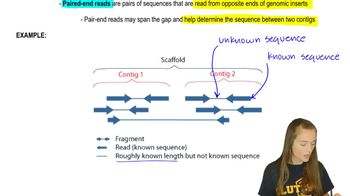
Contigs are contiguous sequences of DNA that have been assembled from overlapping fragments, representing a continuous stretch of the genome. Scaffolds, on the other hand, are larger structures that consist of multiple contigs linked together, often with gaps in between. Understanding the relationship between contigs and scaffolds is essential for interpreting genome assemblies and the presence of gaps.
추천 영상:
가이드 코스
04:17
Traditional vs. Next-Gen