Ch. 17 - Organelle Inheritance and the Evolution of Organelle Genomes
Sanders - Genetic Analysis: An Integrated Approach 3rd Edition
Sanders3rd EditionGenetic Analysis: An Integrated ApproachISBN: 9780135564172당신이 사용하는 게 아니라요?교과서 변경
17장, 문제 9

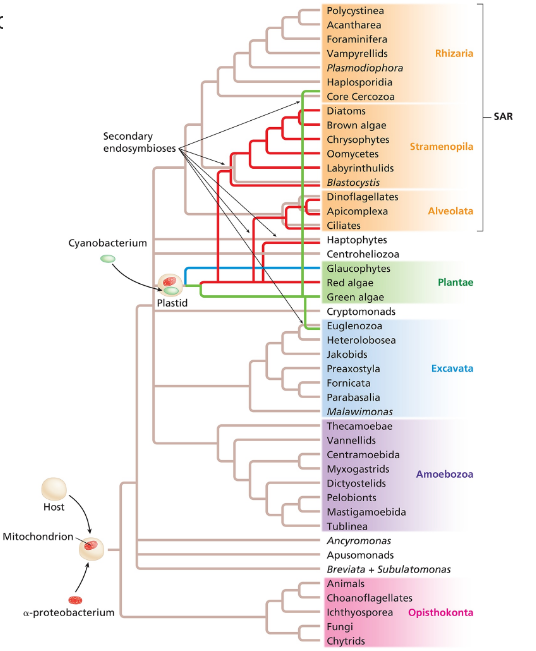
Consider the phylogenetic tree presented in the following figure (Figure 17.17). How were the origins of secondary endosymbiosis in the brown algae determined?
Phylogenetic tree illustrating secondary endosymbiosis origins in brown algae and related organisms.

검증된 단계별 안내
1
Examine the phylogenetic tree in Figure 17.17 to identify the placement of brown algae and their evolutionary relationships with other organisms.
Understand the concept of secondary endosymbiosis, which occurs when a eukaryotic organism engulfs another eukaryotic organism that has already undergone primary endosymbiosis, leading to the acquisition of additional organelles such as chloroplasts.
Analyze the genetic and molecular evidence, such as the presence of specific genes or DNA sequences in brown algae, that indicate the origin of their chloroplasts through secondary endosymbiosis.
Compare the chloroplasts of brown algae with those of other groups, such as red algae and green algae, to determine the likely ancestral lineage of the engulfed eukaryote.
Use the branching patterns and shared genetic markers in the phylogenetic tree to trace the evolutionary events that led to the secondary endosymbiosis in brown algae, identifying the timing and relationships with other lineages.

비슷한 문제에 대한 검증된 영상 답변:

이 영상 해법은 위 문제에 도움이 된다고 튜터들이 추천한 것입니다.
영상 길이:
2m

주요 개념

질문에 올바르게 답하기 위해 반드시 이해해야 하는 핵심 개념들은 다음과 같습니다.

Phylogenetic Trees

Phylogenetic trees are diagrams that represent the evolutionary relationships among various biological species based on their genetic characteristics. They illustrate how species diverged from common ancestors over time, allowing scientists to trace lineage and understand evolutionary history. In the context of secondary endosymbiosis, these trees help identify the relationships between brown algae and their ancestral lineages.
추천 영상:
가이드 코스
08:16
Phylogenetic Trees

Secondary Endosymbiosis

Secondary endosymbiosis refers to the process where a eukaryotic cell engulfs another eukaryotic cell that has already undergone primary endosymbiosis, leading to the development of complex organelles like chloroplasts. This phenomenon is crucial in the evolution of certain groups, such as brown algae, as it allows them to acquire photosynthetic capabilities from their engulfed algal ancestors. Understanding this process is key to analyzing the origins of brown algae.
추천 영상:
가이드 코스
04:11
Organelle DNA Characteristics

Molecular Phylogenetics

Molecular phylogenetics is a technique that uses genetic data, such as DNA or RNA sequences, to infer the evolutionary relationships among organisms. By comparing genetic material, researchers can determine how closely related different species are and trace the history of traits like secondary endosymbiosis. This approach provides insights into the timing and nature of evolutionary events, including those that led to the origins of brown algae.
추천 영상:
가이드 코스
08:16
Phylogenetic Trees
관련 실천
교과서 질문

What type or types of inheritance are consistent with the following pedigree? 

508
views
교과서 질문

Outline the steps required for a gene originally present in the endosymbiont genome to be transferred to the nuclear genome and be expressed, and for its product to be targeted back to the organelle of origin.

521
views
교과서 질문

You are a genetic counselor, and several members of the family whose pedigree for an inherited disorder is depicted in Genetic Analysis 17.2 consult with you about the probability that their progeny may be afflicted. What advice would you give individuals III-1, III-2, III-4, III-6, III-8, and III-9?

836
views
교과서 질문

A mutation in Arabidopsis immutans results in the necrosis (death) of tissues in a mosaic configuration. Examination of the mitochondrial DNA detects deletions of various regions of the mitochondrial genome in the tissues that are necrotic. When immutans plants are crossed with wild-type plants, the  are wild type, and the  are wild type and immutans in a 3:1 ratio. Explain the inheritance of the immutans mutation and a possible origin of the mitochondrial DNA deletions.

462
views
교과서 질문

What are the differences between the universal code and that found in the mitochondria of some species? Given that some changes (UGA =stop→Trp) have occurred multiple independent times in evolution, can you think of any selective advantage to the mitochondrial code?

789
views
교과서 질문

What is the evidence that the ancient mitochondrial and chloroplast endosymbionts are related to the alphaproteobacteria and cyanobacteria, respectively?

552
views