
Ch. 18 - Developmental Genetics
Sanders - Genetic Analysis: An Integrated Approach 3rd Edition
Sanders3rd EditionGenetic Analysis: An Integrated ApproachISBN: 9780135564172당신이 사용하는 게 아니라요?교과서 변경
18장, 문제 2

Bird beaks develop from an embryonic group of cells called neural crest cells that are part of the neural tube, which gives rise to the spinal column and related structures. Amazingly, neural crest cells can be surgically transplanted from one embryo to another, even between embryos of different species. When quail neural crest cells were transplanted into duck embryos, the beak of the host embryo developed into a shape similar to that found in quails, creating the 'quck.' Duck cells were recruited in addition to the quail cells to form part of the quck beak. Conversely, when duck neural crest cells were transplanted into quail embryos, the beak of the embryo resembled that of a duck, creating a 'duail,' and quail cells were recruited to form part of the beak. What do these experiments tell you about the autonomy or nonautonomy of the transplanted and host cells during beak development?

검증된 단계별 안내
1
Understand the concept of cell autonomy: Cell autonomy refers to whether a cell's fate and behavior are determined by its own genetic programming (autonomous) or influenced by external signals from its environment (nonautonomous).
Analyze the experiment where quail neural crest cells were transplanted into duck embryos: The resulting 'quck' beak resembled the quail beak, indicating that the transplanted quail cells retained their intrinsic genetic programming to shape the beak. This suggests that the quail cells are largely autonomous in determining beak shape.
Consider the recruitment of duck cells in the 'quck' beak: The fact that duck cells were recruited to form part of the quck beak indicates that the transplanted quail cells influenced the duck cells. This suggests that the quail cells exerted nonautonomous effects on the duck cells, guiding their contribution to the beak structure.
Analyze the experiment where duck neural crest cells were transplanted into quail embryos: The resulting 'duail' beak resembled the duck beak, indicating that the transplanted duck cells retained their intrinsic programming to shape the beak. This again suggests that the transplanted cells are largely autonomous in determining beak shape.
Summarize the findings: These experiments demonstrate that the transplanted neural crest cells are primarily autonomous in determining the overall shape of the beak, but they also exhibit nonautonomous effects by influencing the host cells to contribute to the beak's development.

비슷한 문제에 대한 검증된 영상 답변:

이 영상 해법은 위 문제에 도움이 된다고 튜터들이 추천한 것입니다.
영상 길이:
2m
도움이 되었나요?

주요 개념

질문에 올바르게 답하기 위해 반드시 이해해야 하는 핵심 개념들은 다음과 같습니다.

Neural Crest Cells

Neural crest cells are a unique group of cells that emerge from the neural tube during embryonic development. They are multipotent, meaning they can differentiate into various cell types, including those that form facial structures like beaks. Their ability to migrate and contribute to different tissues is crucial for understanding how physical traits develop and can be influenced by genetic and environmental factors.
추천 영상:
가이드 코스
03:52
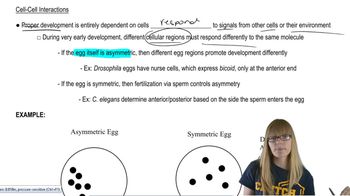
Cell-cell interactions

Cell Autonomy vs. Nonautonomy

Cell autonomy refers to the ability of a cell to develop and function independently, without influence from neighboring cells. In contrast, nonautonomy indicates that a cell's fate and behavior are influenced by its environment or surrounding cells. The experiments with quail and duck neural crest cells illustrate these concepts, as the transplanted cells can dictate the beak shape, suggesting a level of nonautonomy in the host cells' development.
추천 영상:
가이드 코스
03:52
Cell-cell interactions

Transplantation Experiments

Transplantation experiments involve moving cells or tissues from one organism to another to study developmental processes and cellular interactions. In the context of the beak development experiments, these transplants reveal how donor cells can influence the morphology of the host organism, providing insights into the genetic and developmental mechanisms that govern physical traits and the plasticity of embryonic development.
추천 영상:
가이드 코스
08:06
Mendel's Experiments