Ch. 18 - Developmental Genetics
Sanders - Genetic Analysis: An Integrated Approach 3rd Edition
Sanders3rd EditionGenetic Analysis: An Integrated ApproachISBN: 9780135564172당신이 사용하는 게 아니라요?교과서 변경
18장, 문제 18

The bristles that develop from the epidermis in Drosophila are evenly spaced, so that two bristles never occur immediately adjacent to each other. How might this pattern be established during development?

검증된 단계별 안내
1
Step 1: Understand the concept of lateral inhibition. Lateral inhibition is a process where a cell, once it starts to differentiate into a particular type, sends inhibitory signals to its neighboring cells to prevent them from adopting the same fate.
Step 2: Consider the role of Notch signaling pathway. In Drosophila, the Notch signaling pathway is crucial for lateral inhibition. It helps in the communication between adjacent cells to ensure that they do not differentiate into the same type of cell, such as bristle cells.
Step 3: Explore the role of proneural clusters. During development, groups of cells called proneural clusters have the potential to become bristle cells. However, only one cell from each cluster will become a bristle cell, while the others will be inhibited.
Step 4: Analyze the selection of the sensory organ precursor (SOP) cell. Within each proneural cluster, one cell is selected to become the SOP cell, which will eventually develop into a bristle. This selection is influenced by the Notch signaling pathway, which ensures that only one cell in the cluster becomes the SOP.
Step 5: Examine the spatial patterning. The even spacing of bristles is a result of the lateral inhibition and the selection of SOP cells. As each SOP cell inhibits its neighbors, it ensures that no two bristles form adjacent to each other, leading to the characteristic pattern seen in Drosophila.

비슷한 문제에 대한 검증된 영상 답변:

이 영상 해법은 위 문제에 도움이 된다고 튜터들이 추천한 것입니다.
영상 길이:
3m
도움이 되었나요?

주요 개념

질문에 올바르게 답하기 위해 반드시 이해해야 하는 핵심 개념들은 다음과 같습니다.

Pattern Formation

Pattern formation refers to the biological processes that lead to the spatial organization of cells and tissues during development. In Drosophila, this involves the regulation of gene expression and cell signaling pathways that dictate where and how structures like bristles will form. Understanding how these patterns emerge is crucial for explaining the even spacing of bristles.
추천 영상:
가이드 코스
04:06
Formation of Plant Gametes

Cell Communication

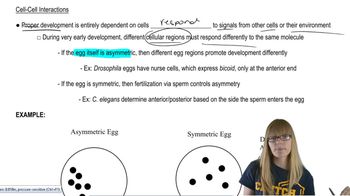
Cell communication is essential for coordinating developmental processes. In Drosophila, cells communicate through signaling molecules that influence neighboring cells' behavior, ensuring that bristles are spaced apart. This communication can involve mechanisms such as lateral inhibition, where a cell inhibits its neighbors from adopting the same fate, thus preventing adjacent bristles.
추천 영상:
가이드 코스
03:52
Cell-cell interactions

Genetic Regulation

Genetic regulation involves the control of gene expression that determines the characteristics of an organism. In the context of Drosophila bristle development, specific genes are activated or repressed to establish the pattern of bristle formation. Understanding the genetic pathways and regulatory networks that govern this process is key to explaining how the even spacing of bristles is achieved.
추천 영상:
관련 실천
교과서 질문

A powerful approach to identifying genes of a developmental pathway is to screen for mutations that suppress or enhance the phenotype of interest. This approach was undertaken to elucidate the genetic pathway controlling C. elegans vulval development. A lin-3 loss-of-function mutant with a vulva-less phenotype was mutagenized. Based on your knowledge of the genetic pathway, what types of mutations will suppress the vulva-less phenotype?

581
views
교과서 질문

In contrast to Drosophila, some insects (e.g., centipedes) have legs on almost every segment posterior to the head. Based on your knowledge of Drosophila, propose a genetic explanation for this phenotype, and describe the expected expression patterns of genes of the Antennapedia and bithorax complexes.

361
views
교과서 질문

The pair-rule gene fushi tarazu is expressed in the seven even-numbered parasegments during Drosophila embryogenesis. In contrast, the segment polarity gene engrailed is expressed in the anterior part of each of the 14 parasegments. Since both genes are active at similar times and places during development, it is possible that the expression of one gene is required for the expression of the other. This can be tested by examining expression of the genes in a mutant background—for example, looking at fushi tarazu expression in an engrailed mutant background, and vice versa. Given the hierarchy of gene action during Drosophila embryogenesis, what might you predict to be the result of these experiments?

564
views
교과서 질문

The pair-rule gene fushi tarazu is expressed in the seven even-numbered parasegments during Drosophila embryogenesis. In contrast, the segment polarity gene engrailed is expressed in the anterior part of each of the 14 parasegments. Since both genes are active at similar times and places during development, it is possible that the expression of one gene is required for the expression of the other. This can be tested by examining the expression of the genes in a mutant background—for example, looking at fushi tarazu expression in an engrailed mutant background, and vice versa. Based on your prediction, can you predict the phenotype of the fushi tarazu and engrailed double mutant?

481
views
교과서 질문

You are traveling in the Netherlands and overhear a tulip breeder describe a puzzling event. Tulips normally have two outer whorls of brightly colored petal-like organs, a third whorl of stamens, and an inner (fourth) whorl of carpels. However, the breeder found a recessive mutant in his field in which the outer two whorls were green and sepal-like, whereas the third and fourth whorls both contained carpels. What can you speculate about the nature of the gene that was mutated?

411
views
교과서 질문

A powerful approach to identifying genes of a developmental pathway is to screen for mutations that suppress or enhance the phenotype of interest. This approach was undertaken to elucidate the genetic pathway controlling C. elegans vulval development. In a complementary experiment, a gain-of-function let-23 mutant with a multi-vulva phenotype was also mutagenized. What types of mutations will suppress the multi-vulva phenotype?

563
views