Ch. 19 - Genetic Analysis of Quantitative Traits
Sanders - Genetic Analysis: An Integrated Approach 3rd Edition
Sanders3rd EditionGenetic Analysis: An Integrated ApproachISBN: 9780135564172당신이 사용하는 게 아니라요?교과서 변경
19장, 문제 14

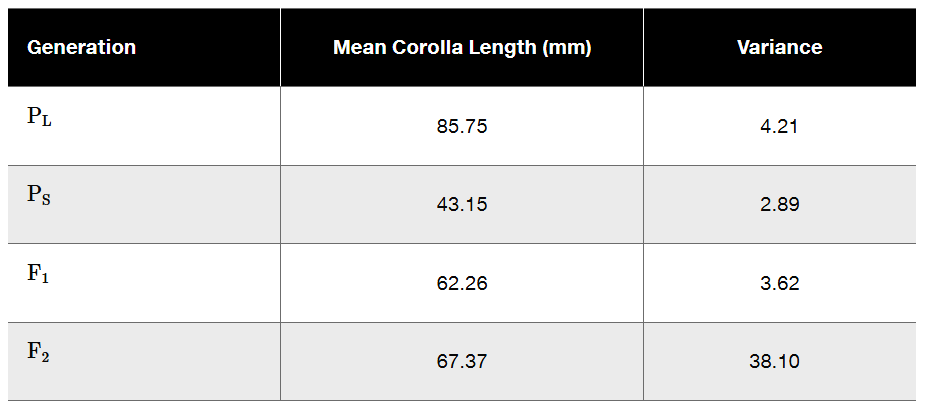
In Nicotiana, two inbred strains produce long (PL) and short (PS) corollas. These lines are crossed to produce F₁, and the F₁ are crossed to produce F₂ plants in which corolla length and variance are measured. The following table summarizes the mean and variance of corolla length in each generation. Calculate H² for corolla length in Nicotiana.
Table displaying mean corolla length and variance for Nicotiana generations PL, PS, F₁, and F₂.

검증된 단계별 안내
1
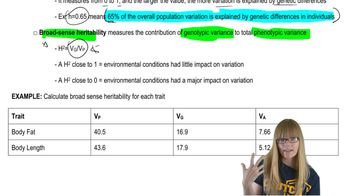
Step 1: Understand the concept of broad-sense heritability (H²). Broad-sense heritability is calculated using the formula: H2=VGTVPT, where VGT is the genetic variance and VPT is the phenotypic variance.
Step 2: Identify the phenotypic variance (VPT) from the F₂ generation. According to the table, the phenotypic variance in the F₂ generation is 38.10 mm².
Step 3: Calculate the environmental variance (VET). The environmental variance can be estimated from the F₁ generation, as F₁ plants are genetically uniform. Therefore, the variance in the F₁ generation (3.62 mm²) is considered the environmental variance.
Step 4: Determine the genetic variance (VGT) using the formula: VGT=VPT-VET. Subtract the environmental variance (3.62 mm²) from the phenotypic variance (38.10 mm²) to find the genetic variance.
Step 5: Calculate H² using the formula: H2=VGTVPT. Divide the genetic variance by the phenotypic variance to determine the broad-sense heritability for corolla length in Nicotiana.

비슷한 문제에 대한 검증된 영상 답변:

이 영상 해법은 위 문제에 도움이 된다고 튜터들이 추천한 것입니다.
영상 길이:
1m

주요 개념

질문에 올바르게 답하기 위해 반드시 이해해야 하는 핵심 개념들은 다음과 같습니다.

Heritability (H²)

Heritability (H²) is a measure used in genetics to quantify the proportion of phenotypic variance in a trait that can be attributed to genetic variance among individuals in a population. It is calculated using the formula H² = Vg / Vp, where Vg is the genetic variance and Vp is the total phenotypic variance. Understanding heritability helps in predicting how traits may respond to selection and informs breeding strategies.
추천 영상:
가이드 코스
07:04
Calculating Heritability

Phenotypic Variance (Vp)

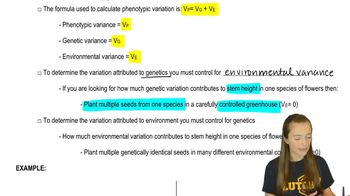
Phenotypic variance (Vp) refers to the total variance observed in a trait within a population, which includes both genetic variance (Vg) and environmental variance (Ve). It is essential to distinguish between these components to understand how much of the observed variation is due to genetic differences versus environmental influences. In the context of the question, Vp is derived from the variances of the parental and F1 and F2 generations.
추천 영상:
가이드 코스
08:34
Analyzing Trait Variance

Genetic Variance (Vg)

Genetic variance (Vg) is the portion of phenotypic variance that is attributable to genetic differences among individuals. It can be further divided into additive genetic variance, dominance variance, and interaction variance. In the context of the Nicotiana example, calculating Vg involves analyzing the differences in mean corolla lengths between the parental strains and their offspring, which helps in understanding the heritable component of the trait.
추천 영상:
가이드 코스
08:34
Analyzing Trait Variance
관련 실천
교과서 질문

In a line of cherry tomatoes, the average fruit weight is 16 g. A plant producing tomatoes with an average weight of 12 g is used in one self-fertilization cross to produce a line of smaller tomatoes, and a plant producing tomatoes of 24 g is used in a second cross to produce larger tomatoes. If narrow sense heritability (h²) for this trait is 0.80, what are the expected responses to selection (R) for fruit weight in the crosses?

434
views
교과서 질문

Two inbred lines of sunflowers (P₁ and P₂) produce different total weights of seeds per flower head. The mean weight of seeds (grams) and the variance of seed weights in different generations are as follows:

Use the information above to determine VG, VE, and VP for this trait.


595
views
교과서 질문

In a line of cherry tomatoes, the average fruit weight is 16 g. A plant producing tomatoes with an average weight of 12 g is used in one self-fertilization cross to produce a line of smaller tomatoes, and a plant producing tomatoes of 24 g is used in a second cross to produce larger tomatoes. What is the selection differential (S) for fruit weight in each cross?

438
views
교과서 질문

In selective breeding experiments, it is frequently observed that the strains respond to artificial selection for many generations, with the selected phenotype changing in the desired direction. Often, however, the response to artificial selection reaches a plateau after many generations, and the phenotype no longer changes as it did in past generations. Once a plateau has been reached, is the heritability of the trait very high or is it very low? Explain.

547
views
교과서 질문

Suppose the length of maize ears has narrow sense heritability (h²) of 0.70. A population produces ears that have an average length of 28 cm, and from this population a breeder selects a plant producing 34-cm ears to cross by self-fertilization. Predict the selection differential (S) and the response to selection (R) for this cross.

402
views
교과서 질문

What is a quantitative trait locus (QTL)? Suppose you wanted to search for QTLs influencing fruit size in tomatoes. Describe the general structure of a QTL experiment, including the kind of tomato strains you would use, how molecular markers should be distributed in the genome, how the genetic marker alleles should differ between the two strains, and how you would use the F₁ progeny in a subsequent cross to obtain information about the possible location(s) of QTLs of interest.

760
views