Ch. 19 - Genetic Analysis of Quantitative Traits
Sanders - Genetic Analysis: An Integrated Approach 3rd Edition
Sanders3rd EditionGenetic Analysis: An Integrated ApproachISBN: 9780135564172당신이 사용하는 게 아니라요?교과서 변경
19장, 문제 11a

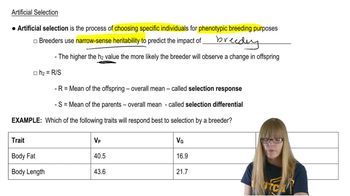
In selective breeding experiments, it is frequently observed that the strains respond to artificial selection for many generations, with the selected phenotype changing in the desired direction. Often, however, the response to artificial selection reaches a plateau after many generations, and the phenotype no longer changes as it did in past generations. What is the genetic explanation for the plateau phenomenon?

검증된 단계별 안내
1
Understand that artificial selection involves choosing individuals with desirable traits to reproduce, thereby increasing the frequency of alleles associated with those traits in the population over generations.
Recognize that the plateau phenomenon occurs when the response to selection diminishes and eventually stops, meaning the phenotype no longer changes significantly despite continued selection.
Explain that one genetic reason for the plateau is the depletion of genetic variation. Over successive generations, alleles contributing to the selected trait may become fixed (reach a frequency of 1), leaving no further genetic variation for selection to act upon.
Consider the role of natural selection and pleiotropy. Some alleles that enhance the selected trait may have negative effects on other traits or overall fitness, leading to a balance between artificial selection and natural selection pressures.
Discuss the possibility of reaching a physiological or developmental limit. Even if genetic variation remains, the phenotype may reach a biological constraint where further improvement is not possible due to the organism's inherent limitations.

비슷한 문제에 대한 검증된 영상 답변:

이 영상 해법은 위 문제에 도움이 된다고 튜터들이 추천한 것입니다.
영상 길이:
3m
도움이 되었나요?

주요 개념

질문에 올바르게 답하기 위해 반드시 이해해야 하는 핵심 개념들은 다음과 같습니다.

Artificial Selection

Artificial selection is a process in which humans intentionally breed individuals with desirable traits to produce offspring that exhibit those traits. This method is commonly used in agriculture and animal husbandry to enhance specific characteristics, such as size, yield, or temperament. Over generations, this selective pressure can lead to significant changes in the phenotype of a population.
추천 영상:
가이드 코스
04:15
Artificial Selection

Genetic Variation

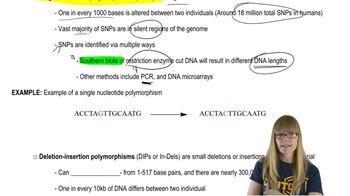
Genetic variation refers to the differences in DNA sequences among individuals within a population. This variation is crucial for evolution and selective breeding, as it provides the raw material for selection to act upon. When a population is subjected to artificial selection, the initial genetic diversity allows for rapid changes in phenotype, but as the most favorable alleles become fixed, the available genetic variation diminishes, leading to a plateau in further changes.
추천 영상:
가이드 코스
09:28
Genomic Variation

Genetic Drift and Fixation

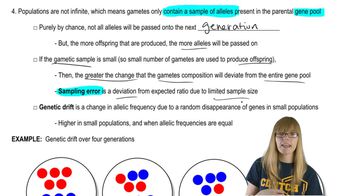
Genetic drift is a mechanism of evolution that causes allele frequencies to change randomly over time, particularly in small populations. As certain traits are selected for, alleles associated with those traits may become fixed, meaning they reach a frequency of 100% in the population. Once fixation occurs, the potential for further phenotypic change diminishes, contributing to the plateau effect observed in selective breeding experiments.
추천 영상:
관련 실천
교과서 질문

Three pairs of genes with two alleles each (A₁ and A₂, B₁ and B₂, and C₁ and C₂) control the height of a plant. The alleles of these genes have an additive relationship: Each copy of alleles A₁, B₁, and C₁ contributes 6 cm to plant height, and each copy of alleles A₂, B₂, and C₂ contributes 3 cm. Identify the number of different genotypes that are possible with these three genes.

570
views
교과서 질문

Two inbred lines of sunflowers (P₁ and P₂) produce different total weights of seeds per flower head. The mean weight of seeds (grams) and the variance of seed weights in different generations are as follows:

Use the information above to determine VG, VE, and VP for this trait.


595
views
교과서 질문

Three pairs of genes with two alleles each (A₁ and A₂, B₁ and B₂, and C₁ and C₂) control the height of a plant. The alleles of these genes have an additive relationship: Each copy of alleles A₁, B₁, and C₁ contributes 6 cm to plant height, and each copy of alleles A₂, B₂, and C₂ contributes 3 cm. Identify the number of different phenotypes (expected plant heights) that are possible with these three genes.

548
views
교과서 질문

In selective breeding experiments, it is frequently observed that the strains respond to artificial selection for many generations, with the selected phenotype changing in the desired direction. Often, however, the response to artificial selection reaches a plateau after many generations, and the phenotype no longer changes as it did in past generations. Once a plateau has been reached, is the heritability of the trait very high or is it very low? Explain.

547
views
교과서 질문

What is a quantitative trait locus (QTL)? Suppose you wanted to search for QTLs influencing fruit size in tomatoes. Describe the general structure of a QTL experiment, including the kind of tomato strains you would use, how molecular markers should be distributed in the genome, how the genetic marker alleles should differ between the two strains, and how you would use the F₁ progeny in a subsequent cross to obtain information about the possible location(s) of QTLs of interest.

760
views
교과서 질문

Three pairs of genes with two alleles each (A₁ and A₂, B₁ and B₂, and C₁ and C₂) control the height of a plant. The alleles of these genes have an additive relationship: Each copy of alleles A₁, B₁, and C₁ contributes 6 cm to plant height, and each copy of alleles A₂, B₂, and C₂ contributes 3 cm. Identify all possible genotypes for plants with an expected height of 33 cm.

524
views