Ch. 19 - Genetic Analysis of Quantitative Traits
Sanders - Genetic Analysis: An Integrated Approach 3rd Edition
Sanders3rd EditionGenetic Analysis: An Integrated ApproachISBN: 9780135564172당신이 사용하는 게 아니라요?교과서 변경
19장, 문제 28

Suppose the mature height of a plant is a multifactorial trait under the control of five independently assorting genes, designated A, B, C, D, and E, and five environmental factors. There are two alleles of each gene (A₁, A₂, etc.). Each allele with a subscript 1 (i.e., A₁) contributes 5 cm to potential plant height, and each allele with a 2 subscript (i.e., A₂, etc.) contributes 10 cm to potential plant height. In other words, a genotype containing only 1 alleles (A₁A₁B₁B₁C₁C₁D₁D₁E₁E₁) would have a potential height of [(10)(5)]=50cm, and a genotype with only 2 alleles (A₂A₂B₂B₂C₂C₂D₂D₂E₂E₂) would have a potential height of [(10)(10)]=100cm. The five environmental factors are (1) amount of water, (2) amount of sunlight, (3) soil drainage, (4) nutrient content of soil, and (5) temperature. Each environmental factor can vary from optimal to poor. If all factors are optimal, assume that full potential height is attained. However, if one or more of the environmental factors is less than optimal, then height is reduced. The state of each environmental factor has an effect on growth. In this exercise, we'll assume that the growth is affected according to the following scale: Environmental Factor State Height Lost Optimal (O) 0 cm Good (G) 4 cm Fair (F) 8 cm Marginal (M) 12 cm Poor (P) 16 cm Thus, for example, if one environmental factor is optimal, two are good, one is fair, and one is marginal, the loss of potential height is . If the loss of height potential is greater than the height potential of the plant, the plant does not survive. List two genotypes that have a height potential of 80 cm.

검증된 단계별 안내
1
Step 1: Understand that each gene has two alleles, A₁ and A₂, where A₁ contributes 5 cm and A₂ contributes 10 cm to the plant's potential height.
Step 2: Calculate the total potential height for a genotype by summing the contributions of all alleles across the five genes (A, B, C, D, E).
Step 3: To achieve a height potential of 80 cm, determine combinations of alleles that sum to 80 cm. For example, a combination of 8 alleles contributing 10 cm and 2 alleles contributing 5 cm will result in 80 cm.
Step 4: Consider possible genotypes such as A₂A₂B₂B₂C₂C₂D₂D₁E₁E₁, where the sum of contributions from A₂, B₂, C₂, and D₂ is 70 cm, and D₁ and E₁ contribute 10 cm.
Step 5: Verify another genotype like A₂A₂B₂B₂C₁C₁D₂D₂E₂E₂, ensuring the total contribution from the alleles equals 80 cm, with a different combination of A₁ and A₂ alleles.

비슷한 문제에 대한 검증된 영상 답변:

이 영상 해법은 위 문제에 도움이 된다고 튜터들이 추천한 것입니다.
영상 길이:
2m
도움이 되었나요?

주요 개념

질문에 올바르게 답하기 위해 반드시 이해해야 하는 핵심 개념들은 다음과 같습니다.

Multifactorial Traits

Multifactorial traits are characteristics influenced by multiple genes and environmental factors. In this case, the mature height of the plant is determined by five genes, each with two alleles, and five environmental conditions. Understanding how these factors interact is crucial for predicting the phenotypic outcome, as both genetic makeup and environmental influences contribute to the final trait expression.
추천 영상:
가이드 코스
13:40
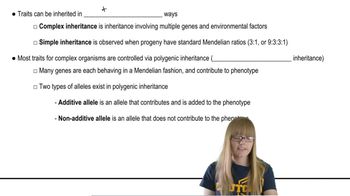
Traits and Variance

Genotype and Phenotype

The genotype refers to the genetic constitution of an organism, while the phenotype is the observable physical or biochemical characteristics resulting from the genotype and environmental interactions. In this scenario, the potential height of the plant is a phenotype determined by the specific alleles present in the genotype, which can be calculated based on the contributions of each allele to the overall height.
추천 영상:
가이드 코스
07:52
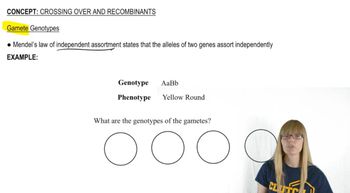
Gamete Genotypes

Environmental Impact on Growth

Environmental factors significantly affect the growth and development of organisms, including plants. In this question, various states of environmental factors (optimal, good, fair, marginal, poor) lead to specific reductions in height potential. Understanding how these factors interact with genetic potential is essential for predicting the actual height a plant can achieve under varying conditions.
추천 영상:
관련 실천
교과서 질문

Answer the following in regard to multifactorial traits in human twins. If the trait is produced with little contribution from genetic variation, what would you expect to see if you compared the concordance rates of MZ twins versus DZ twins? Explain your reasoning.

528
views
교과서 질문

Answer the following in regard to multifactorial traits in human twins. If the trait is substantially influenced by genes, would you expect the concordance rate to be higher in MZ twins or higher in DZ twins? Explain your reasoning.

363
views
교과서 질문
Suppose the mature height of a plant is a multifactorial trait under the control of five independently assorting genes, designated A, B, C, D, and E, and five environmental factors. There are two alleles of each gene (A₁, A₂, etc.). Each allele with a subscript 1 (i.e., A₁) contributes 5 cm to potential plant height, and each allele with a 2 subscript (i.e., A₂, etc.) contributes 10 cm to potential plant height. In other words, a genotype containing only 1 alleles (A₁A₁B₁B₁C₁C₁D₁D₁E₁E₁) would have a potential height of [(10)(5)]=50cm, and a genotype with only 2 alleles (A₂A₂B₂B₂C₂C₂D₂D₂E₂E₂) would have a potential height of [(10)(10)]=100cm. The five environmental factors are (1) amount of water, (2) amount of sunlight, (3) soil drainage, (4) nutrient content of soil, and (5) temperature. Each environmental factor can vary from optimal to poor. If all factors are optimal, assume that full potential height is attained. However, if one or more of the environmental factors is less than optimal, then height is reduced. The state of each environmental factor has an effect on growth. In this exercise, we'll assume that the growth is affected according to the following scale: Environmental Factor State Height Lost Optimal (O) 0 cm Good (G) 4 cm Fair (F) 8 cm Marginal (M) 12 cm Poor (P) 16 cm Thus, for example, if one environmental factor is optimal, two are good, one is fair, and one is marginal, the loss of potential height is . If the loss of height potential is greater than the height potential of the plant, the plant does not survive. How many 1 and 2 alleles must be present to give a height potential of 80 cm?
403
views
교과서 질문

Suppose the mature height of a plant is a multifactorial trait under the control of five independently assorting genes, designated A, B, C, D, and E, and five environmental factors. There are two alleles of each gene (A₁, A₂, etc.). Each allele with a subscript 1 (i.e., A₁) contributes 5 cm to potential plant height, and each allele with a subscript 2 (i.e., A₂, etc.) contributes 10 cm to potential plant height. In other words, a genotype containing only 1 allele (A₁A₁B₁B₁C₁C₁D₁D₁E₁E₁) would have a potential height of [(10)(5)]=50 cm, and a genotype with only 2 alleles (A₂A₂B₂B₂C₂C₂D₂D₂E₂E₂) would have a potential height of [(10)(10)]=100 cm. The five environmental factors are (1) amount of water, (2) amount of sunlight, (3) soil drainage, (4) nutrient content of soil, and (5) temperature. Each environmental factor can vary from optimal to poor. If all factors are optimal, assume that full potential height is attained. However, if one or more of the environmental factors is less than optimal, then height is reduced. The state of each environmental factor has an effect on growth. In this exercise, we'll assume that the growth is affected according to the following scale:

Thus, for example, if one environmental factor is optimal, two are good, one is fair, and one is marginal, the loss of potential height is 0 + 4 + 4 + 8 + 12 = 28 cm. If the loss of height potential is greater than the height potential of the plant, the plant does not survive. If two plants that each have a height potential of 75 cm are crossed, what proportion of the progeny will have a height potential of 80 cm?.

409
views
교과서 질문

Suppose the mature height of a plant is a multifactorial trait under the control of five independently assorting genes, designated A, B, C, D, and E, and five environmental factors. There are two alleles of each gene (A₁, A₂, etc.). Each allele with a subscript 1 (i.e., A₁) contributes 5 cm to potential plant height, and each allele with a subscript 2 (i.e., A₂, etc.) contributes 10 cm to potential plant height. In other words, a genotype containing only 1 allele (A₁A₁B₁B₁C₁C₁D₁D₁E₁E₁) would have a potential height of [(10)(5)]=50 cm, and a genotype with only 2 alleles (A₂A₂B₂B₂C₂C₂D₂D₂E₂E₂) would have a potential height of [(10)(10)]=100 cm. The five environmental factors are (1) amount of water, (2) amount of sunlight, (3) soil drainage, (4) nutrient content of soil, and (5) temperature. Each environmental factor can vary from optimal to poor. If all factors are optimal, assume that full potential height is attained. However, if one or more of the environmental factors is less than optimal, then height is reduced. The state of each environmental factor has an effect on growth. In this exercise, we'll assume that the growth is affected according to the following scale:

Thus, for example, if one environmental factor is optimal, two are good, one is fair, and one is marginal, the loss of potential height is 0 + 4 + 4 + 8 + 12 = 28 cm. If the loss of height potential is greater than the height potential of the plant, the plant does not survive. Calculate the potential height, based on inherited alleles, and the attained height, based on growth in the environmental circumstances given, for the three plants (a, b, and c) in the accompanying table.

606
views
교과서 질문
A three-gene system of additive genes (A, B, and C) controls plant height. Each gene has two alleles (A and a, B and b, and C and c). There is dominance among the alleles of each gene, with alleles A, B, and C dominant over a, b, and c. Under this scheme, the dominant genotype for a gene contributes 10 cm to height potential, and the recessive genotype contributes 4 cm. What is the height potential of a plant that is homozygous for all three recessive alleles?
633
views