Ch. 2 - Transmission Genetics
Sanders - Genetic Analysis: An Integrated Approach 3rd Edition
Sanders3rd EditionGenetic Analysis: An Integrated ApproachISBN: 9780135564172당신이 사용하는 게 아니라요?교과서 변경
2장, 문제 A.6

A 40-year-old woman whose father had Huntington disease currently shows no symptoms of the disease. She is newly pregnant with her first child and seeks your best estimate of the chance her child will inherit the disease. What is your estimate and how did you arrive at it? (Hint: See Figure 4.11)

검증된 단계별 안내
1
Understand that Huntington disease is an autosomal dominant disorder, meaning only one copy of the mutated gene is needed for the disease to manifest.
Since the woman's father had Huntington disease, he must have had one mutated allele (H) and one normal allele (h), so his genotype is likely Hh.
The woman currently shows no symptoms, but because Huntington disease has late onset and incomplete penetrance, she could still be a carrier with genotype Hh or be hh (normal). The chance she inherited the mutated allele from her affected father is 50%, or 1/2.
If the woman is Hh, the chance of passing the mutated allele to her child is 50%, or 1/2. If she is hh, the chance is 0%.
To find the overall chance her child will inherit the disease, multiply the probability the woman is a carrier (1/2) by the probability she passes the mutated allele (1/2), resulting in an overall probability of \(\frac{1}{2}\) \(\times\) \(\frac{1}{2}\) = \(\frac{1}{4}\).

비슷한 문제에 대한 검증된 영상 답변:

이 영상 해법은 위 문제에 도움이 된다고 튜터들이 추천한 것입니다.
영상 길이:
3m
도움이 되었나요?

주요 개념

질문에 올바르게 답하기 위해 반드시 이해해야 하는 핵심 개념들은 다음과 같습니다.

Autosomal Dominant Inheritance

Huntington disease is inherited in an autosomal dominant pattern, meaning only one copy of the mutated gene from an affected parent is sufficient to cause the disease. Each child of an affected individual has a 50% chance of inheriting the mutation and developing the disorder.
추천 영상:
가이드 코스
04:37
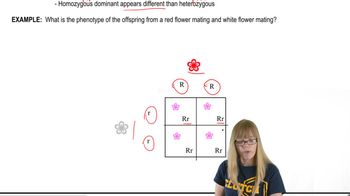
Variations on Dominance

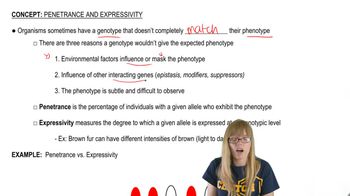
Penetrance and Age of Onset

Huntington disease shows age-dependent penetrance, often manifesting symptoms in mid-adulthood. A person may carry the mutation without symptoms early in life, so an asymptomatic 40-year-old with an affected parent could still carry the gene and develop symptoms later.
추천 영상:
가이드 코스
02:09
Penetrance and Expressivity

Risk Estimation Using Family History and Genetic Testing

Estimating the child's risk involves assessing the mother's probability of carrying the mutation based on her affected father and her current symptom-free status. Genetic testing can confirm her status, but without it, the risk to the child is half the mother's risk of being a carrier.
추천 영상:
가이드 코스
11:35
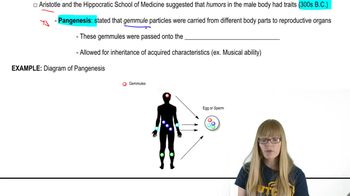
History of Genetics