Ch. 2 - Transmission Genetics
Sanders - Genetic Analysis: An Integrated Approach 3rd Edition
Sanders3rd EditionGenetic Analysis: An Integrated ApproachISBN: 9780135564172당신이 사용하는 게 아니라요?교과서 변경
2장, 문제 52a

In humans, the ability to bend the thumb back beyond vertical is called hitchhiker's thumb and is dominant to the inability to do so (OMIM 274200). Also, the presence of attached earlobes is recessive to unattached earlobes (OMIM 128900).
Check your own phenotype and those of several friends or classmates.

검증된 단계별 안내
1
Step 1: Understand the genetic traits described in the problem. Hitchhiker's thumb is a dominant trait, meaning individuals with at least one dominant allele (H) will exhibit this phenotype. Attached earlobes are recessive, meaning individuals need two recessive alleles (aa) to have this phenotype.
Step 2: Determine your own phenotype for both traits. For hitchhiker's thumb, check if you can bend your thumb back beyond vertical. For earlobes, check if they are attached or unattached.
Step 3: Record the phenotypes of several friends or classmates for both traits. Note whether they exhibit hitchhiker's thumb (dominant) or not (recessive), and whether their earlobes are attached (recessive) or unattached (dominant).
Step 4: Based on the observed phenotypes, infer possible genotypes. For hitchhiker's thumb, individuals with the dominant phenotype could have genotypes HH or Hh, while those with the recessive phenotype must have genotype hh. For earlobes, individuals with unattached earlobes could have genotypes AA or Aa, while those with attached earlobes must have genotype aa.
Step 5: Analyze the inheritance patterns. Consider how these traits might be passed from parents to offspring, using Punnett squares to predict the likelihood of different phenotypes in future generations based on the genotypes of the parents.

비슷한 문제에 대한 검증된 영상 답변:

이 영상 해법은 위 문제에 도움이 된다고 튜터들이 추천한 것입니다.
영상 길이:
4m
도움이 되었나요?

주요 개념

질문에 올바르게 답하기 위해 반드시 이해해야 하는 핵심 개념들은 다음과 같습니다.

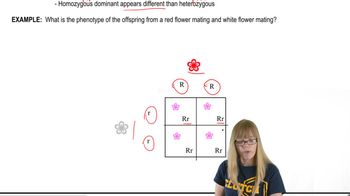
Dominant and Recessive Traits

In genetics, traits can be classified as dominant or recessive based on their expression in an organism. A dominant trait, such as hitchhiker's thumb, will manifest in the phenotype even if only one copy of the allele is present. In contrast, a recessive trait, like attached earlobes, requires two copies of the allele to be expressed. Understanding this distinction is crucial for predicting inheritance patterns.
추천 영상:
가이드 코스
04:37
Variations on Dominance

Phenotype vs. Genotype

The phenotype refers to the observable characteristics or traits of an organism, such as thumb flexibility or earlobe attachment, while the genotype is the genetic makeup that determines these traits. The relationship between genotype and phenotype is essential for understanding how traits are inherited and expressed in individuals. Analyzing phenotypes in a population can provide insights into the underlying genotypes.
추천 영상:
가이드 코스
07:52
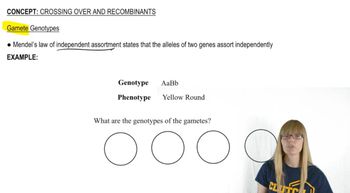
Gamete Genotypes

Punnett Squares

Punnett squares are a tool used in genetics to predict the probability of an offspring inheriting particular traits based on the genotypes of the parents. By organizing the possible combinations of alleles, Punnett squares help visualize the inheritance patterns of dominant and recessive traits. This method is particularly useful for understanding the likelihood of traits like hitchhiker's thumb and earlobe attachment appearing in offspring.
추천 영상:
가이드 코스
18:27
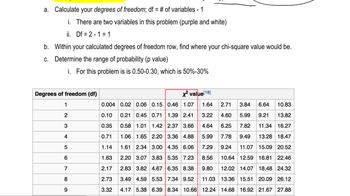
Chi Square Analysis
관련 실천
교과서 질문

For a number of human hereditary conditions, genetic testing is available to identify heterozygous carriers. Some heterozygous carrier testing programs are community-based, often as part of an organized effort targeting specific populations in which a disease and carriers of a disease are relatively frequent. For example, carrier genetic testing programs for Tay–Sachs disease target Ashkenazi Jewish populations and sickle cell disease carrier testing programs target African American populations. The testing is usually free or available at minimal cost, the wait time for results is short, and the results are confidential and unavailable to third parties such as insurance companies. Neither the Tay–Sachs nor the sickle cell allele produces serious consequences for heterozygous carriers.

In a broader sense, what is the value of a community-based effort targeting specific populations for selected diseases?

418
views
교과서 질문

In humans, the ability to bend the thumb back beyond vertical is called hitchhiker's thumb and is dominant to the inability to do so (OMIM 274200). Also, the presence of attached earlobes is recessive to unattached earlobes (OMIM 128900).

Using all available and willing members of your family, or members of another family if yours is not easily accessible, trace the transmission of both traits in a pedigree. Use allelic symbols H and h for the thumb and E and e for earlobes, and identify the genotypes for each family member as completely as possible. Bring the pedigree back to share with your group.

517
views
교과서 질문

For a number of human hereditary conditions, genetic testing is available to identify heterozygous carriers. Some heterozygous carrier testing programs are community-based, often as part of an organized effort targeting specific populations in which a disease and carriers of a disease are relatively frequent. For example, carrier genetic testing programs for Tay–Sachs disease target Ashkenazi Jewish populations and sickle cell disease carrier testing programs target African American populations. The testing is usually free or available at minimal cost, the wait time for results is short, and the results are confidential and unavailable to third parties such as insurance companies. Neither the Tay–Sachs nor the sickle cell allele produces serious consequences for heterozygous carriers.

Do you personally think you would participate in the kind of carrier genetic testing described if you were a member of a population targeted for such testing?

530
views
교과서 질문

For a number of human hereditary conditions, genetic testing is available to identify heterozygous carriers. Some heterozygous carrier testing programs are community-based, often as part of an organized effort targeting specific populations in which a disease and carriers of a disease are relatively frequent. For example, carrier genetic testing programs for Tay–Sachs disease target Ashkenazi Jewish populations and sickle cell disease carrier testing programs target African American populations. The testing is usually free or available at minimal cost, the wait time for results is short, and the results are confidential and unavailable to third parties such as insurance companies. Neither the Tay–Sachs nor the sickle cell allele produces serious consequences for heterozygous carriers.

From a genetic perspective, what is the value of the information obtained by genetic testing of the type described?

479
views