Ch. 2 - Transmission Genetics
Sanders - Genetic Analysis: An Integrated Approach 3rd Edition
Sanders3rd EditionGenetic Analysis: An Integrated ApproachISBN: 9780135564172당신이 사용하는 게 아니라요?교과서 변경
2장, 문제 27c

In pea plants, plant height, seed shape, and seed color are governed by three independently assorting genes. The three genes have dominant and recessive alleles, with tall (T) dominant to short (t), round (R) dominant to wrinkled (r), and yellow (G) dominant to green (g).


What proportion of the that produce round, green seeds (regardless of the height of the plant) are expected to breed true?

검증된 단계별 안내
1
Step 1: Understand the problem. The question asks for the proportion of plants producing round, green seeds that are expected to breed true. Breeding true means the organism is homozygous for the traits in question. For round seeds, the genotype must be RR, and for green seeds, the genotype must be gg.
Step 2: Identify the relevant genes and their alleles. The traits are governed by three independently assorting genes: T/t for plant height, R/r for seed shape, and G/g for seed color. Since the question focuses on round (R) and green (g) seeds, we will focus on these two genes.
Step 3: Determine the genotypes that produce round, green seeds. Round seeds can result from either RR (homozygous dominant) or Rr (heterozygous), and green seeds result from gg (homozygous recessive). Therefore, the possible genotypes for round, green seeds are RRgg and Rrgg.
Step 4: Calculate the proportion of round, green seeds that are homozygous for both traits (breeding true). To breed true, the plant must have the genotype RRgg. Use the rules of independent assortment and Punnett squares to determine the probability of RRgg among all round, green seeds.
Step 5: Use the probabilities from the Punnett squares to calculate the proportion of RRgg individuals among the total round, green seeds. This involves dividing the probability of RRgg by the combined probability of RRgg and Rrgg. Ensure that the calculations account for independent assortment of the genes.

비슷한 문제에 대한 검증된 영상 답변:

이 영상 해법은 위 문제에 도움이 된다고 튜터들이 추천한 것입니다.
영상 길이:
6m
도움이 되었나요?

주요 개념

질문에 올바르게 답하기 위해 반드시 이해해야 하는 핵심 개념들은 다음과 같습니다.

Independent Assortment

Independent assortment is a fundamental principle of genetics that states genes for different traits are inherited independently of one another. This means that the allele a gamete receives for one gene does not influence the allele received for another gene. In the context of the question, this principle allows us to analyze the inheritance of plant height, seed shape, and seed color separately.
추천 영상:
가이드 코스
04:58
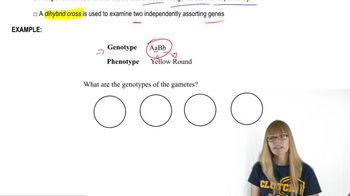
Gamete Genetics and Independent Assortment

Dominant and Recessive Alleles

Dominant and recessive alleles are types of alleles that determine the expression of traits. A dominant allele, represented by a capital letter (e.g., T, R, G), masks the effect of a recessive allele (e.g., t, r, g) when both are present in an organism. In this scenario, the dominant alleles for round seeds (R) and yellow seeds (G) will determine the phenotype of the seeds, while the recessive alleles will only express their traits when homozygous.
추천 영상:
가이드 코스
04:37
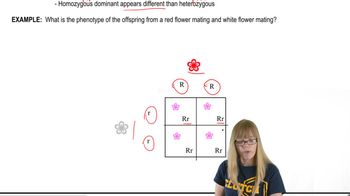
Variations on Dominance

Breeding True

Breeding true refers to the ability of a plant to produce offspring that consistently exhibit the same traits as the parent. This typically occurs when an organism is homozygous for a trait, meaning it has two identical alleles (e.g., RR for round seeds or gg for green seeds). In the context of the question, determining the proportion of plants that produce round, green seeds and breed true involves identifying the homozygous combinations for those traits.
추천 영상:
가이드 코스
18:27
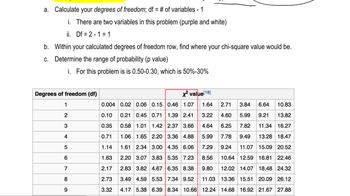
Chi Square Analysis
관련 실천
교과서 질문

In pea plants, plant height, seed shape, and seed color are governed by three independently assorting genes. The three genes have dominant and recessive alleles, with tall (T) dominant to short (t), round (R) dominant to wrinkled (r), and yellow (G) dominant to green (g).


If a true-breeding tall, wrinkled, yellow plant is crossed to a true-breeding short, round, green plant, what phenotypic ratios are expected in the F1 and F2?

1873
views
교과서 질문

A variety of pea plant called Blue Persian produces a tall plant with blue seeds. A second variety of pea plant called Spanish Dwarf produces a short plant with white seed. The two varieties are crossed, and the resulting seeds are collected. All of the seeds are white; and when planted, they produce all tall plants. These tall F₁ plants are allowed to self-fertilize. The results for seed color and plant stature in the F₂ generation are as follows:


Which phenotypes are dominant, and which are recessive? Why?

400
views
교과서 질문

A variety of pea plant called Blue Persian produces a tall plant with blue seeds. A second variety of pea plant called Spanish Dwarf produces a short plant with white seed. The two varieties are crossed, and the resulting seeds are collected. All of the seeds are white; and when planted, they produce all tall plants. These tall F₁ plants are allowed to self-fertilize. The results for seed color and plant stature in the F₂ generation are as follows:

   F₂ Plant Phenotype     Number

   Blue seed, tall plant.      97

   White seed, tall plant    270

   Blue seed, short plant     33

   White seed, short plant   100

  TOTAL                 500


What is the expected distribution of phenotypes in the F₂ generation?

518
views
교과서 질문

A variety of pea plant called Blue Persian produces a tall plant with blue seeds. A second variety of pea plant called Spanish Dwarf produces a short plant with white seed. The two varieties are crossed, and the resulting seeds are collected. All of the seeds are white; and when planted, they produce all tall plants. These tall F₁ plants are allowed to self-fertilize. The results for seed color and plant stature in the F₂ generation are as follows:

   F₂ Plant Phenotype    Number

   Blue seed, tall plant.     97

   White seed, tall plant    270

   Blue seed, short plant    33

   White seed, short plant  100

  TOTAL                500


State the hypothesis being tested in this experiment.

449
views
교과서 질문

In pea plants, plant height, seed shape, and seed color are governed by three independently assorting genes. The three genes have dominant and recessive alleles, with tall (T) dominant to short (t), round (R) dominant to wrinkled (r), and yellow (G) dominant to green (g).


What proportion of the F2 are expected to be tall, wrinkled, yellow? ttRRGg?

531
views
교과서 질문

In the fruit fly Drosophila, a rudimentary wing called 'vestigial' and dark body color called 'ebony' are inherited as independently assorting genes and are recessive to their dominant counterparts full wing and gray body color. Dihybrid dominant-phenotype males and females are crossed, and 3200 progeny are produced. How many progeny flies are expected to be found in each phenotypic class?

1351
views