Ch. 2 - Transmission Genetics
Sanders - Genetic Analysis: An Integrated Approach 3rd Edition
Sanders3rd EditionGenetic Analysis: An Integrated ApproachISBN: 9780135564172당신이 사용하는 게 아니라요?교과서 변경
2장, 문제 24c

Organisms with the genotypes AABbCcDd and AaBbCcDd are crossed. What are the expected proportions of the following progeny?


A phenotype identical to either parent

검증된 단계별 안내
1
Step 1: Identify the genotypes of the parents. The first parent has the genotype AABbCcDd, and the second parent has the genotype AaBbCcDd. Each gene is independently assorted, as no linkage is mentioned.
Step 2: Determine the phenotypes of the parents. For each gene, dominant alleles (A, B, C, D) will determine the phenotype. The first parent (AABbCcDd) has the phenotype determined by A, B, C, and D. The second parent (AaBbCcDd) also has a phenotype determined by A, B, C, and D.
Step 3: To calculate the probability of progeny having a phenotype identical to either parent, consider each gene independently. For a phenotype to match a parent, the progeny must inherit at least one dominant allele for each gene where the parent is dominant. For example, for gene A, the first parent is homozygous dominant (AA), so all progeny will inherit at least one A allele. For gene B, the first parent is heterozygous (Bb), so there is a 50% chance of inheriting the dominant B allele.
Step 4: Repeat this process for all four genes (A, B, C, D). For each gene, calculate the probability of the progeny inheriting the necessary alleles to match the phenotype of either parent. Use the rules of probability to combine these independent probabilities across all genes.
Step 5: Multiply the probabilities for all genes to determine the overall proportion of progeny with a phenotype identical to either parent. This will give the expected proportion of progeny with the desired phenotype.

비슷한 문제에 대한 검증된 영상 답변:

이 영상 해법은 위 문제에 도움이 된다고 튜터들이 추천한 것입니다.
영상 길이:
2m
도움이 되었나요?

주요 개념

질문에 올바르게 답하기 위해 반드시 이해해야 하는 핵심 개념들은 다음과 같습니다.

Genotype and Phenotype

The genotype refers to the genetic makeup of an organism, represented by alleles (e.g., AABbCcDd). The phenotype is the observable physical or biochemical characteristics resulting from the genotype, influenced by both genetic and environmental factors. Understanding the relationship between genotype and phenotype is crucial for predicting the traits of offspring in genetic crosses.
추천 영상:
가이드 코스
07:52
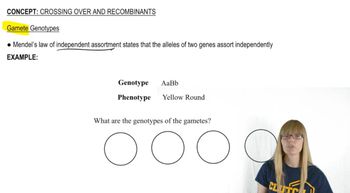
Gamete Genotypes

Mendelian Inheritance

Mendelian inheritance describes the patterns of inheritance for traits controlled by single genes, as established by Gregor Mendel. It includes concepts such as dominant and recessive alleles, segregation, and independent assortment. These principles help predict the expected ratios of different genotypes and phenotypes in the progeny of genetic crosses.
추천 영상:
가이드 코스
05:13
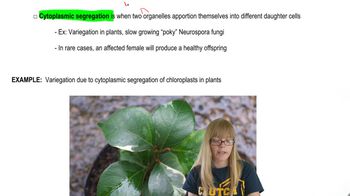
Organelle Inheritance

Punnett Square

A Punnett square is a diagram used to predict the genotypes and phenotypes of offspring from a genetic cross. By organizing the alleles from each parent, it allows for the visualization of possible combinations and their probabilities. This tool is essential for calculating the expected proportions of progeny with specific traits, such as those identical to either parent in the given cross.
추천 영상:
가이드 코스
18:27
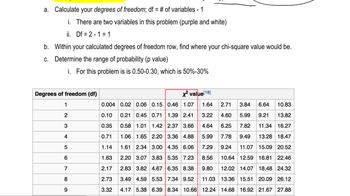
Chi Square Analysis