Ch. 2 - Transmission Genetics
Sanders - Genetic Analysis: An Integrated Approach 3rd Edition
Sanders3rd EditionGenetic Analysis: An Integrated ApproachISBN: 9780135564172당신이 사용하는 게 아니라요?교과서 변경
2장, 문제 47d

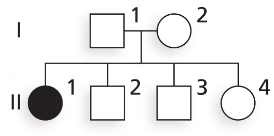
The accompanying pedigree shows a family in which one child (II-1) has an autosomal recessive condition. On the basis of this fact alone, provide the following information.
Pedigree chart showing a family with one child affected by an autosomal recessive condition.
What is the probability that all three of the children in generation II who have the dominant phenotype are Aa?

검증된 단계별 안내
1
Step 1: Understand the inheritance pattern. The condition is autosomal recessive, meaning individuals with the genotype 'aa' express the condition, while individuals with 'AA' or 'Aa' have the dominant phenotype. The child II-1 has the recessive condition, so their genotype is 'aa'. This indicates that both parents in generation I must be carriers (genotype 'Aa').
Step 2: Determine the possible genotypes of the children in generation II. Since both parents are carriers (Aa), the offspring can inherit one of four possible combinations of alleles: 'AA', 'Aa', 'Aa', or 'aa'. The probabilities for these genotypes are 25% 'AA', 50% 'Aa', and 25% 'aa'.
Step 3: Focus on the children with the dominant phenotype. The dominant phenotype is expressed by individuals with genotypes 'AA' or 'Aa'. Since II-1 has the recessive condition ('aa'), the other three children in generation II must have the dominant phenotype ('AA' or 'Aa').
Step 4: Calculate the probability that each child with the dominant phenotype is heterozygous ('Aa'). For each child with the dominant phenotype, the probability of being 'Aa' is 2/3, because out of the three possible genotypes ('AA', 'Aa', 'Aa'), two are heterozygous.
Step 5: Multiply the probabilities for all three children. Since the events are independent, the probability that all three children with the dominant phenotype are 'Aa' is calculated by multiplying the individual probabilities: (2/3) × (2/3) × (2/3).

비슷한 문제에 대한 검증된 영상 답변:

이 영상 해법은 위 문제에 도움이 된다고 튜터들이 추천한 것입니다.
영상 길이:
2m

주요 개념

질문에 올바르게 답하기 위해 반드시 이해해야 하는 핵심 개념들은 다음과 같습니다.

Autosomal Recessive Inheritance

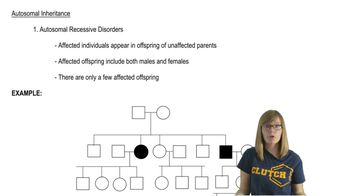
Autosomal recessive inheritance occurs when a trait or condition is expressed only when an individual has two copies of the recessive allele (aa). Carriers, who have one dominant allele and one recessive allele (Aa), do not express the condition but can pass the recessive allele to their offspring. Understanding this inheritance pattern is crucial for analyzing the pedigree and determining the genotypes of the children.
추천 영상:
가이드 코스
09:08
Autosomal Pedigrees

Genotype Probability Calculation

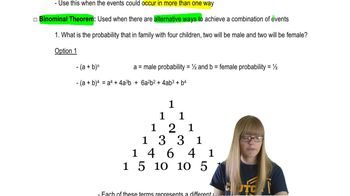
Calculating genotype probabilities involves using the principles of Mendelian genetics to determine the likelihood of specific genotypes in offspring based on parental genotypes. In this case, we need to assess the probability that the children with the dominant phenotype (A_) are heterozygous (Aa) given the presence of an autosomal recessive condition in the family. This requires understanding the ratios of genotypes produced from potential parental combinations.
추천 영상:

Pedigree Analysis

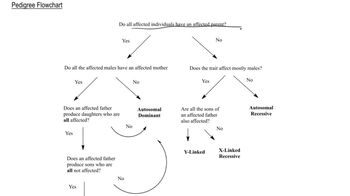
Pedigree analysis is a method used to track the inheritance of traits through generations in a family. It visually represents family relationships and the occurrence of specific traits, allowing for the identification of carriers and affected individuals. By analyzing the pedigree provided, one can infer the genotypes of individuals based on their phenotypes and the inheritance patterns observed.
추천 영상:
가이드 코스
01:59
Pedigree Flowchart
관련 실천
교과서 질문

The accompanying pedigree shows a family in which one child (II-1) has an autosomal recessive condition. On the basis of this fact alone, provide the following information.

What is the chance that among the three children in generation II who have the dominant phenotype, one of them is AA and two of them are Aa? (Hint: Consider all possible orders of genotypes.)

979
views
교과서 질문

A pea plant that has the genotype RrGgwwdd is crossed to a plant that has the rrGgWwDd genotype. The R gene controls round versus wrinkled seed, the G gene controls yellow versus green seed, the W gene controls purple versus white flower, and the D gene controls tall versus short plants. Determine the following;


What are the phenotypes of each plant?

575
views
교과서 질문

The accompanying pedigree shows a family in which one child (II-1) has an autosomal recessive condition. On the basis of this fact alone, provide the following information.

What are the probabilities for each of the possible genotypes for II-2, II-3, and II-4?

515
views
교과서 질문

The accompanying pedigree shows a family in which one child (II-1) has an autosomal recessive condition. On the basis of this fact alone, provide the following information.

Using the same alleles, give the possible genotypes for II-2, II-3, and II-4.

776
views
교과서 질문

The accompanying pedigree shows a family in which one child (II-1) has an autosomal recessive condition. On the basis of this fact alone, provide the following information.

Using A for the dominant allele and a for the recessive allele, give the genotypes for I-1, I-2, and II-1.

1318
views
교과서 질문

A pea plant that has the genotype RrGgwwdd is crossed to a plant that has the rrGgWwDd genotype. The R gene controls round versus wrinkled seed, the G gene controls yellow versus green seed, the W gene controls purple versus white flower, and the D gene controls tall versus short plants. Determine the following;


What proportion of the progeny are expected to have the genotype RrGGwwDd?

432
views