Ch. 20 - Population Genetics and Evolution at the Population, Species, and Molecular Levels
Sanders - Genetic Analysis: An Integrated Approach 3rd Edition
Sanders3rd EditionGenetic Analysis: An Integrated ApproachISBN: 9780135564172당신이 사용하는 게 아니라요?교과서 변경
20장, 문제 31d

Albinism, an autosomal recessive trait characterized by an absence of skin pigmentation, is found in 1 in 4000 people in populations at equilibrium. Brachydactyly, an autosomal dominant trait producing shortened fingers and toes, is found in 1 in 6000 people in populations at equilibrium. For each of these traits, calculate the frequency of For albinism only, what is the frequency of mating between heterozygotes?

검증된 단계별 안내
1
Step 1: Understand the inheritance pattern of albinism. Albinism is an autosomal recessive trait, meaning that an individual must inherit two copies of the recessive allele (aa) to express the trait. Heterozygotes (Aa) are carriers but do not exhibit the phenotype.
Step 2: Use the Hardy-Weinberg equilibrium to calculate allele frequencies. The Hardy-Weinberg equation is p² + 2pq + q² = 1, where p is the frequency of the dominant allele (A), q is the frequency of the recessive allele (a), p² represents the frequency of homozygous dominant individuals (AA), 2pq represents the frequency of heterozygotes (Aa), and q² represents the frequency of homozygous recessive individuals (aa).
Step 3: Since the frequency of albinism (aa) is given as 1 in 4000, this corresponds to q² = 1/4000. Solve for q, the frequency of the recessive allele, by taking the square root of q².
Step 4: Once q is determined, calculate p, the frequency of the dominant allele, using the relationship p + q = 1. Rearrange to find p = 1 - q.
Step 5: To find the frequency of mating between heterozygotes, calculate the probability of two heterozygotes (2pq) mating. This is done by squaring the heterozygote frequency (2pq) to represent the probability of two heterozygotes mating in the population.

비슷한 문제에 대한 검증된 영상 답변:

이 영상 해법은 위 문제에 도움이 된다고 튜터들이 추천한 것입니다.
영상 길이:
3m
도움이 되었나요?

주요 개념

질문에 올바르게 답하기 위해 반드시 이해해야 하는 핵심 개념들은 다음과 같습니다.

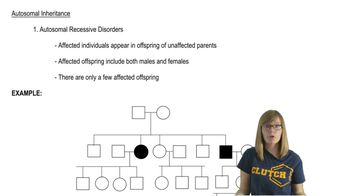
Autosomal Recessive Inheritance

Autosomal recessive inheritance occurs when a trait is expressed only when an individual has two copies of the recessive allele. In the case of albinism, individuals must inherit the recessive allele from both parents to exhibit the trait. This concept is crucial for understanding how the frequency of the trait in a population can be calculated using the Hardy-Weinberg principle.
추천 영상:
가이드 코스
09:08
Autosomal Pedigrees

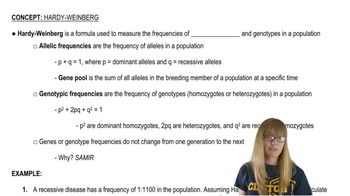
Hardy-Weinberg Equilibrium

The Hardy-Weinberg equilibrium is a principle that describes the genetic variation in a population that is not evolving. It provides a mathematical framework to calculate allele and genotype frequencies based on assumptions such as random mating and no selection. This principle is essential for determining the frequency of alleles in a population, which can be applied to calculate the mating frequency of heterozygotes for traits like albinism.
추천 영상:

Heterozygote Frequency

Heterozygote frequency refers to the proportion of individuals in a population that carry two different alleles for a given gene. In the context of albinism, calculating the frequency of mating between heterozygotes involves determining how often individuals with one dominant and one recessive allele (carriers) mate with each other. This frequency can be derived from the allele frequencies established through the Hardy-Weinberg equations.
추천 영상:
가이드 코스
03:03
New Alleles and Migration
관련 실천
교과서 질문

The frequency of an autosomal recessive condition is 0.001 (1 in 1000) in a population.

What is the frequency of the mutant allele?

638
views
교과서 질문

Albinism, an autosomal recessive trait characterized by an absence of skin pigmentation, is found in 1 in 4000 people in populations at equilibrium. Brachydactyly, an autosomal dominant trait producing shortened fingers and toes, is found in 1 in 6000 people in populations at equilibrium. For each of these traits, calculate the frequency of heterozygotes in the population

821
views
교과서 질문

The frequency of an autosomal recessive condition is 0.001 (1 in 1000) in a population.

Assuming individuals mate at random, what is the chance that two heterozygous individuals will mate?

892
views
교과서 질문

The frequency of an autosomal recessive condition is 0.001 (1 in 1000) in a population.

What is the frequency of carriers of the mutant allele?

1825
views
교과서 질문

Albinism, an autosomal recessive trait characterized by an absence of skin pigmentation, is found in 1 in 4000 people in populations at equilibrium. Brachydactyly, an autosomal dominant trait producing shortened fingers and toes, is found in 1 in 6000 people in populations at equilibrium. For each of these traits, calculate the frequency of the dominant allele at the locus

854
views
교과서 질문

Albinism, an autosomal recessive trait characterized by an absence of skin pigmentation, is found in 1 in 4000 people in populations at equilibrium. Brachydactyly, an autosomal dominant trait producing shortened fingers and toes, is found in 1 in 6000 people in populations at equilibrium. For each of these traits, calculate the frequency of the recessive allele at the locus

743
views