Ch. 20 - Population Genetics and Evolution at the Population, Species, and Molecular Levels
Sanders - Genetic Analysis: An Integrated Approach 3rd Edition
Sanders3rd EditionGenetic Analysis: An Integrated ApproachISBN: 9780135564172당신이 사용하는 게 아니라요?교과서 변경
20장, 문제 40d

Divide the contents of a large bag of different-colored candies randomly and approximately equally among the members of the group. Do not pick specific candy colors, but simply empty the contents of the bag onto a table and quickly divide the pile. If you are doing this exercise by yourself, divide the contents of the bag into five piles. Identify what phenomenon explains the observed differences. What evolutionary mechanism do the observations emulate?

검증된 단계별 안내
1
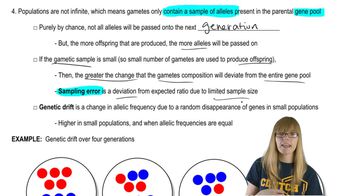
Step 1: Begin by understanding the concept of genetic drift, which is a mechanism of evolution that refers to random changes in allele frequencies within a population. This randomness can occur due to chance events, such as the random division of candies in this exercise.
Step 2: Recognize that the random division of candies into piles emulates the random sampling of alleles in a population. Just as the candies are divided without regard to color, alleles in a population can be passed on randomly to the next generation.
Step 3: Note that the observed differences in the composition of the candy piles (e.g., some piles may have more of one color than another) reflect the concept of genetic drift. This randomness can lead to certain alleles becoming more or less common purely by chance.
Step 4: Understand that this exercise also demonstrates the 'founder effect,' a specific type of genetic drift. If each pile represents a new population, the random assortment of candies (alleles) can lead to differences in genetic composition between populations.
Step 5: Conclude that the evolutionary mechanism being emulated is genetic drift, which highlights the role of chance in shaping genetic variation within populations over time.

비슷한 문제에 대한 검증된 영상 답변:

이 영상 해법은 위 문제에 도움이 된다고 튜터들이 추천한 것입니다.
영상 길이:
2m

주요 개념

질문에 올바르게 답하기 위해 반드시 이해해야 하는 핵심 개념들은 다음과 같습니다.

Genetic Variation

Genetic variation refers to the differences in DNA sequences among individuals within a population. This variation is crucial for evolution as it provides the raw material for natural selection to act upon. In the context of the candy division, the different colors represent genetic traits, and the random distribution mimics how genetic traits are passed on and mixed in a population.
추천 영상:
가이드 코스
09:28
Genomic Variation

Natural Selection

Natural selection is the process by which certain traits become more or less common in a population based on their advantages or disadvantages in a given environment. In the candy exercise, the random division can lead to some groups having more of a certain color, similar to how certain traits may be favored in nature, leading to differential survival and reproduction.
추천 영상:
가이드 코스
05:54
Natural Selection

Genetic Drift

Genetic drift is a mechanism of evolution that refers to random changes in allele frequencies within a population, particularly in small populations. The random division of candies can be seen as a form of genetic drift, where the distribution of colors (alleles) is influenced by chance rather than selection, leading to variations that may not reflect the original proportions.
추천 영상:
관련 실천
교과서 질문

Put all the candies used in Problem 40 into a single mound and then divide them into four equal piles, this time being sure that the frequency of each color is the same in each pile. Label two of these piles 'male' and the other two 'female.' Half of the group will take one male and one female pile, and the other half of the group will take the other two piles. Each half of the group will carry out its own experiments: Repeat this activity 24 more times, recording the 'genotype' each time.

432
views
교과서 질문

Divide the contents of a large bag of different-colored candies randomly and approximately equally among the members of the group. Do not pick specific candy colors, but simply empty the contents of the bag onto a table and quickly divide the pile. If you are doing this exercise by yourself, divide the contents of the bag into five piles. Have each person compare the frequencies of each color in they pile with the frequencies in the original bag. Describe any differences in frequency between the pile and the original bag.

446
views
교과서 질문

Divide the contents of a large bag of different-colored candies randomly and approximately equally among the members of the group. Do not pick specific candy colors, but simply empty the contents of the bag onto a table and quickly divide the pile. If you are doing this exercise by yourself, divide the contents of the bag into five piles. Have each person count the number of candies of each color in they pile and calculate the frequency of each color in the pile.

461
views
교과서 질문

Put all the candies used in Problem 40 into a single mound and then divide them into four equal piles, this time being sure that the frequency of each color is the same in each pile. Label two of these piles 'male' and the other two 'female.' Half of the group will take one male and one female pile, and the other half of the group will take the other two piles. Each half of the group will carry out its own experiments: Determine the frequency of each candy color in the total of 25 draws (a total of 50 candies) and compare these frequencies with the original frequencies of the colors in the pile.

385
views
교과서 질문

Divide the contents of a large bag of different-colored candies randomly and approximately equally among the members of the group. Do not pick specific candy colors, but simply empty the contents of the bag onto a table and quickly divide the pile. If you are doing this exercise by yourself, divide the contents of the bag into five piles. Tabulate the total number of candies of each color in the original bag by combining the numbers from each person. Use these numbers to determine the frequency of each color in the original bag.

382
views
교과서 질문

Put all the candies used in Problem 40 into a single mound and then divide them into four equal piles, this time being sure that the frequency of each color is the same in each pile. Label two of these piles 'male' and the other two 'female.' Half of the group will take one male and one female pile, and the other half of the group will take the other two piles. Each half of the group will carry out its own experiments: Blindly draw one candy from the male pile and one candy from the female pile. Record the colors of the two candies as though they were a genotype. Put the candies back into their respective piles.

401
views