Ch. 20 - Population Genetics and Evolution at the Population, Species, and Molecular Levels
Sanders - Genetic Analysis: An Integrated Approach 3rd Edition
Sanders3rd EditionGenetic Analysis: An Integrated ApproachISBN: 9780135564172당신이 사용하는 게 아니라요?교과서 변경
20장, 문제 20

Epidemiologic data on the population in the previous problem reveal that before the application of modern medical treatment, natural selection played a major role in shaping the frequencies of alleles. Heterozygous individuals have the highest relative fitness, and in comparison with heterozygotes, those who are βᴬβᴬ have a relative fitness of 82%, but only about 32% of those with SCD survived to reproduce. What are the estimated equilibrium frequencies of βᴬ and βˢ in this population?

검증된 단계별 안내
1
Define the variables: Let p represent the frequency of the βᴬ allele and q represent the frequency of the βˢ allele. Since these are the only two alleles in the population, p + q = 1.
Understand the fitness values: The relative fitness of βᴬβᴬ individuals is 0.82, the relative fitness of βᴬβˢ (heterozygotes) is 1 (highest fitness), and the relative fitness of βˢβˢ individuals is 0.32.
Set up the equilibrium condition: At equilibrium, the change in allele frequencies due to selection is zero. This can be expressed using the equation for balancing selection: \( p^2 \cdot w_{AA} + 2pq \cdot w_{AS} + q^2 \cdot w_{SS} = 1 \), where \( w_{AA}, w_{AS}, \) and \( w_{SS} \) are the fitness values for βᴬβᴬ, βᴬβˢ, and βˢβˢ, respectively.
Substitute the fitness values into the equation: Replace \( w_{AA} \) with 0.82, \( w_{AS} \) with 1, and \( w_{SS} \) with 0.32. The equation becomes \( p^2 \cdot 0.82 + 2pq \cdot 1 + q^2 \cdot 0.32 = 1 \).
Solve for the equilibrium frequencies: Use the relationship \( q = 1 - p \) to substitute for q in the equation. This will give a quadratic equation in terms of p. Solve this quadratic equation to find the equilibrium frequencies of p (βᴬ) and q (βˢ).

비슷한 문제에 대한 검증된 영상 답변:

이 영상 해법은 위 문제에 도움이 된다고 튜터들이 추천한 것입니다.
영상 길이:
3m
도움이 되었나요?

주요 개념

질문에 올바르게 답하기 위해 반드시 이해해야 하는 핵심 개념들은 다음과 같습니다.

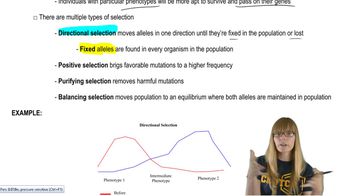
Natural Selection

Natural selection is a fundamental mechanism of evolution where individuals with traits better suited to their environment tend to survive and reproduce more than those with less advantageous traits. In the context of genetics, this process can influence allele frequencies in a population, favoring alleles that confer higher fitness, such as those found in heterozygous individuals.
추천 영상:
가이드 코스
05:54
Natural Selection

Heterozygote Advantage

Heterozygote advantage occurs when individuals with two different alleles for a particular gene (heterozygotes) have a higher fitness than those with two identical alleles (homozygotes). This phenomenon can maintain genetic diversity within a population, as seen in the case of sickle cell disease (SCD), where heterozygous individuals are more likely to survive malaria, thus promoting the frequency of both alleles.
추천 영상:

Hardy-Weinberg Equilibrium

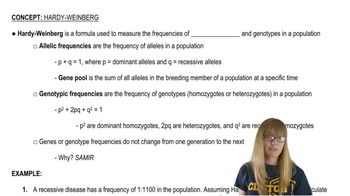
The Hardy-Weinberg equilibrium is a principle that describes the genetic variation in a population that is not evolving. It provides a mathematical framework to estimate allele frequencies under certain conditions, such as no selection, mutation, migration, or genetic drift. In this scenario, understanding how to apply this principle can help estimate the equilibrium frequencies of the alleles βᴬ and βˢ based on the given fitness values.
추천 영상:
관련 실천
교과서 질문

The frequency of tasters and nontasters of PTC varies among populations. In population A, 64% of people are tasters (an autosomal dominant trait) and 36% are nontasters. In population B, tasters are 75% and nontasters 25%. In population C, tasters are 91% and nontasters are 9%.

Calculate the frequency of the dominant (T) allele for PTC tasting and the recessive (t) allele for nontasting in each population.

742
views
교과서 질문

Tay–Sachs disease is an autosomal recessive neurological disorder that is fatal in infancy. Despite its invariably lethal effect, Tay–Sachs disease occurs at very high frequency in some Central and Eastern European (Ashkenazi) Jewish populations. In certain Ashkenazi populations, 1 in 750 infants has Tay–Sachs disease. Population biologists believe the high frequency is a consequence of genetic bottlenecks caused by pogroms (genocide) that have reduced the population multiple times in the past several hundred years. What is a genetic bottleneck?

800
views
교과서 질문

The frequency of tasters and nontasters of PTC varies among populations. In population A, 64% of people are tasters (an autosomal dominant trait) and 36% are nontasters. In population B, tasters are 75% and nontasters 25%. In population C, tasters are 91% and nontasters are 9%.

Assuming that Hardy–Weinberg conditions apply, determine the genotype frequencies in each population.

1290
views
교과서 질문

Sickle cell disease (SCD) is found in numerous populations whose ancestral homes are in the malaria belt of Africa and Asia. SCD is an autosomal recessive disorder that results from homozygosity for a mutant β-globin gene allele. Data on one affected population indicates that approximately 8 in 100 newborn infants have SCD.

What is the frequency of carriers of SCD in the population?

681
views
교과서 질문

In a population of rabbits, f(C₁) = 0.70 and f(C₂) = 0.30. The alleles exhibit an incomplete dominance relationship in which C₁C₁ produces black rabbits, C₁C₂ produces tan-colored rabbits, and C₂C₂ produces rabbits with white fur. If the assumptions of the Hardy–Weinberg principle apply to the rabbit population, what are the expected frequencies of black, tan, and white rabbits?

851
views
교과서 질문

Sickle cell disease (SCD) is found in numerous populations whose ancestral homes are in the malaria belt of Africa and Asia. SCD is an autosomal recessive disorder that results from homozygosity for a mutant β-globin gene allele. Data on one affected population indicates that approximately 8 in 100 newborn infants have SCD.

What are the frequencies of the wild-type (βᴬ) and mutant (βˢ) alleles in this population?

574
views