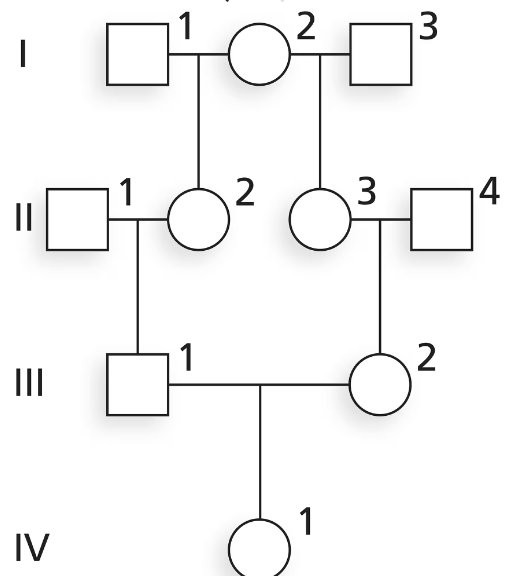
Evaluate the following pedigree, and answer the questions below. Which individual(s) in this family is/are inbred?
Ch. 20 - Population Genetics and Evolution at the Population, Species, and Molecular Levels

모든 교과서
Sanders 3rd Edition
Ch. 20 - Population Genetics and Evolution at the Population, Species, and Molecular Levels
문제 33b
Sanders 3rd Edition
Ch. 20 - Population Genetics and Evolution at the Population, Species, and Molecular Levels
문제 33b20장, 문제 33b
Evaluate the following pedigree, and answer the questions below for individual IV-1. What is F for this individual?

검증된 단계별 안내1
Step 1: Understand the concept of 'F', which represents the inbreeding coefficient. It measures the probability that an individual has two alleles at a locus that are identical by descent due to shared ancestry.
Step 2: Analyze the pedigree provided. Identify all ancestors of individual IV-1 and determine if there are any loops in the pedigree (i.e., instances where the same ancestor appears more than once due to consanguineous mating).
Step 3: For each loop in the pedigree, calculate the contribution to the inbreeding coefficient using the formula: , where n is the number of individuals in the loop excluding the individual being evaluated.
Step 4: Sum the contributions from all loops to determine the total inbreeding coefficient for individual IV-1. Ensure that you account for all possible paths of shared ancestry.
Step 5: Verify your calculations by cross-checking the pedigree and ensuring that all loops and shared ancestors have been accounted for correctly.

비슷한 문제에 대한 검증된 영상 답변:
이 영상 해법은 위 문제에 도움이 된다고 튜터들이 추천한 것입니다.
영상 길이:
1m도움이 되었나요?
주요 개념
질문에 올바르게 답하기 위해 반드시 이해해야 하는 핵심 개념들은 다음과 같습니다.
Pedigree Analysis
Pedigree analysis is a method used to study the inheritance patterns of traits in families. It involves creating a diagram that represents family relationships and the presence or absence of specific traits across generations. This visual representation helps in understanding how traits are passed down and can indicate whether a trait is dominant, recessive, or linked to sex chromosomes.
추천 영상:
가이드 코스
Pedigree Flowchart
Coefficient of Inbreeding (F)
The coefficient of inbreeding (F) quantifies the probability that an individual has inherited identical alleles from both parents due to a common ancestor. It ranges from 0 (no inbreeding) to 1 (complete inbreeding). In pedigree analysis, calculating F helps assess the genetic diversity of a population and the potential for genetic disorders resulting from inbreeding.
추천 영상:
가이드 코스
F Factor and Hfr
Generational Relationships
Generational relationships in a pedigree chart indicate the lineage and connections between individuals. Each generation is typically represented by a horizontal row, with parents above their offspring. Understanding these relationships is crucial for determining the inheritance patterns of traits and calculating coefficients like F, as it allows for the identification of common ancestors and the degree of relatedness between individuals.
추천 영상:
가이드 코스
Phylogenetic Trees
관련 실천
교과서 질문
503
views
교과서 질문
Evaluate the following pedigree, and answer the questions below for individual IV-1. Is IV-1 an inbred individual? If so, who is/are the common ancestor(s)?
485
views
교과서 질문
Evaluate the following pedigree, and answer the questions below. Who is/are the common ancestor(s) of the inbred individual(s)?
450
views
교과서 질문
Evaluate the following pedigree, and answer the questions below. Calculate F for any inbred members of this family.
428
views
교과서 질문
The frequency of an autosomal recessive condition is 0.001 (1 in 1000) in a population.
Assuming individuals mate at random, what is the chance that two heterozygous individuals will mate?
892
views
교과서 질문
The frequency of an autosomal recessive condition is 0.001 (1 in 1000) in a population.
What is the frequency of carriers of the mutant allele?
1825
views