Ch. 20 - Population Genetics and Evolution at the Population, Species, and Molecular Levels
Sanders - Genetic Analysis: An Integrated Approach 3rd Edition
Sanders3rd EditionGenetic Analysis: An Integrated ApproachISBN: 9780135564172당신이 사용하는 게 아니라요?교과서 변경
20장, 문제 2

In a population, what is the consequence of inbreeding? Does inbreeding change allele frequencies? What is the effect of inbreeding with regard to rare recessive alleles in a population?

검증된 단계별 안내
1
Inbreeding refers to the mating of individuals who are closely related genetically, which increases the probability of offspring inheriting the same alleles from both parents.
Inbreeding does not change allele frequencies in the population. Allele frequencies remain constant because inbreeding affects genotype frequencies, not allele frequencies.
The primary consequence of inbreeding is an increase in homozygosity, which means there is a higher chance of individuals being homozygous for alleles, including rare recessive alleles.
Increased homozygosity due to inbreeding can lead to inbreeding depression, where the fitness of a population decreases because harmful recessive alleles are more likely to be expressed.
Inbreeding can lead to an increased expression of rare recessive alleles, which may result in genetic disorders or reduced survival and reproduction rates in the population.

비슷한 문제에 대한 검증된 영상 답변:

이 영상 해법은 위 문제에 도움이 된다고 튜터들이 추천한 것입니다.
영상 길이:
3m
도움이 되었나요?

주요 개념

질문에 올바르게 답하기 위해 반드시 이해해야 하는 핵심 개념들은 다음과 같습니다.

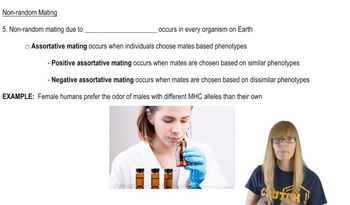
Inbreeding

Inbreeding refers to the mating of individuals who are closely related genetically. This practice can lead to a decrease in genetic diversity within a population, as it increases the likelihood of offspring inheriting identical alleles from both parents. Consequently, inbreeding can result in the expression of deleterious recessive traits, which may negatively impact the health and viability of the population.
추천 영상:
가이드 코스
07:55
Non-Random Mating

Allele Frequencies

Allele frequencies represent the proportion of different alleles of a gene in a population. Inbreeding can influence these frequencies by increasing the chances of homozygosity for certain alleles, particularly rare recessive ones. While inbreeding itself does not directly change allele frequencies, it can lead to an increase in the frequency of homozygous individuals for specific alleles, thereby affecting the overall genetic structure of the population.
추천 영상:
가이드 코스
03:03
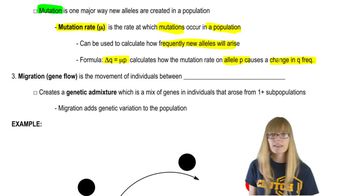
New Alleles and Migration

Rare Recessive Alleles

Rare recessive alleles are variants of genes that typically do not manifest in the phenotype unless an individual is homozygous for that allele. In a population undergoing inbreeding, the likelihood of these alleles pairing up increases, leading to a higher expression of associated traits. This can result in a higher incidence of genetic disorders or reduced fitness in the population, as these recessive traits may be harmful.
추천 영상:
가이드 코스
03:03
New Alleles and Migration