Ch. 20 - Population Genetics and Evolution at the Population, Species, and Molecular Levels
Sanders - Genetic Analysis: An Integrated Approach 3rd Edition
Sanders3rd EditionGenetic Analysis: An Integrated ApproachISBN: 9780135564172당신이 사용하는 게 아니라요?교과서 변경
20장, 문제 10b

The ability to taste the bitter compound phenylthiocarbamide (PTC) is an autosomal dominant trait. The inability to taste PTC is a recessive condition. In a sample of 500 people, 360 have the ability to taste PTC and 140 do not. Calculate the frequency of the dominant allele.

검증된 단계별 안내
1
Determine the total population size (N) from the problem statement. Here, N = 500.
Identify the number of individuals who cannot taste PTC (recessive phenotype). This is given as 140. These individuals are homozygous recessive (genotype q²).
Calculate the frequency of the recessive genotype (q²) by dividing the number of recessive individuals by the total population: q² = 140 / 500.
Find the frequency of the recessive allele (q) by taking the square root of q²: q = √(q²).
Use the Hardy-Weinberg equation (p + q = 1) to calculate the frequency of the dominant allele (p): p = 1 - q.

비슷한 문제에 대한 검증된 영상 답변:

이 영상 해법은 위 문제에 도움이 된다고 튜터들이 추천한 것입니다.
영상 길이:
2m
도움이 되었나요?

주요 개념

질문에 올바르게 답하기 위해 반드시 이해해야 하는 핵심 개념들은 다음과 같습니다.

Autosomal Dominance and Recessiveness

Autosomal dominance refers to a pattern of inheritance where only one copy of a dominant allele is needed for the trait to be expressed. In contrast, recessive traits require two copies of the recessive allele for expression. In the context of PTC tasting, the ability to taste is dominant, while the inability to taste is recessive.
추천 영상:
가이드 코스
04:37
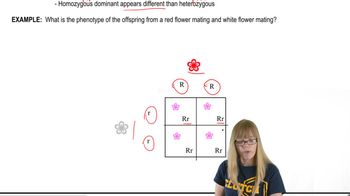
Variations on Dominance

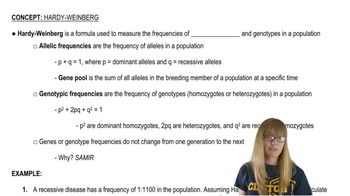
Hardy-Weinberg Principle

The Hardy-Weinberg principle provides a mathematical framework for understanding allele frequencies in a population under ideal conditions. It states that allele and genotype frequencies will remain constant from generation to generation in the absence of evolutionary influences. This principle is essential for calculating allele frequencies, such as the frequency of the dominant allele in the given population.
추천 영상:

Allele Frequency Calculation

Allele frequency is the proportion of a specific allele among all allele copies in a population. To calculate the frequency of the dominant allele (T) in the PTC tasting scenario, we can use the observed phenotypic ratios and apply the Hardy-Weinberg equations. This involves determining the number of homozygous dominant and heterozygous individuals based on the total population and the number of individuals expressing the dominant trait.
추천 영상:
가이드 코스
03:03
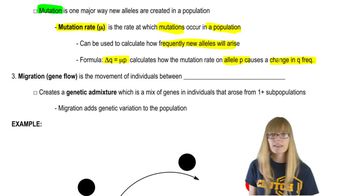
New Alleles and Migration
관련 실천
교과서 질문

In Island Melanesia and Polynesia, most mtDNA haplotypes are of Asian ancestry, whereas Y chromosome haplotypes are predominantly New Guinean. Provide a hypothesis for this sex-biased distribution.

449
views
교과서 질문

The ability to taste the bitter compound phenylthiocarbamide (PTC) is an autosomal dominant trait. The inability to taste PTC is a recessive condition. In a sample of 500 people, 360 have the ability to taste PTC and 140 do not. Calculate the frequency of each genotype.

1237
views
교과서 질문

The ability to taste the bitter compound phenylthiocarbamide (PTC) is an autosomal dominant trait. The inability to taste PTC is a recessive condition. In a sample of 500 people, 360 have the ability to taste PTC and 140 do not. Calculate the frequency of the recessive allele.

563
views
교과서 질문

The figure illustrates the effect of an ethanol-rich and an ethanol-free environment on the frequency of the Drosophila AdhF allele in four populations in a 50-generation laboratory experiment. Population 1 and population 2 were reared for 50 generations in a high-ethanol environment, while control 1 and control 2 populations were reared for 50 generations in a zero-ethanol environment. Describe the effect of each environment on the populations, and state any conclusions you can reach about the role of any of the evolutionary processes in producing these effects.

498
views
교과서 질문

Denisovans are known from bones found in Denisova Cave in the Altai Mountains in Siberia, but traces of their DNA are found in Australians and Melanesians, whose ancestors likely migrated across Asia much farther to the south. How can these geographic differences be reconciled?

444
views
교과서 질문

How can ancient DNA provide insight into past migrations that analyses of extant human genomes fail to uncover?

527
views