Ch. 20 - Population Genetics and Evolution at the Population, Species, and Molecular Levels
Sanders - Genetic Analysis: An Integrated Approach 3rd Edition
Sanders3rd EditionGenetic Analysis: An Integrated ApproachISBN: 9780135564172당신이 사용하는 게 아니라요?교과서 변경
20장, 문제 D.13

When the human genome is examined, the chromosomes appear to have undergone only minimal rearrangement in the 100 million years since the last common ancestor of eutherian mammals. However, when individual humans are examined or when the human genome is compared with that of chimpanzees, a large number of small indels and SNPs can be detected. How are these observations reconciled?

검증된 단계별 안내
1
Understand the difference between large-scale chromosomal rearrangements and small-scale genetic variations. Large-scale rearrangements involve major changes like inversions, translocations, or fusions of chromosome segments, while small-scale variations include single nucleotide polymorphisms (SNPs) and small insertions or deletions (indels).
Recognize that the observation of minimal chromosomal rearrangement over 100 million years refers to the overall structure and organization of chromosomes remaining largely conserved among eutherian mammals, indicating evolutionary stability at the macro level.
Acknowledge that within species (such as individual humans) or between closely related species (like humans and chimpanzees), genetic diversity arises primarily through small-scale mutations such as SNPs and indels, which accumulate more rapidly and contribute to genetic variation without altering chromosome structure significantly.
Explain that these small-scale mutations can occur frequently and are responsible for genetic differences observed within populations and between closely related species, while the large-scale chromosomal architecture remains stable over much longer evolutionary timescales.
Conclude that the reconciliation lies in the different scales and types of genetic changes: chromosome structure is conserved over millions of years, but small mutations accumulate continuously, leading to detectable genetic variation among individuals and closely related species.

비슷한 문제에 대한 검증된 영상 답변:

이 영상 해법은 위 문제에 도움이 된다고 튜터들이 추천한 것입니다.
영상 길이:
2m
도움이 되었나요?

주요 개념

질문에 올바르게 답하기 위해 반드시 이해해야 하는 핵심 개념들은 다음과 같습니다.

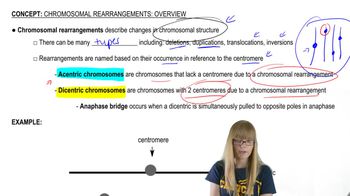
Chromosomal Rearrangements and Genome Stability

Chromosomal rearrangements involve large-scale changes like inversions, translocations, or fusions that alter chromosome structure. Over long evolutionary timescales, such as 100 million years, these events are relatively rare in eutherian mammals, leading to overall genome stability at the chromosomal level despite species divergence.
추천 영상:
가이드 코스
04:38
Rearrangement Overview

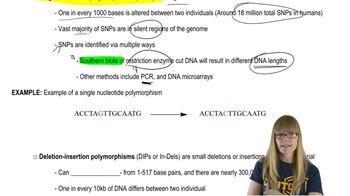
Small-scale Genetic Variations: SNPs and Indels

Single nucleotide polymorphisms (SNPs) and small insertions/deletions (indels) are minor genetic changes occurring frequently within populations and between closely related species. These variations accumulate rapidly and contribute to genetic diversity without altering large chromosomal structures.
추천 영상:
가이드 코스
09:28
Genomic Variation

Evolutionary Timescales and Mutation Rates

Different types of genetic changes occur at different rates; large chromosomal rearrangements happen slowly over millions of years, while small mutations like SNPs and indels accumulate quickly within populations and species. This explains why chromosomes appear stable over long periods, yet individuals and closely related species show many small genetic differences.
추천 영상:
가이드 코스
10:48
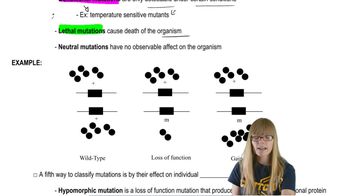
Mutations and Phenotypes
관련 실천
교과서 질문
Biologists have proposed that the use of antibiotics to treat human infectious disease has played a role in the evolution of widespread antibiotic resistance in several bacterial species, including Staphylococcus aureus and the bacteria causing gonorrhea, tuberculosis, and other infectious diseases. Explain how the evolutionary mechanisms mutation and natural selection may have contributed to the development of antibiotic resistance.
487
views
교과서 질문

Two populations of deer, one of them large and living in a mainland forest and the other small and inhabiting a forest on an island, regularly exchange members that migrate across a land bridge that connects the island to the mainland. An earthquake destroys the bridge between the island and the mainland, making migration impossible for the deer. What do you expect will happen to allele frequencies in the two populations over the following 10 generations?

455
views
교과서 질문

In Island Melanesia and Polynesia, most mtDNA haplotypes are of Asian ancestry, whereas Y chromosome haplotypes are predominantly New Guinean. Provide a hypothesis for this sex-biased distribution.

449
views
교과서 질문

Two populations of deer, one of them large and living in a mainland forest and the other small and inhabiting a forest on an island, regularly exchange members that migrate across a land bridge that connects the island to the mainland. If you compared the allele frequencies in the two populations, what would you expect to find?

422
views
교과서 질문

Look over the 10 diseases approved for genetic health risk assessment listed in Application Chapter B. Select one disease other than the three discussed in Application Chapter B or in this chapter (alpha-1 antitrypsin deficiency, late-onset Alzheimer disease, and celiac disease) or another of the diseases of your choice. Do a brief Internet search to find and download (1) one article for a nonscientific audience identifying the gene or genes whose alleles are associated with occurrence of the disease and (2) one scientific paper that provides data supporting the association of specific alleles of the gene or genes with the disease. Write a short summary combining the information contained in the two papers.

509
views
교과서 질문

A 9-bp deletion in the mitochondrial genome between the gene for cytochrome oxidase subunit II and the gene for tRNAᴸʸˢ is a common polymorphism among Polynesians and also in a population of Taiwanese natives. The frequency of the polymorphism varies between populations: The highest frequency is seen in the Maoris of New Zealand (98%), lower levels are seen in eastern Polynesia (80%) and western Polynesia (89%), and the lowest level is seen in the Taiwanese population. What do these frequencies tell us about the settlement of the Pacific by the ancestors of the present-day Polynesians?

437
views