Ch. 3 - Cell Division and Chromosome Heredity
Sanders - Genetic Analysis: An Integrated Approach 3rd Edition
Sanders3rd EditionGenetic Analysis: An Integrated ApproachISBN: 9780135564172당신이 사용하는 게 아니라요?교과서 변경
3장, 문제 12a

A woman's father has ornithine transcarbamylase deficiency (OTD), an X-linked recessive disorder producing mental deterioration if not properly treated. The woman's mother is homozygous for the wild-type allele.


What is the woman's genotype? (Use D to represent the dominant allele and d to represent the recessive allele.)

검증된 단계별 안내
1
Step 1: Understand the inheritance pattern of ornithine transcarbamylase deficiency (OTD). It is an X-linked recessive disorder, meaning the gene responsible for the condition is located on the X chromosome, and the recessive allele (d) causes the disorder.
Step 2: Analyze the genetic information provided for the woman's parents. Her father has OTD, which means he must have the genotype XdY (since males have one X chromosome and one Y chromosome). Her mother is homozygous for the wild-type allele, meaning her genotype is XDXD.
Step 3: Determine the possible X chromosome contributions from each parent. The father can only pass on his Xd chromosome to his daughters (since males pass their Y chromosome to sons). The mother can pass on one of her XD chromosomes to her offspring.
Step 4: Combine the contributions from both parents to determine the woman's genotype. She inherits Xd from her father and XD from her mother, resulting in the genotype XDXd.
Step 5: Conclude that the woman is a carrier for OTD. She has one wild-type allele (XD) and one recessive allele (Xd), meaning she does not exhibit symptoms of the disorder but can pass the recessive allele to her offspring.

비슷한 문제에 대한 검증된 영상 답변:

이 영상 해법은 위 문제에 도움이 된다고 튜터들이 추천한 것입니다.
영상 길이:
2m

주요 개념

질문에 올바르게 답하기 위해 반드시 이해해야 하는 핵심 개념들은 다음과 같습니다.

X-Linked Inheritance

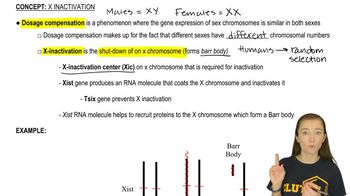
X-linked inheritance refers to the pattern of inheritance for genes located on the X chromosome. In X-linked recessive disorders, such as ornithine transcarbamylase deficiency, males (XY) are more likely to express the disorder because they have only one X chromosome. Females (XX) can be carriers if they have one affected X chromosome and one normal X chromosome, but they typically do not express the disorder unless they are homozygous for the recessive allele.
추천 영상:

Genotype Representation

Genotype representation involves using symbols to denote the alleles an individual possesses for a particular gene. In this case, 'D' represents the dominant allele and 'd' represents the recessive allele. A woman with one normal allele and one affected allele would be represented as 'Dd', while a woman with two normal alleles would be 'DD', and one with two affected alleles would be 'dd'. Understanding this notation is crucial for determining the woman's genotype.
추천 영상:
가이드 코스
07:52
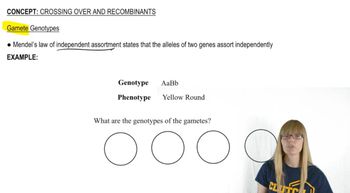
Gamete Genotypes

Homozygosity and Heterozygosity

Homozygosity refers to having two identical alleles for a specific gene, while heterozygosity refers to having two different alleles. In this scenario, the woman's mother is homozygous for the wild-type allele (DD), meaning she can only pass on the dominant allele (D) to her offspring. The woman's father, being affected by an X-linked disorder, contributes an affected X chromosome (d) to his daughter, leading to the determination of the woman's genotype based on the combination of alleles inherited from both parents.
추천 영상: