Ch. 3 - Cell Division and Chromosome Heredity
Sanders - Genetic Analysis: An Integrated Approach 3rd Edition
Sanders3rd EditionGenetic Analysis: An Integrated ApproachISBN: 9780135564172당신이 사용하는 게 아니라요?교과서 변경
3장, 문제 20a

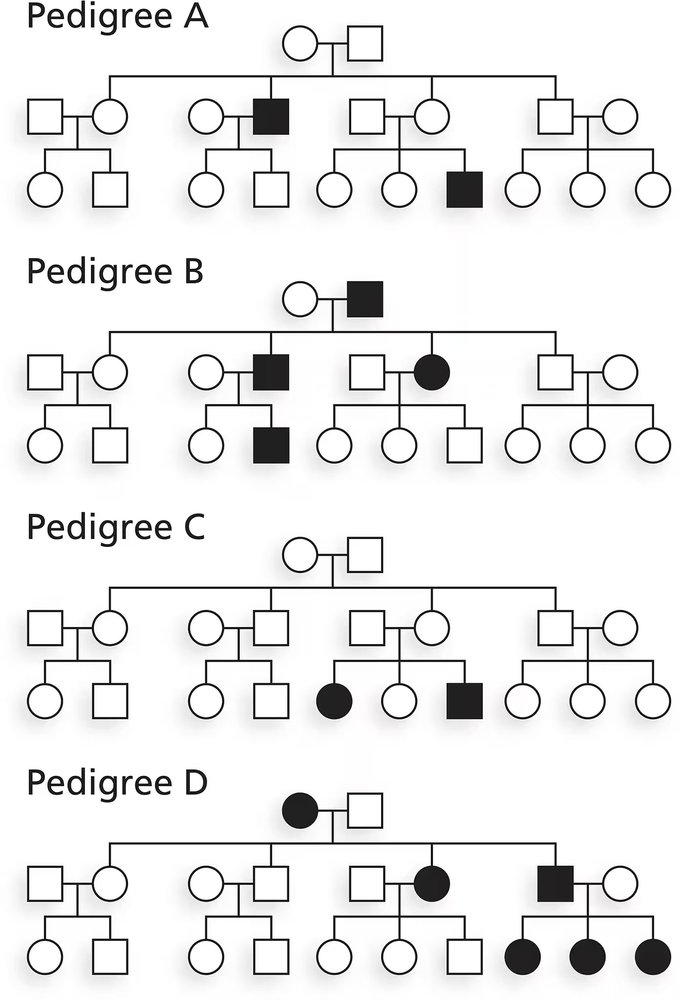
For each pedigree shown,

Identify which simple pattern of hereditary transmission (autosomal dominant, autosomal recessive, X-linked dominant, or X-linked recessive) is most likely to have occurred. Give genotypes for individuals involved in transmitting the trait. 

검증된 단계별 안내
1
Examine the pedigree chart carefully to determine the inheritance pattern. Look for key indicators such as whether the trait appears in every generation (suggesting dominance) or skips generations (suggesting recessiveness). Also, check if the trait is more common in one sex (suggesting X-linked inheritance).
Determine if the trait is autosomal or X-linked. If males and females are equally affected, it is likely autosomal. If the trait is more common in one sex (e.g., males in X-linked recessive), it may be X-linked.
Assess whether the trait is dominant or recessive. If affected individuals have at least one affected parent, the trait is likely dominant. If unaffected parents can have affected offspring, the trait is likely recessive.
Assign genotypes to individuals based on the inheritance pattern. For autosomal dominant traits, affected individuals will have at least one dominant allele (e.g., 'AA' or 'Aa'). For autosomal recessive traits, affected individuals will have two recessive alleles (e.g., 'aa'). For X-linked traits, consider the sex chromosomes: males (XY) will have one X-linked allele, while females (XX) will have two.
Validate your hypothesis by checking if the assigned genotypes are consistent with the inheritance pattern across the entire pedigree. Adjust the genotypes if necessary to ensure they align with the observed transmission of the trait.

비슷한 문제에 대한 검증된 영상 답변:

이 영상 해법은 위 문제에 도움이 된다고 튜터들이 추천한 것입니다.
영상 길이:
44s
도움이 되었나요?

주요 개념

질문에 올바르게 답하기 위해 반드시 이해해야 하는 핵심 개념들은 다음과 같습니다.

Pedigree Analysis

Pedigree analysis is a diagrammatic method used to trace the inheritance of traits through generations in a family. It helps identify patterns of inheritance by mapping out relationships and phenotypes of individuals. Understanding how to read and interpret pedigrees is crucial for determining whether a trait is autosomal or X-linked, as well as dominant or recessive.
추천 영상:
가이드 코스
01:59
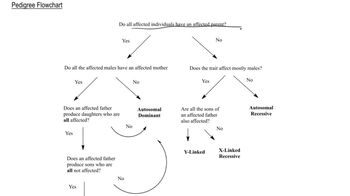
Pedigree Flowchart

Patterns of Inheritance

Patterns of inheritance refer to the predictable ways traits are passed from parents to offspring. The main patterns include autosomal dominant, where only one copy of the allele is needed for the trait to manifest, and autosomal recessive, where two copies are required. X-linked inheritance involves genes on the X chromosome, with X-linked dominant traits appearing in both sexes, while X-linked recessive traits are more common in males.
추천 영상:
가이드 코스
05:13
Organelle Inheritance

Genotype and Phenotype

Genotype refers to the genetic constitution of an individual, specifically the alleles they carry for a particular gene, while phenotype is the observable expression of those genes. Understanding the relationship between genotype and phenotype is essential for predicting how traits will be expressed in offspring and for determining the genotypes of individuals in a pedigree based on their phenotypic traits.
추천 영상:
가이드 코스
07:52
Gamete Genotypes
관련 실천
교과서 질문

Four eye-color mutants in Drosophila—apricot, brown, carnation, and purple—are inherited as recessive traits. Red is the dominant wild-type color of fruit-fly eyes. Eight crosses (A through H) are made between parents from pure-breeding lines.

Which of these eye-color mutants are X-linked recessive and which are autosomal recessive? Explain how you distinguish X-linked from autosomal heredity.

506
views
교과서 질문

Use the blank pedigrees provided to depict transmission of

(a) an X-linked recessive trait and

(b) an X-linked dominant trait, by filling in circles and squares to represent individuals with the trait of interest. Give genotypes for each person in each pedigree.

Carefully design each transmission pattern so that pedigree

(a) cannot be confused with autosomal recessive transmission and pedigree

(b) cannot be confused with autosomal dominant transmission. Identify the transmission events that eliminate the possibility of autosomal transmission for each pedigree.

647
views
교과서 질문

For each pedigree shown,

Identify which pattern(s) of transmission is/are impossible. Specify why transmission is impossible.

547
views
교과서 질문

The gene causing Coffin–Lowry syndrome (OMIM 303600) was recently identified and mapped on the human X chromosome. Coffin–Lowry syndrome is a rare disorder affecting brain morphology and development. It also produces skeletal and growth abnormalities, as well as abnormalities of motor control. Coffin–Lowry syndrome affects males who inherit a mutation of the X-linked gene. Most carrier females show no symptoms of the disease but a few carriers do. These carrier females are always less severely affected than males. Offer an explanation for this finding.

709
views
교과서 질문

For each pedigree shown,

Determine which other pattern(s) of transmission is/are possible. For each possible mode of transmission, specify the genotypes necessary for transmission to occur.

519
views
교과서 질문

Four eye-color mutants in Drosophila—apricot, brown, carnation, and purple—are inherited as recessive traits. Red is the dominant wild-type color of fruit-fly eyes. Eight crosses (A through H) are made between parents from pure-breeding lines.

Predict F2 phenotype ratios of crosses A, B, D, and G.

1100
views