Ch. 3 - Cell Division and Chromosome Heredity
Sanders - Genetic Analysis: An Integrated Approach 3rd Edition
Sanders3rd EditionGenetic Analysis: An Integrated ApproachISBN: 9780135564172당신이 사용하는 게 아니라요?교과서 변경
3장, 문제 2a

Our closest primate relative, the chimpanzee, has a diploid number of 2n = 48. For each of the following stages of M phase, identify the number of chromosomes present in each cell.
End of mitotic telophase

검증된 단계별 안내
1
Understand that the diploid number (2n) represents the total number of chromosomes in a somatic cell of the organism. For chimpanzees, this is 48 chromosomes.
Recall that during mitosis, the goal is to produce two genetically identical daughter cells, each with the same diploid number of chromosomes as the parent cell.
At the end of mitotic telophase, the chromosomes have been separated into two groups, one for each forming daughter cell. However, the cell has not yet fully divided (cytokinesis has not occurred).
Each group of chromosomes in the forming daughter cells will have the same diploid number as the parent cell, which is 48 chromosomes.
Conclude that at the end of mitotic telophase, each forming daughter cell contains 48 chromosomes, and the total number of chromosomes in the entire cell (before cytokinesis) is 96 (48 in each group).

비슷한 문제에 대한 검증된 영상 답변:

이 영상 해법은 위 문제에 도움이 된다고 튜터들이 추천한 것입니다.
영상 길이:
2m
도움이 되었나요?

주요 개념

질문에 올바르게 답하기 위해 반드시 이해해야 하는 핵심 개념들은 다음과 같습니다.

Diploid Number

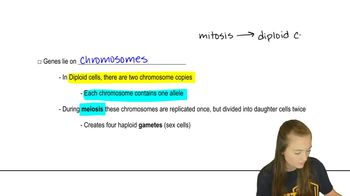
The diploid number (2n) refers to the total number of chromosomes in a somatic cell, where chromosomes exist in pairs. In the case of chimpanzees, the diploid number is 48, meaning there are 24 pairs of homologous chromosomes. This concept is crucial for understanding how chromosomes are distributed during cell division.
추천 영상:
가이드 코스
27:36
Diploid Genetics

M Phase of Cell Cycle

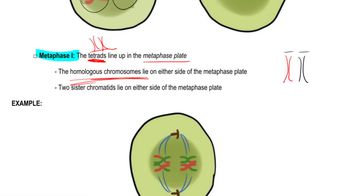
The M phase, or mitotic phase, is the part of the cell cycle where cell division occurs, including mitosis and cytokinesis. During this phase, the cell undergoes several stages: prophase, metaphase, anaphase, and telophase, leading to the separation of sister chromatids and the formation of two daughter cells. Understanding the M phase is essential for determining the number of chromosomes at various stages of cell division.
추천 영상:
가이드 코스
04:29
Bacteriophage Life Cycle

Mitotic Telophase

Mitotic telophase is the final stage of mitosis, where the separated sister chromatids reach opposite poles of the cell and begin to decondense back into chromatin. At the end of telophase, the cell has two nuclei, each containing the same diploid number of chromosomes as the original cell. Therefore, at the end of mitotic telophase in chimpanzees, there would be 48 chromosomes in each daughter nucleus.
추천 영상: