Ch. 3 - Cell Division and Chromosome Heredity
Sanders - Genetic Analysis: An Integrated Approach 3rd Edition
Sanders3rd EditionGenetic Analysis: An Integrated ApproachISBN: 9780135564172당신이 사용하는 게 아니라요?교과서 변경
3장, 문제 5c

The diploid number of the hypothetical animal Geneticus introductus is 2n = 36. Each diploid nucleus contains 3 ng of DNA in G₁.
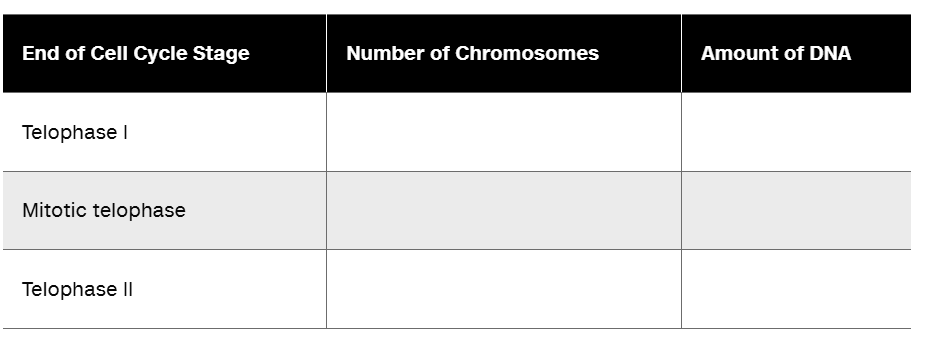
Complete the following table by entering the number of chromosomes and amount of DNA present per cell at the end of each stage listed.
Table showing cell cycle stages with columns for number of chromosomes and amount of DNA in a hypothetical animal.

검증된 단계별 안내
1
Step 1: Understand the diploid number (2n = 36) and DNA content (3 ng in G₁). The diploid number represents the total number of chromosomes in a somatic cell, and the DNA content in G₁ represents the amount of DNA before replication.
Step 2: For Telophase I (end of meiosis I), recall that homologous chromosomes separate, resulting in haploid cells. Each haploid cell will have half the number of chromosomes (n = 18) but the DNA content will still be doubled (since sister chromatids are still attached).
Step 3: For Mitotic Telophase, understand that mitosis results in two identical diploid daughter cells. At the end of mitotic telophase, each daughter cell will have the same number of chromosomes as the parent cell (2n = 36) and the same DNA content as in G₁ (3 ng).
Step 4: For Telophase II (end of meiosis II), sister chromatids separate, resulting in haploid cells with a single set of chromosomes (n = 18). The DNA content will now be halved compared to Telophase I, as each chromosome consists of a single chromatid.
Step 5: Use the information from the steps above to fill in the table: Telophase I (n = 18, DNA = 3 ng), Mitotic Telophase (2n = 36, DNA = 3 ng), Telophase II (n = 18, DNA = 1.5 ng).

비슷한 문제에 대한 검증된 영상 답변:

이 영상 해법은 위 문제에 도움이 된다고 튜터들이 추천한 것입니다.
영상 길이:
1m

주요 개념

질문에 올바르게 답하기 위해 반드시 이해해야 하는 핵심 개념들은 다음과 같습니다.

Diploid and Haploid Cells

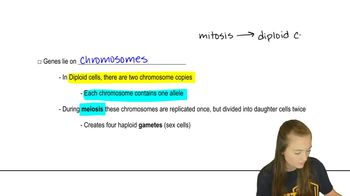
Diploid cells contain two complete sets of chromosomes, one from each parent, denoted as 2n. In the case of the animal Geneticus introductus, the diploid number is 36, meaning there are 36 chromosomes in somatic cells. During meiosis, diploid cells undergo two rounds of division to produce haploid cells (n), which contain only one set of chromosomes, essential for sexual reproduction.
추천 영상:
가이드 코스
27:36
Diploid Genetics

Cell Cycle Stages

The cell cycle consists of several stages, including interphase and mitotic phases. Key stages relevant to the question are telophase I and II, which occur during meiosis, and mitotic telophase, which occurs during mitosis. Each stage is characterized by specific events, such as chromosome separation and nuclear envelope reformation, affecting the number of chromosomes and the amount of DNA in the cells.
추천 영상:
가이드 코스
04:29
Bacteriophage Life Cycle

DNA Content and Replication

The amount of DNA in a cell varies throughout the cell cycle, particularly during the S phase when DNA is replicated. In G₁, the cell contains a specific amount of DNA (3 ng in this case), which doubles during S phase. By the end of telophase I, the DNA content is halved in each daughter cell, while in mitotic telophase, the DNA content returns to the original amount, reflecting the completion of cell division.
추천 영상:
가이드 코스
11:59
Steps to DNA Replication
관련 실천
교과서 질문

The diploid number of the hypothetical animal Geneticus introductus is 2n = 36. Each diploid nucleus contains 3 ng of DNA in G₁.

What amount of DNA is contained in each nucleus at the end of the S phase?

463
views
교과서 질문

Explain how the behavior of homologous chromosomes in meiosis parallels Mendel's law of segregation for autosomal alleles D and d. During which stage of M phase do these two alleles segregate from one another?

631
views
교과서 질문

Cohesion between sister chromatids, as well as tension created by the pull of kinetochore microtubules, is essential to ensure efficient separation of chromatids at mitotic anaphase or in meiotic anaphase II. Explain why sister chromatid cohesion is important, and discuss the role of the proteins cohesin and separase in sister chromatid separation.

714
views
교과서 질문

The diploid number of the hypothetical animal Geneticus introductus is 2n = 36. Each diploid nucleus contains 3 ng of DNA in G₁.

Explain why a somatic cell of Geneticus introductus has the same number of chromosomes and the same amount of DNA at the beginning of mitotic prophase as one of these cells does at the beginning of prophase I of meiosis.

576
views
교과서 질문

An organism has alleles R₁ and R₂ on one pair of homologous chromosomes, and it has alleles T₁ and T₂ on another pair. Diagram these pairs of homologs at the end of metaphase I, the end of telophase I, and the end of telophase II, and show how meiosis in this organism produces gametes in expected Mendelian proportions. Assume no crossover between homologous chromosomes.

484
views
교과서 질문

Suppose crossover occurs between the homologous chromosomes in the previous problem. At what stage of M phase do alleles D and d segregate?

601
views