Ch. 4 - Gene Interaction
Sanders - Genetic Analysis: An Integrated Approach 3rd Edition
Sanders3rd EditionGenetic Analysis: An Integrated ApproachISBN: 9780135564172당신이 사용하는 게 아니라요?교과서 변경
4장, 문제 24c

Blue flower color is produced in a species of morning glories when dominant alleles are present at two gene loci, A and B. (Plants with the genotype have blue flowers.) Purple flowers result when a dominant allele is present at only one of the two gene loci, A or B. (Plants with the genotypes and are purple.) Flowers are red when the plant is homozygous recessive for each gene (i.e., aabb).
If an F₁ plant is backcrossed to one of the pure-breeding parental plants, what is the expected ratio of phenotypes among progeny? Why is the phenotype ratio the same regardless of which parental strain is selected for the backcross?

검증된 단계별 안내
1
Step 1: Understand the genetic basis of flower color. Blue flowers require dominant alleles at both loci (A and B), purple flowers require a dominant allele at only one locus (A or B), and red flowers occur when the plant is homozygous recessive at both loci (aabb).
Step 2: Identify the genotypes of the F₁ plant and the pure-breeding parental plants. The F₁ plant is heterozygous at both loci (AaBb), while the pure-breeding parental plants are either AABB (blue) or aabb (red).
Step 3: Determine the possible gametes produced by the F₁ plant (AaBb). The F₁ plant can produce four types of gametes: AB, Ab, aB, and ab, each with equal probability (1/4).
Step 4: Analyze the backcross scenarios. If the F₁ plant is backcrossed to the AABB parent, the offspring genotypes will be determined by combining the gametes of the F₁ plant (AB, Ab, aB, ab) with the AABB gametes (AB). Similarly, if the F₁ plant is backcrossed to the aabb parent, the offspring genotypes will be determined by combining the F₁ gametes with the aabb gametes (ab).
Step 5: Calculate the expected phenotypic ratios for both backcrosses. In both cases, the phenotypic ratio will be the same because the F₁ gametes (AB, Ab, aB, ab) determine the phenotypes, and the parental gametes (AB or ab) do not alter the phenotypic outcomes. The expected phenotypic ratio among progeny will be 1 blue: 2 purple: 1 red.

비슷한 문제에 대한 검증된 영상 답변:

이 영상 해법은 위 문제에 도움이 된다고 튜터들이 추천한 것입니다.
영상 길이:
6m

주요 개념

질문에 올바르게 답하기 위해 반드시 이해해야 하는 핵심 개념들은 다음과 같습니다.

Dominant and Recessive Alleles

In genetics, alleles are different forms of a gene that can exist at a specific locus. Dominant alleles mask the expression of recessive alleles in heterozygous conditions. In the context of the morning glories, the presence of dominant alleles at loci A and B results in blue flowers, while the absence of these dominant alleles leads to purple or red flowers, depending on the genotype.
추천 영상:
가이드 코스
04:37
Variations on Dominance

Gene Interaction

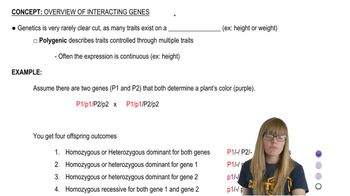
Gene interaction occurs when two or more genes influence a single trait, leading to a variety of phenotypes. In this case, the interaction between the two loci (A and B) determines the flower color in morning glories. The presence of dominant alleles at both loci results in blue flowers, while the presence of a dominant allele at only one locus results in purple flowers, illustrating how multiple genes can affect a single phenotype.
추천 영상:
가이드 코스
07:56
Interacting Genes Overview

Backcrossing and Phenotypic Ratios

Backcrossing involves crossing a hybrid organism (F₁) with one of its parental strains to analyze inheritance patterns. The expected phenotypic ratio among progeny can be predicted using a Punnett square, which shows that the ratio remains consistent regardless of which parental strain is used, due to the fixed genetic contributions from the homozygous parent and the heterozygous F₁ plant.
추천 영상:
가이드 코스
10:48
Mutations and Phenotypes
관련 실천
교과서 질문

Blue flower color is produced in a species of morning glories when dominant alleles are present at two gene loci, A and B. (Plants with the genotype have blue flowers.) Purple flowers result when a dominant allele is present at only one of the two gene loci, A or B. (Plants with the genotypes and are purple.) Flowers are red when the plant is homozygous recessive for each gene (i.e., aabb).

Two pure-breeding purple strains are crossed, and all the F₁ plants have blue flowers. What are the genotypes of the parental plants?

493
views
교과서 질문

Two pure-breeding strains of summer squash producing yellow fruit, Y₁ and Y₂, are each crossed to a pure-breeding strain of summer squash producing green fruit, G₁, and to one another. The following results are obtained:

Examine the results of each cross and predict how many genes are responsible for fruit-color determination in summer squash. Justify your answer. 

489
views
교과서 질문

Three strains of green-seeded lentil plants appear to have the same phenotype. The strains are designated G₁, G₂, and G₃. Each green-seeded strain is crossed to a pure-breeding yellow-seeded strain designated Y. The F₁ of each cross are yellow; however, self-fertilization of F₁ plants produces F₂ with different proportions of yellow- and green-seeded plants as shown below.

What proportion of the F₂ will have yellow seeds? Show your work. 

445
views
교과서 질문

Two pure-breeding strains of summer squash producing yellow fruit, Y₁ and Y₂, are each crossed to a pure-breeding strain of summer squash producing green fruit, G₁, and to one another. The following results are obtained:

Using clearly defined symbols of your choice, give the genotypes of parental, F₁, and F₂ plants in each cross. 

429
views
교과서 질문

The crosses shown are performed between morning glories whose flower color is determined as described in Problem 24. Use the segregation data to determine the genotype of each parental plant.


513
views
교과서 질문

Blue flower color is produced in a species of morning glories when dominant alleles are present at two gene loci, A and B. (Plants with the genotype have blue flowers.) Purple flowers result when a dominant allele is present at only one of the two gene loci, A or B. (Plants with the genotypes and are purple.) Flowers are red when the plant is homozygous recessive for each gene (i.e., aabb).

If two F₁ plants are crossed, what are the expected phenotypes and frequencies in the F₂?

492
views