Ch. 5 - Genetic Linkage and Mapping in Eukaryotes
Sanders - Genetic Analysis: An Integrated Approach 3rd Edition
Sanders3rd EditionGenetic Analysis: An Integrated ApproachISBN: 9780135564172당신이 사용하는 게 아니라요?교과서 변경
5장, 문제 23a

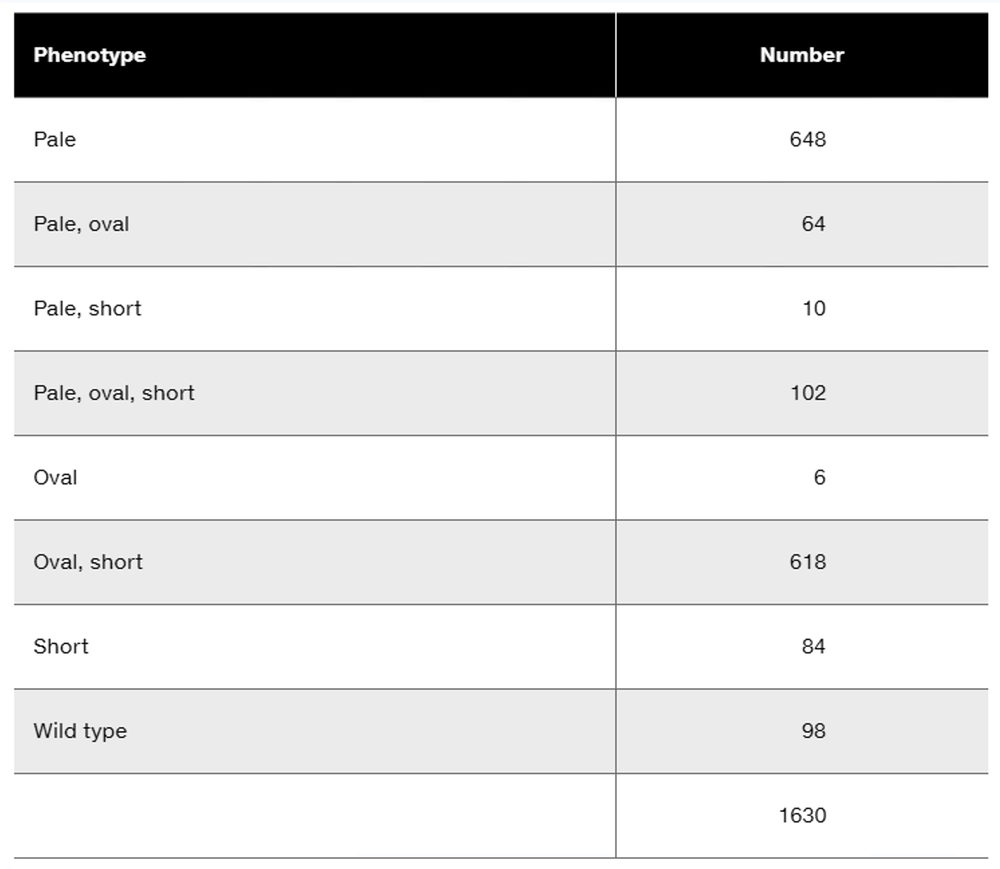
A wild-type trihybrid soybean plant is crossed to a pure-breeding soybean plant with the recessive phenotypes pale leaf (l), oval seed (r), and short height (t). The results of the three-point test cross are shown below. Traits not listed are wild type.
Table showing phenotypes and their corresponding numbers for a trihybrid soybean cross, highlighting genetic variations.
What are the alleles on each homologous chromosome of the parental wild-type trihybrid soybean plant? Place the alleles in their correct gene order. Use L, R, and T to represent dominant alleles and l, r, and t for recessive alleles.

검증된 단계별 안내
1
Step 1: Understand the problem. This is a three-point test cross involving a wild-type trihybrid soybean plant and a pure-breeding recessive soybean plant. The goal is to determine the gene order and the arrangement of alleles on the parental chromosomes of the wild-type trihybrid plant.
Step 2: Identify the parental phenotypes. The most frequent phenotypes in the offspring represent the parental types. From the data, the two most frequent phenotypes are 'Pale' (648) and 'Oval, short' (618). These correspond to the parental genotypes.
Step 3: Identify the double crossover phenotypes. The least frequent phenotypes represent double crossovers. From the data, the two least frequent phenotypes are 'Oval' (6) and 'Pale, short' (10). These will help determine the gene order.
Step 4: Determine the gene order. Compare the parental phenotypes with the double crossover phenotypes. The gene that differs between the parental and double crossover phenotypes is the middle gene. For example, if the parental genotype is LRT/lrt and the double crossover genotype is lRT/Lrt, the gene that changes position is the middle gene.
Step 5: Assign the alleles to the parental chromosomes. Once the gene order is determined, assign the dominant (L, R, T) and recessive (l, r, t) alleles to the parental chromosomes based on the phenotypes of the parental offspring. The final arrangement will reflect the correct gene order and allele configuration.

비슷한 문제에 대한 검증된 영상 답변:

이 영상 해법은 위 문제에 도움이 된다고 튜터들이 추천한 것입니다.
영상 길이:
3m

주요 개념

질문에 올바르게 답하기 위해 반드시 이해해야 하는 핵심 개념들은 다음과 같습니다.

Trihybrid Cross

A trihybrid cross involves the genetic crossing of organisms that are heterozygous for three different traits. In this case, the wild-type soybean plant carries dominant alleles for three traits, while the pure-breeding plant has recessive alleles. Understanding the inheritance patterns of these traits is crucial for predicting the phenotypic ratios in the offspring.
추천 영상:
가이드 코스
26:08
Trihybrid Cross

Alleles and Phenotypes

Alleles are different forms of a gene that can exist at a specific locus on a chromosome. In this scenario, dominant alleles (L, R, T) express the wild-type phenotype, while recessive alleles (l, r, t) result in specific phenotypic traits such as pale leaves, oval seeds, and short height. Recognizing how these alleles interact helps in determining the genetic makeup of the parental plants.
추천 영상:
가이드 코스
03:03
New Alleles and Migration

Three-Point Test Cross

A three-point test cross is a genetic tool used to determine the arrangement of alleles on chromosomes and the linkage between genes. By analyzing the offspring's phenotypes and their frequencies, one can infer the order of genes and the recombination rates. This method is essential for solving the question regarding the alleles on the homologous chromosomes of the wild-type trihybrid soybean plant.
추천 영상:
가이드 코스
26:08
Trihybrid Cross
관련 실천
교과서 질문

The boss in your laboratory has just heard of a proposal by another laboratory that genes for eye color and the length of body bristles may be linked in Drosophila. Your lab has numerous pure-breeding stocks of Drosophila that could be used to verify or refute genetic linkage. In Drosophila, red eyes (c⁺) are dominant to brown eyes (c) and long bristles (d⁺) are dominant to short bristles (d). Your lab boss asks you to design an experiment to test the genetic linkage of eye color and bristle-length genes, and to begin by crossing a pure-breeding line homozygous for red eyes and short bristles to a pure-breeding line that has brown eyes and long bristles.


Give the genotypes of the pure-breeding parental flies and the genotype(s) and phenotype(s) of the F₁ progeny they produce.

380
views
교과서 질문

Gene R and gene T are genetically linked. Answer the following questions concerning a dihybrid organism with the genotype Rt/rT:


Can you make a general statement about how the occurrence of two crossover events between a given pair of linked genes affects the estimate of recombination frequency?

407
views
교과서 질문

T. H. Morgan's data on eye color and wing form genetic linkage between the two genes. Test the genetic linkage (shown in the figure below) data with chi-square analysis, and show that the results are significantly different from the expectation under the assumption of independent assortment.

806
views
교과서 질문

A wild-type trihybrid soybean plant is crossed to a pure-breeding soybean plant with the recessive phenotypes pale leaf (l), oval seed (r), and short height (t). The results of the three-point test cross are shown below. Traits not listed are wild type.

Calculate the recombination frequencies between the adjacent genes.

447
views
교과서 질문

A wild-type trihybrid soybean plant is crossed to a pure-breeding soybean plant with the recessive phenotypes pale leaf (l), oval seed (r), and short height (t). The results of the three-point test cross are shown below. Traits not listed are wild type.

Calculate the interference value for these data.

486
views
교과서 질문

Gene R and gene T are genetically linked. Answer the following questions concerning a dihybrid organism with the genotype Rt/rT:


If two crossover events occur between these two genes, what are the genotypes of the recombinant chromosomes?

450
views