Ch. 5 - Genetic Linkage and Mapping in Eukaryotes
Sanders - Genetic Analysis: An Integrated Approach 3rd Edition
Sanders3rd EditionGenetic Analysis: An Integrated ApproachISBN: 9780135564172당신이 사용하는 게 아니라요?교과서 변경
5장, 문제 35c

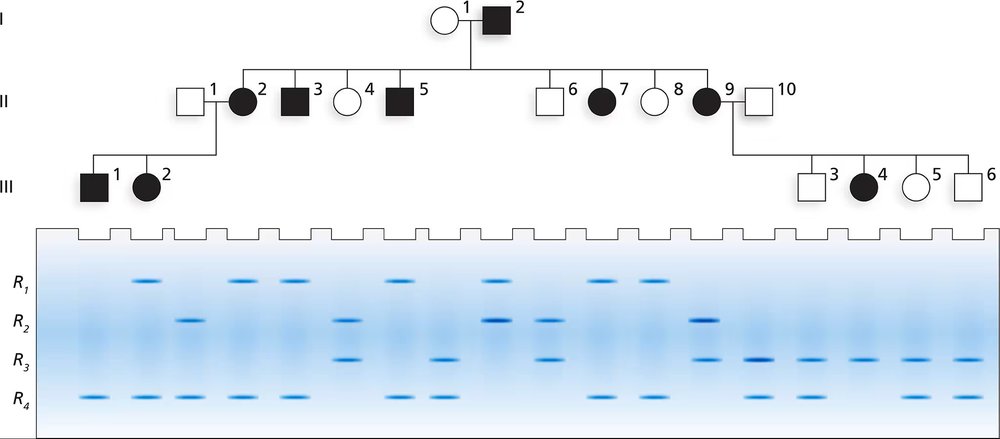
Based on previous family studies, an autosomal recessive disease with alleles A and a is suspected to be linked to an RFLP marker. The RFLP marker has four alleles, R₁, R₂, R₃, and R₄. The accompanying pedigree shows a three-generation family in which the disease is present. The gel shows the RFLP alleles for each family member directly below the pedigree symbol for that person. After determining the genotypes for the RFLP and disease gene for each family member, answer the following questions.
Pedigree chart of a three-generation family with RFLP gel results for genetic analysis of an autosomal recessive disease.
Based on your analysis, what is the recombination frequency in this family? Explain how you obtained your answer.

검증된 단계별 안내
1
Step 1: Understand the problem. The goal is to calculate the recombination frequency between the disease gene (A/a) and the RFLP marker (R₁, R₂, R₃, R₄). Recombination frequency is calculated as the number of recombinant offspring divided by the total number of offspring, expressed as a percentage.
Step 2: Analyze the pedigree and gel data. Determine the genotypes for the disease gene (A/a) and the RFLP marker (R₁, R₂, R₃, R₄) for each individual in the family. Use the gel bands to identify the RFLP alleles and the pedigree to infer the disease gene alleles.
Step 3: Identify parental and recombinant genotypes. Parental genotypes are the combinations of alleles that are inherited together without recombination. Recombinant genotypes are those that result from a crossover event between the disease gene and the RFLP marker. Compare the offspring genotypes to the parental genotypes to classify each as parental or recombinant.
Step 4: Count the number of recombinant and total offspring. Tally the number of individuals with recombinant genotypes and the total number of offspring in the family. This will provide the data needed to calculate the recombination frequency.
Step 5: Calculate the recombination frequency. Use the formula: \( \text{Recombination Frequency} = \frac{\text{Number of Recombinants}}{\text{Total Number of Offspring}} \times 100 \). This will give the recombination frequency as a percentage, which indicates the genetic distance between the disease gene and the RFLP marker.

비슷한 문제에 대한 검증된 영상 답변:

이 영상 해법은 위 문제에 도움이 된다고 튜터들이 추천한 것입니다.
영상 길이:
3m
도움이 되었나요?

주요 개념

질문에 올바르게 답하기 위해 반드시 이해해야 하는 핵심 개념들은 다음과 같습니다.

Autosomal Recessive Inheritance

Autosomal recessive inheritance refers to a pattern where two copies of a mutated gene (one from each parent) are necessary for an individual to express a trait or disease. In this case, alleles A (normal) and a (mutated) determine the presence of the disease. Individuals with genotype aa will exhibit the disease, while those with AA or Aa will not. Understanding this inheritance pattern is crucial for analyzing the pedigree and determining which family members are affected.
추천 영상:
가이드 코스
09:08
Autosomal Pedigrees

Restriction Fragment Length Polymorphism (RFLP)

Restriction Fragment Length Polymorphism (RFLP) is a molecular technique used to analyze the variations in DNA sequences. It involves digesting DNA with specific restriction enzymes, resulting in fragments of different lengths that can be separated by gel electrophoresis. The presence of different alleles (R₁, R₂, R₃, R₄) at the RFLP marker can help identify genetic linkage to the disease gene, making it essential for determining genotypes in the family study.
추천 영상:
가이드 코스
07:11
Mapping with Markers

Recombination Frequency

Recombination frequency is a measure of the likelihood that two genes will be separated during meiosis due to crossing over. It is calculated by dividing the number of recombinant offspring by the total number of offspring, often expressed as a percentage. In this context, determining the recombination frequency between the disease gene and the RFLP marker helps assess their genetic linkage, which is vital for understanding inheritance patterns in the family.
추천 영상:
가이드 코스
03:51
Recombination after Single Strand Breaks
관련 실천
교과서 질문

For six genes known to be linked on chromosome 10 of corn (Zea mays), the recombination frequencies between various pairs have been determined in a series of genetic crosses. Use the recombination frequency data in the table below to determine the order of and distance between the genes on a genetic map. The gene lc1 is known to be closest to the telomere of the chromosome.

621
views
교과서 질문

Based on previous family studies, an autosomal recessive disease with alleles A and a is suspected to be linked to an RFLP marker. The RFLP marker has four alleles, R₁, R₂, R₃, and R₄. The accompanying pedigree shows a three-generation family in which the disease is present. The gel shows the RFLP alleles for each family member directly below the pedigree symbol for that person. After determining the genotypes for the RFLP and disease gene for each family member, answer the following questions.

Is there any evidence of recombination in this pedigree? If so, identify the recombinant individuals and illustrate the recombination that has occurred.

478
views
교과서 질문

Based on previous family studies, an autosomal recessive disease with alleles A and a is suspected to be linked to an RFLP marker. The RFLP marker has four alleles, R₁, R₂, R₃, and R₄. The accompanying pedigree shows a three-generation family in which the disease is present. The gel shows the RFLP alleles for each family member directly below the pedigree symbol for that person. After determining the genotypes for the RFLP and disease gene for each family member, answer the following questions.

What is the most likely arrangement of syntenic alleles for the RFLP and the disease gene in I-1 and I-2?

854
views
교과서 질문

The accompanying pedigree below shows a family in which an autosomal recessive disorder is present. Family members I-2 and II-2 are affected by the disorder and have the genotype dd. A pregnancy involving II-4 has just undergone genetic testing for a VNTR that is linked to the disease gene. The VNTR has a recombination frequency of r = 20 with the disease gene. The VNTR has two alleles, V1 and V2. The gel electrophoresis patterns for each family member are shown, including the VNTR genotype for II-4. Based on the information given, answer the following questions about the family.

What is the chance II-4 has the disease?

516
views
교과서 질문

Divide a clean sheet of paper into four quadrants and draw one pair of homologous chromosomes in each quadrant. Draw the chromosomes with two sister chromatids each. The four sets of homologous pairs are identical. Label one chromosome of each pair with alleles A₁ and A₂ and the other member of each pair with the alleles A₁ and A₂. You are to illustrate a single crossover between the homologs in each quadrant and list the parental and recombinant chromosomes, but you are to illustrate four different ways the crossover can occur by involving different chromatids in each illustration.

452
views