Ch. 5 - Genetic Linkage and Mapping in Eukaryotes
Sanders - Genetic Analysis: An Integrated Approach 3rd Edition
Sanders3rd EditionGenetic Analysis: An Integrated ApproachISBN: 9780135564172당신이 사용하는 게 아니라요?교과서 변경
5장, 문제 1d

Give the information requested.


The gametes produced by an organism with the genotype Rt/rT

검증된 단계별 안내
1
Step 1: Understand the genotype Rt/rT. This represents a heterozygous organism where the alleles for two genes (R and T) are located on homologous chromosomes. The slash (/) separates the alleles on the two homologous chromosomes. One chromosome has the alleles R and t, while the other has r and T.
Step 2: Draw a diagram of the homologous chromosomes. On one chromosome, place the alleles R and t in the order given. On the homologous chromosome, place the alleles r and T in the same order. This will visually represent the genotype Rt/rT.
Step 3: Recall the concept of independent assortment and crossing over. During gamete formation (meiosis), homologous chromosomes can segregate independently, and crossing over can occur between them, leading to different combinations of alleles in the gametes.
Step 4: Determine the possible gametes. Without crossing over, the organism can produce two types of gametes: Rt and rT. If crossing over occurs between the genes, recombinant gametes (RT and rt) can also be produced. Thus, the possible gametes are Rt, rT, RT, and rt.
Step 5: Summarize the results. The organism with the genotype Rt/rT can produce four types of gametes: Rt, rT, RT, and rt. The proportions of these gametes depend on the frequency of crossing over between the R and T loci, which is influenced by their physical distance on the chromosome.

비슷한 문제에 대한 검증된 영상 답변:

이 영상 해법은 위 문제에 도움이 된다고 튜터들이 추천한 것입니다.
영상 길이:
2m

주요 개념

질문에 올바르게 답하기 위해 반드시 이해해야 하는 핵심 개념들은 다음과 같습니다.

Homologous Chromosomes

Homologous chromosomes are pairs of chromosomes in a diploid organism that have the same structure and gene sequence but may carry different alleles. Each parent contributes one chromosome to the pair, resulting in genetic variation. Understanding homologous chromosomes is essential for visualizing how alleles are arranged and inherited during gamete formation.
추천 영상:
가이드 코스
07:10
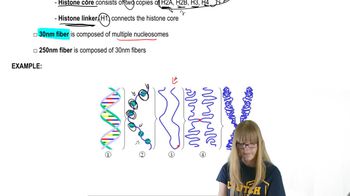
Chromosome Structure

Alleles

Alleles are different versions of a gene that can exist at a specific locus on a chromosome. In the context of the genotype Rt/rT, 'R' and 'r' represent different alleles for one gene, while 't' and 'T' represent different alleles for another gene. The combination of these alleles determines the organism's traits and is crucial for understanding genetic variation and inheritance patterns.
추천 영상:
가이드 코스
03:03
New Alleles and Migration

Gamete Formation

Gamete formation, or gametogenesis, is the process by which diploid cells undergo meiosis to produce haploid gametes. During this process, alleles segregate so that each gamete receives one allele from each gene pair. For the genotype Rt/rT, the possible gametes produced would reflect the combinations of these alleles, which is key to predicting offspring genotypes in genetic crosses.
추천 영상:
가이드 코스
04:06
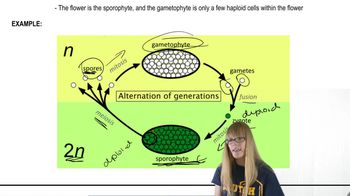
Formation of Plant Gametes