Ch. 6 - Genetic Analysis and Mapping in Bacteria and Bacteriophages
Sanders - Genetic Analysis: An Integrated Approach 3rd Edition
Sanders3rd EditionGenetic Analysis: An Integrated ApproachISBN: 9780135564172당신이 사용하는 게 아니라요?교과서 변경
6장, 문제 22c

An attribute of growth behavior of eight bacteriophage mutants (1 to 8) is investigated in experiments that establish coinfection by pairs of mutants. The experiments determine whether the mutants complement one another (+) or fail to complement (-). These eight mutants are known to result from point mutation. The results of the complementation tests are shown below.
Table showing complementation results of eight bacteriophage mutants in genetics experiments.
In each coinfection identified as a failure to complement (−) in the table, researchers see evidence of recombination producing wild-type growth. How do the researchers distinguish between wild-type growth resulting from complementation and wild-type growth that is due to recombination?

검증된 단계별 안내
1
Step 1: Understand the concept of complementation and recombination. Complementation occurs when two mutations in different genes allow the organism to produce a wild-type phenotype because the functional gene product from one compensates for the defective gene product from the other. Recombination, on the other hand, involves the physical exchange of genetic material between two DNA molecules, potentially restoring a wild-type sequence.
Step 2: Analyze the table provided. The table shows the results of complementation tests between pairs of bacteriophage mutants. A '+' indicates complementation (wild-type growth due to functional gene products), while a '-' indicates failure to complement (wild-type growth due to recombination).
Step 3: Researchers distinguish between wild-type growth due to complementation and recombination by observing the genetic makeup of the progeny. If wild-type growth is due to complementation, the genetic material of the mutants remains unchanged. If wild-type growth is due to recombination, the genetic material of the progeny will show evidence of a physical exchange of DNA segments.
Step 4: To confirm recombination, researchers can use molecular techniques such as sequencing or restriction enzyme analysis to detect changes in the DNA sequence of the progeny. These changes would indicate that recombination has occurred.
Step 5: Complementation tests are typically performed under conditions where recombination is minimized (e.g., using non-permissive conditions for recombination). If wild-type growth is observed under these conditions, it is more likely due to complementation rather than recombination.

비슷한 문제에 대한 검증된 영상 답변:

이 영상 해법은 위 문제에 도움이 된다고 튜터들이 추천한 것입니다.
영상 길이:
5m

주요 개념

질문에 올바르게 답하기 위해 반드시 이해해야 하는 핵심 개념들은 다음과 같습니다.

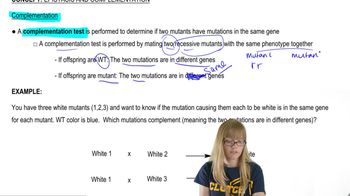
Complementation

Complementation occurs when two different mutations in a gene or pathway can restore a wild-type phenotype when present together. In the context of bacteriophage mutants, if two mutants can complement each other, it indicates that they affect different genes or functions, allowing for the restoration of normal growth. This is crucial for understanding genetic interactions and the functional relationships between genes.
추천 영상:
가이드 코스
05:05
Complementation

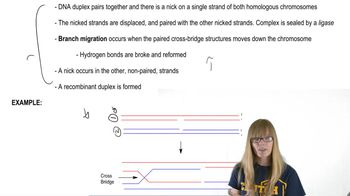
Recombination

Recombination is a genetic process where genetic material is exchanged between different DNA molecules, leading to new combinations of alleles. In the context of the experiments, recombination can produce wild-type growth even when mutants fail to complement each other. Distinguishing between growth due to complementation and that due to recombination is essential for accurately interpreting the results of the complementation tests.
추천 영상:
가이드 코스
03:51
Recombination after Single Strand Breaks

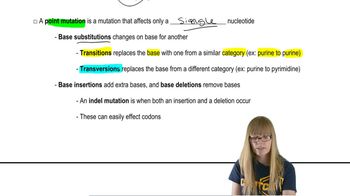
Point Mutation

Point mutations are changes in a single nucleotide base pair in the DNA sequence, which can lead to alterations in gene function. The eight bacteriophage mutants mentioned in the question arise from point mutations, and understanding these mutations is vital for analyzing their effects on growth behavior and the outcomes of complementation tests. Point mutations can result in loss-of-function or gain-of-function effects, influencing the ability of mutants to complement each other.
추천 영상:
가이드 코스
09:49
Point Mutations
관련 실천
교과서 질문

An attribute of growth behavior of eight bacteriophage mutants (1 to 8) is investigated in experiments that establish coinfection by pairs of mutants. The experiments determine whether the mutants complement one another (+) or fail to complement (-). These eight mutants are known to result from point mutation. The results of the complementation tests are shown below.

How many genes are represented by these mutations?

630
views
교과서 질문

An attribute of growth behavior of eight bacteriophage mutants (1 to 8) is investigated in experiments that establish coinfection by pairs of mutants. The experiments determine whether the mutants complement one another (+) or fail to complement (-). These eight mutants are known to result from point mutation. The results of the complementation tests are shown below.

New mutation 10 fails to complement mutants 1, 4, 5, 6, 8, and 9. Mutant 10 forms wild-type recombinants with mutants 1, 5, and 6, but not with mutants 4 and 8. Mutant 9 and mutant 10 form wild-type recombinants. What kind of mutation is mutant 10? Explain your reasoning.

438
views
교과서 질문

An attribute of growth behavior of eight bacteriophage mutants (1 to 8) is investigated in experiments that establish coinfection by pairs of mutants. The experiments determine whether the mutants complement one another (+) or fail to complement (-). These eight mutants are known to result from point mutation. The results of the complementation tests are shown below.

A new mutation, designated 9, fails to complement mutants 1, 3, 5, 7, and 8. Wild-type recombinants form between mutant 9 and mutations 3, 5, and 8; however, no wild-type recombinants form between mutant 9 and mutations 1 and 7. What kind of mutation is mutant 9? Explain your reasoning.

483
views
교과서 질문

An attribute of growth behavior of eight bacteriophage mutants (1 to 8) is investigated in experiments that establish coinfection by pairs of mutants. The experiments determine whether the mutants complement one another (+) or fail to complement (-). These eight mutants are known to result from point mutation. The results of the complementation tests are shown below.

Gene-mapping information identifies mutations 2 and 3 as the flanking markers in this group of genes. Assuming these mutations are on opposite ends of the gene map, determine the order of mutations in the region of the chromosome.

538
views
교과서 질문

Penicillin was first used in the 1940s to treat gonorrhea infections produced by the bacterium Neisseria gonorrhoeae. In 1984, according to the CDC, fewer than 1% of gonorrhea infections were caused by penicillin-resistant N. gonorrhoeae. By 1990, more than 10% of cases were penicillin-resistant, and a few years later the level of resistance was at greater than 95%. Almost every year the CDC issues new treatment guidelines for gonorrhea that identify the recommended antibiotic drugs and dosages.

What are the long-term implications of these frequent changes in treatment recommendations for the patient population?

538
views
교과서 질문

An attribute of growth behavior of eight bacteriophage mutants (1 to 8) is investigated in experiments that establish coinfection by pairs of mutants. The experiments determine whether the mutants complement one another (+) or fail to complement (-). These eight mutants are known to result from point mutation. The results of the complementation tests are shown below.

Identify the mutants of each gene.

495
views