Ch. 6 - Genetic Analysis and Mapping in Bacteria and Bacteriophages
Sanders - Genetic Analysis: An Integrated Approach 3rd Edition
Sanders3rd EditionGenetic Analysis: An Integrated ApproachISBN: 9780135564172당신이 사용하는 게 아니라요?교과서 변경
6장, 문제 19d

An Hfr strain with the genotype cys⁺ lue⁺ met⁺ strˢ is mated with an F- strain carrying the genotype cys⁻ lue⁻ met⁻ strᴿ. In an interrupted mating experiment, small samples of the conjugating bacteria are withdrawn every 3 minutes for 30 minutes. The withdrawn cells are shaken vigorously to stop conjugation and then placed on three different selection media, composed as follows:


Medium 1: Minimal medium plus leucine, methionine, and streptomycin
Medium 2: Minimal medium plus cysteine, methionine, and streptomycin
Medium 3: Minimal medium plus cysteine, leucine, and streptomycin


The following table shows the number of colonies growing on each selection medium. The sampling time indicates how many minutes have passed since conjugation began.


Sampling Time (minutes)       Number of Colonies
                      Plate 1    Plate 2    Plate 3
      3                 0         0         0
      6                0         0         0
      9                 0        62         0
     12                 0        87         0
     15                 51       124        0
     18                 79       210        62
     21                109       250        85
     24                144       250       111
     27                152       250       122
     30                152       250       122


Determine the order of donor genes cys, leu, and met from the interrupted mating data.

검증된 단계별 안내
1
Step 1: Understand the experimental setup. In this interrupted mating experiment, an Hfr strain (donor) with genotype cys⁺ leu⁺ met⁺ strˢ is mated with a recipient strain cys⁻ leu⁻ met⁻ strᴿ. The selection media are designed to identify which genes have been transferred based on colony growth. Streptomycin resistance (strᴿ) ensures only recipient cells grow, and the presence of specific amino acids in the media allows identification of transferred genes.
Step 2: Analyze the data from the table. Growth on Medium 1 indicates transfer of the leu gene, Medium 2 indicates transfer of the cys gene, and Medium 3 indicates transfer of the met gene. The number of colonies at each time point reflects the order in which genes are transferred during conjugation.
Step 3: Identify the first gene transferred. Look at the time points where colonies first appear on each plate. Colonies appear on Plate 2 (Medium 2) at 9 minutes, indicating that the cys gene is transferred first.
Step 4: Determine the second gene transferred. Colonies appear on Plate 1 (Medium 1) at 15 minutes, indicating that the leu gene is transferred second.
Step 5: Determine the third gene transferred. Colonies appear on Plate 3 (Medium 3) at 18 minutes, indicating that the met gene is transferred last. The order of gene transfer is cys → leu → met.

비슷한 문제에 대한 검증된 영상 답변:

이 영상 해법은 위 문제에 도움이 된다고 튜터들이 추천한 것입니다.
영상 길이:
3m

주요 개념

질문에 올바르게 답하기 위해 반드시 이해해야 하는 핵심 개념들은 다음과 같습니다.

Hfr Strains and Conjugation

Hfr (high frequency of recombination) strains are bacterial strains that have integrated a plasmid into their chromosomal DNA, allowing them to transfer chromosomal genes to a recipient cell during conjugation. This process involves direct contact between two bacteria, where the Hfr strain donates genetic material, which can be mapped based on the time of transfer. Understanding Hfr strains is crucial for analyzing gene transfer and mapping gene order.
추천 영상:
가이드 코스
04:06
Conjugation Overview

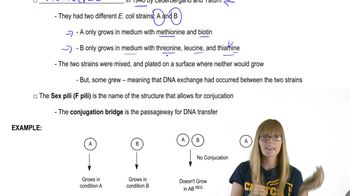
Interrupted Mating Experiment

An interrupted mating experiment is a technique used to study gene transfer in bacteria by stopping the conjugation process at specific time intervals. By withdrawing samples at regular intervals and analyzing the resulting colonies on selective media, researchers can determine the order in which genes are transferred. This method provides insights into the relative positions of genes on the bacterial chromosome.
추천 영상:
가이드 코스
08:06
Mendel's Experiments

Selection Media and Gene Function

Selection media are specially formulated growth environments that allow only certain bacteria to thrive based on their genetic capabilities. In this experiment, different media contain specific nutrients that correspond to the genes being studied (cys, leu, met). By observing which colonies grow on which media, researchers can infer the presence or absence of specific genes, aiding in the determination of gene order based on the timing of their transfer.
추천 영상:
가이드 코스
08:26
Functional Genomics
관련 실천
교과서 질문

An Hfr strain with the genotype cys⁺ lue⁺ met⁺ strS is mated with an F- strain carrying the genotype cys⁻ lue⁻ met⁻ strᴿ. In an interrupted mating experiment, small samples of the conjugating bacteria are withdrawn every 3 minutes for 30 minutes. The withdrawn cells are shaken vigorously to stop conjugation and then placed on three different selection media, composed as follows:


Medium 1: Minimal medium plus leucine, methionine, and streptomycin

Medium 2: Minimal medium plus cysteine, methionine, and streptomycin

Medium 3: Minimal medium plus cysteine, leucine, and streptomycin


What is the purpose of adding streptomycin to each selection medium?

720
views
교과서 질문

A triple-auxotrophic strain of E. coli having the genotype phe⁻ met⁻ ara⁻ is used as a recipient strain in a transduction experiment. The strain is unable to synthesize its own phenylalanine or methionine, and it carries a mutation that leaves it unable to utilize the sugar arabinose for growth. The recipient is crossed to a prototrophic strain with the genotype phe⁺ met⁺ ara⁺. The table below shows the selected marker and gives cotransduction frequencies for the unselected markers.

Use the cotransduction data to determine the order of these genes.

465
views
교과서 질문

A triple-auxotrophic strain of E. coli having the genotype phe⁻ met⁻ ara⁻ is used as a recipient strain in a transduction experiment. The strain is unable to synthesize its own phenylalanine or methionine, and it carries a mutation that leaves it unable to utilize the sugar arabinose for growth. The recipient is crossed to a prototrophic strain with the genotype phe⁺ met⁺ ara⁺. The table below shows the selected marker and gives cotransduction frequencies for the unselected markers.

Identify the compounds present in each of the selective media.

418
views
교과서 질문

An Hfr strain with the genotype cys⁺ lue⁺ met⁺ strS is mated with an F- strain carrying the genotype cys⁻ lue⁻ met⁻ strᴿ. In an interrupted mating experiment, small samples of the conjugating bacteria are withdrawn every 3 minutes for 30 minutes. The withdrawn cells are shaken vigorously to stop conjugation and then placed on three different selection media, composed as follows:


Medium 1: Minimal medium plus leucine, methionine, and streptomycin

Medium 2: Minimal medium plus cysteine, methionine, and streptomycin

Medium 3: Minimal medium plus cysteine, leucine, and streptomycin


What donor gene is the selected marker in each medium?

715
views
교과서 질문

An Hfr strain with the genotype cys⁺ lue⁺ met⁺ strS is mated with an F- strain carrying the genotype cys⁻ lue⁻ met⁻ strᴿ. In an interrupted mating experiment, small samples of the conjugating bacteria are withdrawn every 3 minutes for 30 minutes. The withdrawn cells are shaken vigorously to stop conjugation and then placed on three different selection media, composed as follows:


Medium 1: Minimal medium plus leucine, methionine, and streptomycin

Medium 2: Minimal medium plus cysteine, methionine, and streptomycin

Medium 3: Minimal medium plus cysteine, leucine, and streptomycin


List all possible bacterial genotypes growing on each medium.

746
views
교과서 질문

Penicillin was first used in the 1940s to treat gonorrhea infections produced by the bacterium Neisseria gonorrhoeae. In 1984, according to the CDC, fewer than 1% of gonorrhea infections were caused by penicillin-resistant N. gonorrhoeae. By 1990, more than 10% of cases were penicillin-resistant, and a few years later the level of resistance was at greater than 95%. Almost every year the CDC issues new treatment guidelines for gonorrhea that identify the recommended antibiotic drugs and dosages.

Why is the CDC so active in making these recommendations?

670
views