Ch. 6 - Genetic Analysis and Mapping in Bacteria and Bacteriophages
Sanders - Genetic Analysis: An Integrated Approach 3rd Edition
Sanders3rd EditionGenetic Analysis: An Integrated ApproachISBN: 9780135564172당신이 사용하는 게 아니라요?교과서 변경
6장, 문제 3

Conjugation between an Hfr cell and an F⁻ cell does not usually result in conversion of exconjugants to the donor state. Occasionally, however, the result of this conjugation is two Hfr cells. Explain how this occurs.

검증된 단계별 안내
1
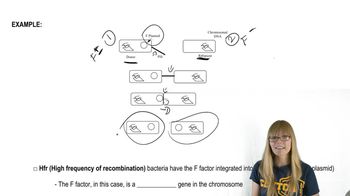
Understand the basics of bacterial conjugation: Conjugation is a process where genetic material is transferred from a donor cell (Hfr cell) to a recipient cell (F⁻ cell) through a physical connection called a pilus. The Hfr cell contains the F factor integrated into its chromosome, which facilitates the transfer of genetic material.
Recognize the typical outcome of Hfr and F⁻ conjugation: During conjugation, the Hfr cell transfers part of its chromosomal DNA to the F⁻ cell. However, the entire F factor is rarely transferred because the process is often interrupted before completion. As a result, the F⁻ cell does not become an Hfr cell in most cases.
Consider the rare scenario where the entire F factor is transferred: If the conjugation process is unusually prolonged or uninterrupted, the Hfr cell may successfully transfer the entire F factor along with a portion of its chromosomal DNA to the F⁻ cell. This would allow the F factor to integrate into the recipient's chromosome, converting the F⁻ cell into an Hfr cell.
Understand the mechanism of F factor integration: The F factor integrates into the recipient's chromosome through homologous recombination. This process requires specific sequences on the F factor and the bacterial chromosome to align and recombine, resulting in the formation of a new Hfr cell.
Conclude how two Hfr cells can result: In this rare event, the original Hfr cell remains unchanged, while the recipient F⁻ cell becomes an Hfr cell due to the successful transfer and integration of the F factor. This explains how conjugation can occasionally result in two Hfr cells.

비슷한 문제에 대한 검증된 영상 답변:

이 영상 해법은 위 문제에 도움이 된다고 튜터들이 추천한 것입니다.
영상 길이:
4m
도움이 되었나요?

주요 개념

질문에 올바르게 답하기 위해 반드시 이해해야 하는 핵심 개념들은 다음과 같습니다.

Hfr and F⁻ Cells

Hfr (high frequency of recombination) cells are bacterial cells that have integrated the F (fertility) plasmid into their chromosomal DNA, allowing them to transfer chromosomal genes during conjugation. F⁻ cells, on the other hand, lack the F plasmid and cannot initiate conjugation. Understanding the roles of these cell types is crucial for grasping the dynamics of genetic exchange in bacteria.
추천 영상:
가이드 코스
08:52
F Factor and Hfr

Conjugation Process

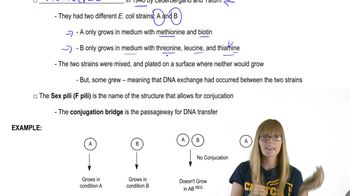
Conjugation is a form of horizontal gene transfer in bacteria where genetic material is transferred from a donor cell to a recipient cell through direct contact. In the case of Hfr and F⁻ cells, the Hfr cell can transfer part of its chromosomal DNA to the F⁻ cell. However, the transfer is often incomplete, which is why the F⁻ cell typically does not become an Hfr cell.
추천 영상:
가이드 코스
04:06
Conjugation Overview

Recombination and Gene Transfer

Recombination is the process by which genetic material is rearranged or exchanged between organisms, leading to genetic diversity. In the context of Hfr and F⁻ cell conjugation, if the transferred chromosomal DNA integrates into the recipient's genome, it can occasionally lead to the formation of a new Hfr cell if the F plasmid is also transferred. This rare event explains how two Hfr cells can arise from a single conjugation event.
추천 영상:
가이드 코스
02:36
Gene Conversion
관련 실천
교과서 질문

Go online to the Online Mendelian Inheritance of Man (OMIM) website. Look up the following genetic conditions and answer the questions posed about them.

Go to the 'Population Genetics' section discussing the TSD gene. In a few sentences, summarize the human population in which TSD is most frequently found and give the approximate frequency of heterozygous carriers for the TSD mutation in North American Jews.

574
views
교과서 질문

A couple comes into your genetic counseling practice with a question about the chance a future child of theirs might have a genetic disease. Three or four men in the woman's family, including her father, had a condition that might be genetic. Although her father is still alive, she has had little contact with him for much of her life and cannot describe or name the condition. Her partner is a healthy man whose family has no history indicating the presence of a genetic condition. To provide more information about this possible genetic condition for the couple, what is the first step you recommend?

472
views
교과서 질문
Bacteria transfer genes by conjugation, transduction, and transformation. Compare and contrast these mechanisms. In your answer, identify which if any processes involve homologous recombination and which if any do not.
1224
views
교과서 질문

Go online to the Online Mendelian Inheritance of Man (OMIM) website. Look up the following genetic conditions and answer the questions posed about them.

Look up cystic fibrosis (CF), OMIM 602421, and give the gene name and abbreviation and the chromosome location of the gene.

730
views
교과서 질문

Explain the importance of the following features in conjugating donor bacteria:

the origin of transfer

663
views
교과서 질문

Go online to the Online Mendelian Inheritance of Man (OMIM) website. Look up the following genetic conditions and answer the questions posed about them.

Look up Tay–Sachs disease (TSD), OMIM number 272800, and give the name and abbreviation of the affected gene and the chromosome location of the gene.

500
views