Ch. 7 - DNA Structure and Replication
Sanders - Genetic Analysis: An Integrated Approach 3rd Edition
Sanders3rd EditionGenetic Analysis: An Integrated ApproachISBN: 9780135564172당신이 사용하는 게 아니라요?교과서 변경
7장, 문제 3

Hershey and Chase selected the bacteriophage T2 for their experiment assessing the role of DNA in heredity because T2 contains protein and DNA, but not RNA. Explain why T2 was a good choice for this experiment.

검증된 단계별 안내
1
Identify the components of the bacteriophage T2: T2 is composed of only DNA and protein, which makes it an ideal candidate for determining which of these molecules is responsible for heredity.
Understand the experimental design: Hershey and Chase used radioactive isotopes to label the DNA and protein of the T2 phages separately. They used phosphorus-32 (\(^{32}\text{P}\)) to label DNA, as DNA contains phosphorus, and sulfur-35 (\(^{35}\text{S}\)) to label protein, as proteins contain sulfur.
Consider the infection process: When T2 phages infect a bacterial cell, they inject their genetic material into the host. By observing which labeled component (DNA or protein) enters the bacterial cell, researchers can determine the hereditary material.
Analyze the results: After allowing the phages to infect bacteria, Hershey and Chase used a blender to separate the phage coats from the bacterial cells and then centrifuged the mixture. They found that \(^{32}\text{P}\) was present inside the bacterial cells, indicating that DNA was the material injected and responsible for heredity.
Conclude the significance: The experiment demonstrated that DNA, not protein, is the genetic material responsible for heredity in phages, providing strong evidence for DNA's role in genetic inheritance.

비슷한 문제에 대한 검증된 영상 답변:

이 영상 해법은 위 문제에 도움이 된다고 튜터들이 추천한 것입니다.
영상 길이:
3m
도움이 되었나요?

주요 개념

질문에 올바르게 답하기 위해 반드시 이해해야 하는 핵심 개념들은 다음과 같습니다.

Bacteriophage

Bacteriophages, or phages, are viruses that specifically infect bacteria. The T2 bacteriophage is composed of a protein coat and DNA, making it an ideal model for studying the genetic material responsible for heredity. Its simple structure allows researchers to easily manipulate and observe the effects of DNA versus protein in genetic transmission.
추천 영상:
가이드 코스
06:04
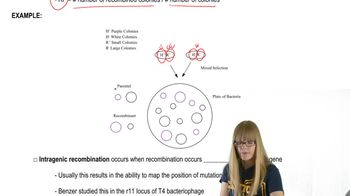
Mapping Bacteriophages

DNA vs. Protein Hypothesis

The DNA vs. Protein hypothesis posits that DNA is the genetic material responsible for heredity, while proteins serve primarily structural and functional roles. Hershey and Chase aimed to determine which of these macromolecules carried genetic information. By using T2, they could effectively isolate and test the contributions of DNA and protein to heredity.
추천 영상:

Experimental Design

The experimental design of Hershey and Chase's study involved labeling the DNA and protein components of the T2 phage with radioactive isotopes. This allowed them to track which component entered the bacterial cells during infection. A well-structured experimental design is crucial for drawing valid conclusions about the role of DNA in heredity, as it minimizes confounding variables and enhances the reliability of results.
추천 영상: